All species › Owls › Owls › Flammulated Owl
Flammulated Owl | Psiloscops flammeolus
Ponderosadwergooruil | Tecolote Ojos Oscuros
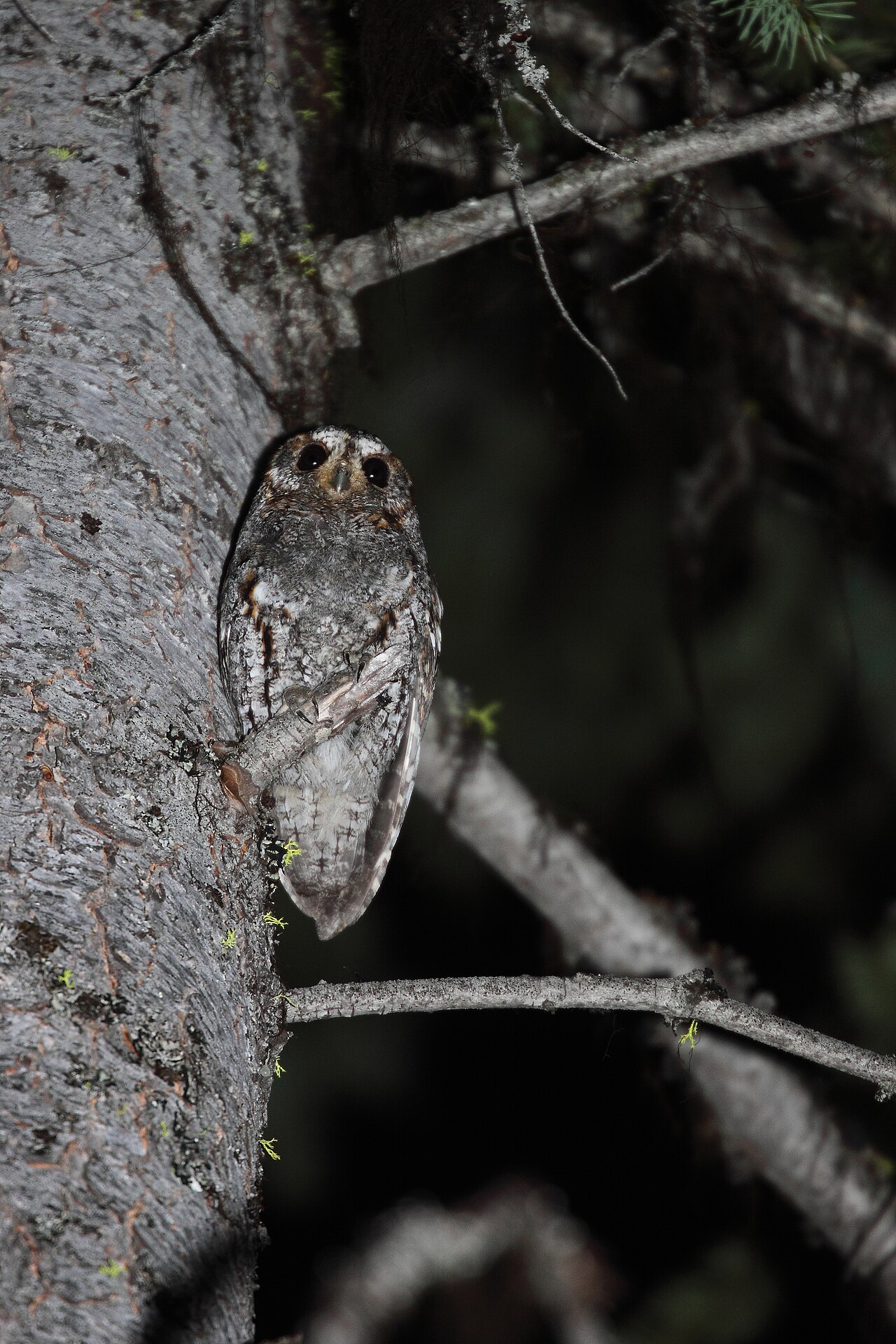
The Flammulated Owl is a fist-sized owl that hunts moths in old ponderosa pines. It is the only small owl in North America with dark brown eyes — all the others have yellow — and one of the few that migrate far south every autumn. Its call is pitched so low that listeners reliably take it for a much larger owl.
Click a thumbnail to switch the photo above.
Voice
The song is a short, hollow boop on one pitch, repeated every two to three seconds and unvarying for half an hour at a time; sometimes the note is doubled into boo-boop. The pitch is low for so small an animal: the windpipe is enlarged, and the sound rolls through the forest without betraying where it comes from. The male sings hidden in the crown of a heavy pine, usually not until an hour after sunset and most persistently in the first weeks after arrival. The female answers with a higher, mewing note, and short growling calls are given at the nest.
Recording: Edgardo Orozco Díaz (Birding Guide) Contact: birdergtexpeditions@gmail.com — CC BY-NC-SA 4.0 · Todos Santos Cuchumatán, Huehuetenango, Guatemala · xeno-canto
Identification
A small, short-tailed owl with a large head and ear tufts so short that they normally lie flat and go unnoticed. The eyes are dark brown, nearly black, in a grey face edged with rusty red; those rusty flames run on across the shoulders and the row of scapular feathers. The rest of the plumage is finely marbled grey with black shaft streaks, and greyer and more rufous individuals occur side by side. Male and female look alike; the female is the heavier bird. Flight is quick and direct on relatively long, pointed wings for an owl of this size — it takes moths on the wing, launching from a perch up in the canopy.
Confusion species
Western Screech-Owl (Megascops kennicottii) is a third longer, has yellow eyes and obvious, often raised ear tufts, and sings an accelerating series of whistles rather than a single low note. Whiskered Screech-Owl (Megascops trichopsis) shares the same Arizona pine-oak woodland but also has yellow eyes and gives an even series of toots. Elf Owl (Micrathene whitneyi) is smaller still, lacks ear tufts altogether, has yellow eyes and sits lower down, in desert and streamside woodland. In the dark the eye settles it fastest: put a torch on the bird and the eyes reflect dull and dark instead of bright yellow.
Habitat
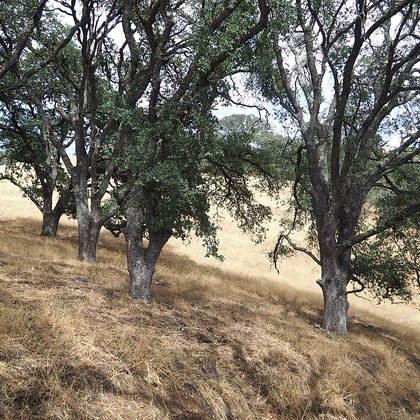
Old, open montane forest of ponderosa pine, with room between the trees to hunt and heavy trunks holding old woodpecker holes to nest in; also Douglas-fir, pine with oak, and stands of aspen. It picks the middle and upper slopes and avoids the valleys and the lower foot of the mountain. It excavates no cavity itself, so the number of pairs stands or falls with standing dead trees and with the woodpeckers that cut holes in them. The food is almost entirely insects — owlet moths, geometrid moths, crickets, grasshoppers and beetles — which is why it cannot winter in the north.
Where the bird is most often found, arranged by the USNVC — the vegetation classification of the United States and Canada — and CMECS for sea and coast.



Range and movements
A breeding bird of the western mountains, from southern British Columbia through Washington, Oregon, Idaho and the Rockies to California, Arizona, New Mexico and west Texas, and on south through the Mexican highlands. It is a true long-distance migrant: birds leave in August and September and winter in the montane forests of southern Mexico, Guatemala and El Salvador, with birds present all year in Guerrero and Oaxaca. Return falls in late April and early May. It was long held to be rare, until deliberate night listening showed it to be widespread in suitable old forest; that revision is a matter of method, not of increase.
- Breeding (summer)
- Winter
- Passage
- dark = core range, pale = thinly spread
Where and when to look
In late May or June, on a windless night an hour after dark, drive a forest road through mature ponderosa pine on a middle slope, switch the engine off and listen: the low boop carries far but seems to come from every direction at once. Walk slowly the way the note grows a little louder and expect the bird high in the crown of the heaviest pine around, not in young timber. By day it is almost never found by sight.
Conservation
Least Concern (LC) globally; Partners in Flight puts the breeding population at about 5,500 birds and places the species on the Yellow Watch List with a high concern score for its restricted range; for a nocturnal owl that is hard to census, that figure carries a great deal of uncertainty. Decline is attributed to the thinning of old mountain forest and the removal of standing dead trees, which takes the nest holes with it. A low reproductive rate adds to that, and possibly sensitivity to pesticides through its insect food. Nest boxes in mature pine forest are used.
Scientific name
Psiloscops flammeolus | (Kaup, 1852)
Kaup described the species in 1852 as Scops (Megascops) flammeola, with the feminine ending that went with Scops; because it was later placed in another genus, author and year stand in parentheses. flammeolus is a Latin diminutive of flammeus, 'flaming' or 'fire-coloured', after the rusty markings along the face and across the shoulders. The genus Psiloscops was introduced by Coues in 1899 and holds this species alone; the name is built from Greek psilos, 'bare', and skōps, 'little owl', after the sparsely feathered toes. The first described specimen came from Mexico.