All species › Owls › Owls › Whiskered Screech-Owl
Whiskered Screech-Owl | Megascops trichopsis
Gevlekte schreeuwuil | Tecolote Rítmico
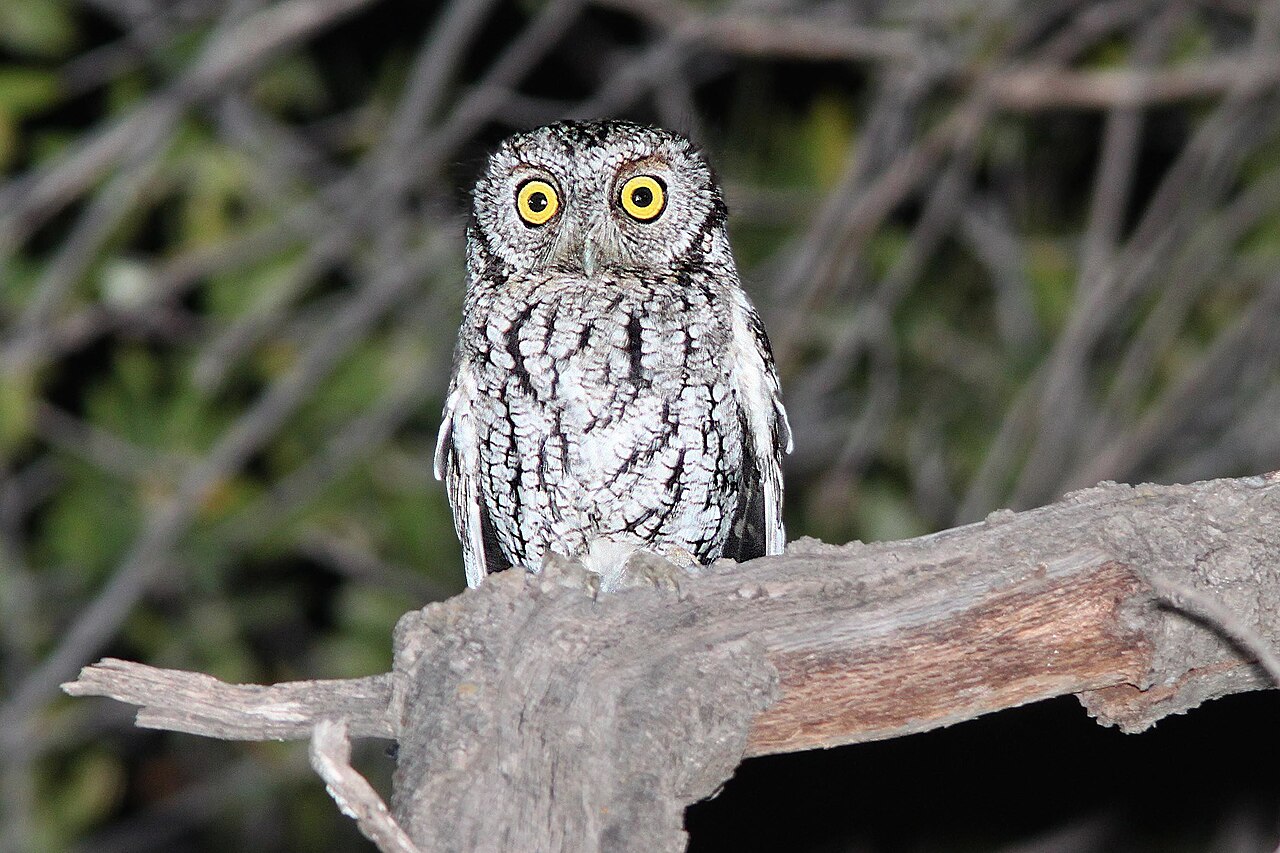
The Whiskered Screech-Owl is a small mountain bird of pine-oak woodland that in the United States reaches only the canyons of southeastern Arizona and southwestern New Mexico. Its scientific and English names both come from the long bristle feathers around the bill and eyes, which stand out like whiskers. It does not screech: it toots, in a series that can be as even as a metronome or as broken as morse code.
Voice
There are two songs, and both are runs of short, hollow toot notes. The first has five to eight notes at perfectly equal intervals, a shade higher in the middle of the run and a shade lower at either end; the tempo never changes. The second is the morse rhythm: toot-toot, toot, toot, toot-toot, toot, short and long gaps mixed together, and that uneven rhythm is the quickest mark of the species. The notes are higher and more musical than Western Screech-Owl's, and the male calls lower than the female, which often joins in duet.
Recording: GABRIEL LEITE — CC BY-NC-SA 4.0 · Todos Santos Cuchumatán, Huehuetenango, Guatemala · xeno-canto
Identification
A small, stocky owl with a big head, short tail and ear tufts raised when the bird is uneasy. Long stiff bristle feathers stand forward around the bill and eyes like whiskers; at close range in a torch beam they are clearly visible. The plumage is grey with black lengthwise streaks and coarse cross bars, which gives the underparts a heavier, more blotched look than in related species; a browner morph also occurs. The eyes are yellow with an orange cast, the bill pale olive-yellow, and the toes are feathered. Male and female look alike, the female being the heavier of the two.
Confusion species
Western Screech-Owl (Megascops kennicottii) shares the same Arizona and New Mexico canyons and is the real problem: it is slightly larger, finer and thinner-streaked below, has a dark grey to blackish bill and sits on average lower down the mountain. Its song accelerates — a run of whistles like a bouncing ball — while Whiskered Screech-Owl holds its tempo or chops it into morse. Eastern Screech-Owl (Megascops asio) does not occur here; it stops at the Rio Grande and whinnies and purrs. Flammulated Owl (Psiloscops flammeolus) is in the same pine forest but is smaller, has dark brown eyes instead of yellow, and repeats a single low note.
Habitat
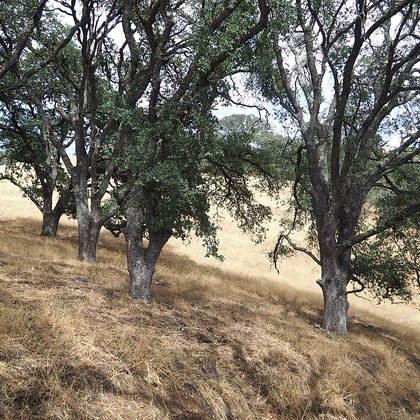
Mountain woodland of oak and pine in canyons and on the flanks of the high sky islands, usually between one thousand and two thousand nine hundred metres. In Arizona it uses three zones at once: the broadleaf woodland on the canyon floor, the oak-pine belt above it, and the lower edge of the conifer forest. Further south, cloud forest, the edge of tropical deciduous forest and shade-grown coffee plantations are added. It sits higher on the mountain than Western Screech-Owl and does not use the dry lowlands. It cuts no cavity of its own, so it depends on old woodpecker holes and natural rot pockets in heavy oaks.
Where the bird is most often found, arranged by the USNVC — the vegetation classification of the United States and Canada — and CMECS for sea and coast.




Range and movements
Resident from southeastern Arizona and southwestern New Mexico south through the Mexican highlands — the Sierra Madre Occidental, the Sierra Madre Oriental, the volcanic belt and the Sierra Madre del Sur — to Guatemala, El Salvador, Honduras and northern Nicaragua. It does not migrate and keeps one canyon territory all year; at most it drops a little lower in hard winters. In the United States the range covers only a few dozen mountains, the so-called sky islands, each with its own small population. That northern part is a fraction of the whole; the weight of the species lies in Mexico.
- Resident
- Breeding (summer)
- Winter
- Passage
- dark = core range, pale = thinly spread
Where and when to look
In April or May, drive a canyon road in the Huachuca, Santa Rita or Chiricahua mountains up into the oak-pine belt after dark, stop at a wide bend and listen to the rhythm rather than the pitch: even spacing or morse means this species, acceleration means Western Screech-Owl. If you get the bird in a torch beam, keep the light brief and low and look for two things: the pale olive-yellow bill and the bristles standing forward across the face. Both species answer playback; use it sparingly, because on heavily visited canyons the birds have become measurably quieter.
Conservation
The species is rated Least Concern (LC). Partners in Flight puts the population at about 200,000 breeding birds and places the species on the Yellow Watch List with a high concern score, mainly because the range is narrow and broken up across separate mountains. The pressures are the felling of old cavity-bearing oaks, the removal of standing dead trees, and the drying out and burning of canyon woodland in the sky islands. In Central America the switch from shade-grown to full-sun coffee adds to that, since it removes the standing trees. Precise trend figures are lacking, because the species can only be counted at night and at awkward altitudes.
Scientific name
Megascops trichopsis | (Wagler, 1832)
Wagler described the species in 1832 as Scops trichopsis; because it was later placed in another genus, author and year stand in parentheses. The genus Megascops was introduced by Kaup in 1848, from Greek megas, 'large', and skōps, 'little owl'. The specific name trichopsis is built from Greek thrix, trichos, 'hair', and opsis, 'look' or 'face', so 'hairy-faced' — after the same bristle feathers the English name refers to. The first described specimen of M. trichopsis came from Mexico.