All species › Birds of prey › Kites, Old World vultures, eagles and hawks › Harris's Hawk
Harris's Hawk | Parabuteo unicinctus
Woestijnbuizerd | Busardo mixto
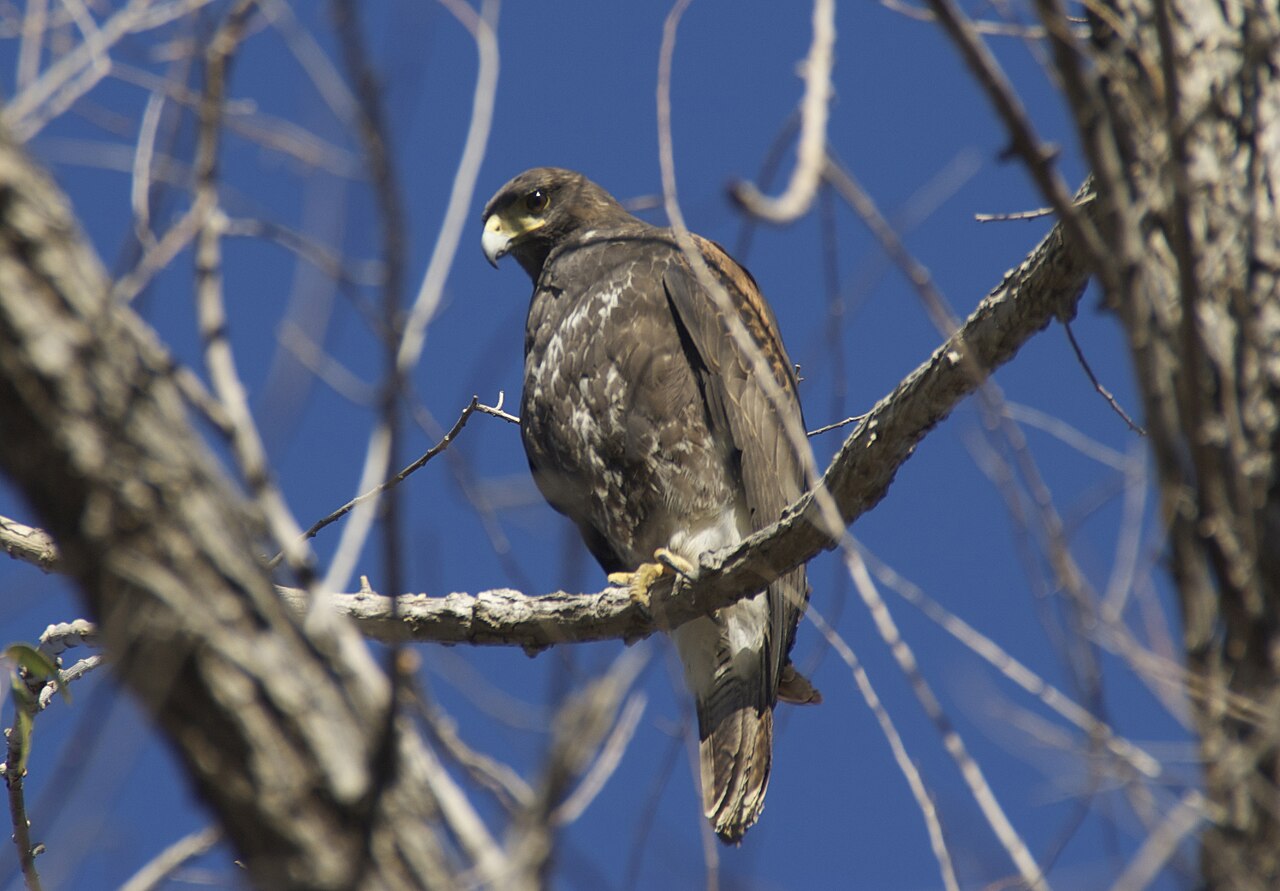
Harris's Hawk is dark brown with chestnut shoulders and thighs and a black tail showing white at both base and tip. It is the most social raptor in North America: it lives in family groups and hunts as a team, two to six birds driving the same hare or rabbit and taking turns in the chase — behaviour that sets it apart from virtually every other buzzard-like hawk in this guide.
Click a thumbnail to switch the photo above.
Voice
The usual sound is a harsh, grating scream lasting about three seconds, low in pitch and without melody — a noise more often likened to a door on rusty hinges than to a bird. It is heard chiefly at the edge of the territory and over a kill when an intruder approaches. A group hunting together is far quieter: coordination is done largely by eye, not by voice. Juveniles beg with a thinner, higher and more persistent scream that can be heard around the nest tree for weeks on end.
Recording: Ricardo José Mitidieri — CC BY-NC-SA 4.0 · Botafogo, Rio de Janeiro, Brazil · xeno-canto
Identification
Adults are uniformly dark brown, with chestnut shoulder patches, chestnut underwing coverts and chestnut thighs, and a black tail with a broad white base and a white tip; legs and cere are yellow. Juveniles are heavily streaked white or buff below rather than plain dark, with white patches on belly and wings and fine barring on underwing and tail, and a narrower white tail band. The wings are broad and rounded and the tail fairly long; soaring birds fan the tail noticeably often. The difference between the sexes is large for a raptor: the female is about a third heavier than the male, and in a group this is plain when birds sit side by side. Perched birds hold themselves upright, often on a post, a saguaro (the giant columnar cactus of the Sonoran Desert) or a transmission tower.
Confusion species
Common Black Hawk (Buteogallus anthracinus) is equally dark but far broader-winged and much shorter-tailed, shows no chestnut at all, and has one broad white tail band instead of white at both base and tip. Zone-tailed Hawk (Buteo albonotatus) has longer, narrower wings held in a shallow V and a multi-banded tail. Dark-morph Red-tailed Hawks are heavier in build, shorter-tailed, and show a pale or reddish tail. At every age the combination of white tail base, white tail tip and chestnut underwing coverts settles it; and when in doubt the company helps, since this species is rarely alone.
Habitat
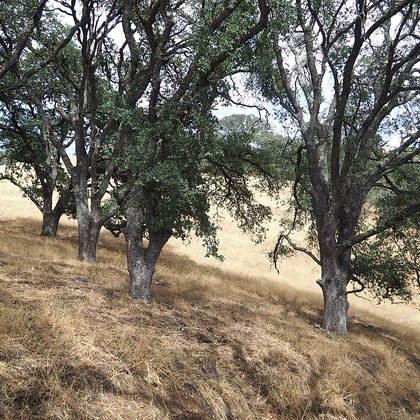
Desert and semi-desert with mesquite (a thorny pod-bearing shrub of the Southwest that forms dense thickets), saguaro and thorn scrub, together with open savanna, thorn woodland and the growth along dry washes. It needs high lookout and nest sites — trees, boulders, power poles — and water within reach, such as springs and cattle tanks. In recent decades it has increasingly nested in suburbs and on the edges of towns, where tall poles, artificial nest platforms and garden doves together make good habitat. Closed forest and cold uplands are avoided; what it wants is open country in which the members of a group can keep each other in sight.
Where the bird is most often found, arranged by the USNVC — the vegetation classification of the United States and Canada — and CMECS for sea and coast.




Range and movements
Resident in southern and central Arizona, southern New Mexico and southern Texas, at its densest in the brush country of south Texas; by far the greater part of the United States breeding population is in Texas. Southwards the range continues down both Mexican coastal plains and through the arid interior, Baja California included, and on through Central America into South America. It does not migrate; groups stay in the same area all year, and young birds sometimes remain with their parents for more than a year. Along the lower Colorado River in California it has all but vanished as a breeding bird during the twentieth century.
- Resident
- Breeding (summer)
- Winter
- Passage
- dark = core range, pale = thinly spread
Where and when to look
Drive a desert road in southern Arizona or south Texas at sunrise and watch the poles and saguaros: two, three or four dark raptors stacked on the same pole are almost certainly this species — no other North American raptor perches that way. On birds taking off, check for white at both the base and the tip of the tail and for chestnut under the wing. Early morning is the likeliest time to see a group hunt.
Conservation
The world population is estimated at some 920,000 breeding birds and the species is listed as Least Concern (LC), but in the United States a cumulative decline of roughly 62 per cent has been recorded since 1968. Loss of desert scrub to urban growth and agriculture is the main cause; birds are also killed every year by electrocution on medium-voltage poles, a problem that insulating the pole heads largely removes. Since about 1980 it has been widely used in falconry, which has produced a separate captive-bred population.
Scientific name
Parabuteo unicinctus | (Temminck, 1824)
Temminck described the species in 1824 as Falco unicinctus, among the falcons; because it was later placed in another genus, author and year stand in parentheses. The genus Parabuteo was introduced by Ridgway in 1874; para is Greek for 'beside' or 'near', and so places this bird alongside, but not within, the genus Buteo of the buzzards. The species name is built from Latin unus, 'one', and cinctus, 'girdled', after the single white band that encircles the black tail. The English name honours Edward Harris, a travelling companion of Audubon. The described specimen came from the neighbourhood of the Rio Grande near Boa Vista in Brazil.