All species › Birds of prey › Kites, Old World vultures, eagles and hawks › Roadside Hawk
Roadside Hawk | Rupornis magnirostris
Wegbuizerd | Busardo caminero
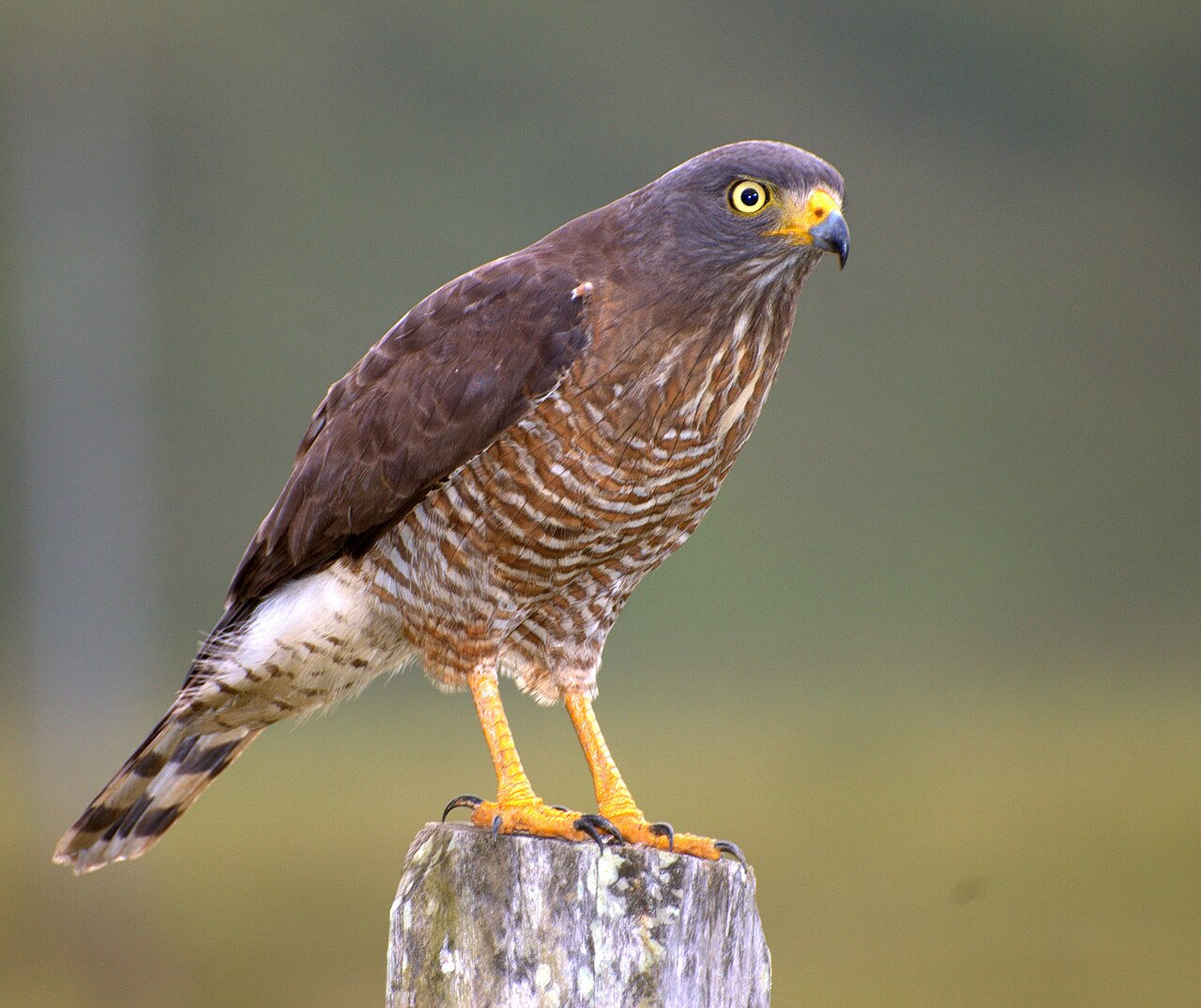
The Roadside Hawk is the commonest bird of prey of the tropical lowlands: a small, short-winged hawk that sits on fence posts, telephone wires and bare branches along the road, which is how it got its name. It is noisy, and it carries a heavy bill for its size — a feature fixed in its scientific name.
Click a thumbnail to switch the photo above.
Voice
The call is a high, piercing, slightly nasal squeal, a drawn-out kweeeee that slides upward in pitch and is repeated after a pause for breath. There is also a fast series of short, sharp kek-kek-kek notes, given in excitement and in disputes with neighbours. It is noisiest in late winter and spring, when it also calls during display flights over the edge of the woods. Because it calls so often and so loudly, over much of its range it is the raptor you hear first and see only afterwards.
Recording: José María Loaiza B. — CC BY-NC-SA 4.0 · Distrito Metropolitano de Quito, Pichincha, Parroquia Nanegalito, Nueva Granada, Hacienda Los Yumbos, Ecuador · xeno-canto
Identification
A small, compact hawk with short, broad, rounded wings, a long tail and a proportionately large, heavy bill; the eye of the adult is whitish to pale yellow. Head and breast are grey or grey-brown, the belly is finely barred brown and white, and the tail carries four or five grey bands. In flight the primaries flash rufous, which at distance is the best mark of all. Juveniles are browner, with a pale eyebrow and a streaked rather than barred breast. Twelve subspecies are recognised, ranging from mainly brown to mainly grey; as in nearly all hawks and buzzards the female is the larger of the pair.
Confusion species
Gray Hawk (Buteo plagiatus) is the main confusion at the northern edge of the range: it is more evenly grey, more finely and regularly barred below, has two broad white bands in the tail and shows no rufous in the primaries. Cooper's Hawk has a similar short-winged, long-tailed shape but flies with the typical burst of quick beats and a glide, and has a far finer bill. Broad-winged Hawk has longer, more pointed wings and a tail with one broad white band. Finally the posture helps: the Roadside Hawk perches upright and low, often on a fence post beside a pasture, and sits tight as a car approaches.
Habitat
Woodland edges, second growth, half-open wooded savanna, hedgerows between fields and pasture, plantations, village fringes and roadside vegetation. It is precisely not a bird of closed rainforest: deep undisturbed forest is avoided, while every edge, clearing or road verge cut through it creates new habitat. It hunts from a low perch and drops onto prey, so it needs open ground beneath it above all. In towns and villages it nests in gardens and along streets, as long as there are trees and unbuilt margins.
Where the bird is most often found, arranged by the USNVC — the vegetation classification of the United States and Canada — and CMECS for sea and coast.




Range and movements
Within the guide area it is a resident of the Mexican lowlands: on the Atlantic slope from Tamaulipas south to Belize, and on the Pacific slope from Mazatlán in Sinaloa south to Guatemala, mostly below a thousand metres. From there the range continues through all of Central America and, east of the Andes, to northeastern Argentina. It does not breed in the United States: there are only a few records from the extreme south of Texas, along the lower Rio Grande. Because it lives off edges and half-open country, it has gained from forest clearance and road building rather than suffered by them.
- Resident
- Winter
- Passage
- dark = core range, pale = thinly spread
Where and when to look
Drive or walk a country road through tropical lowland and watch the posts, wires and bare treetops along the verge: of all the raptors sitting there, this is by far the commonest. Note the upright posture, the long tail and the big bill, and above all the rufous that flares as the bird takes off. If a high, drawn-out squeal comes from a woodland edge with nothing in sight, in the tropical lowlands it is almost always this species.
Conservation
It is numerous across its large range and is listed as Least Concern (LC). It adapts well to landscapes altered by people and lives right into villages and towns, so forest clearance does not reduce its numbers. It is persecuted locally where it is believed to take poultry, but this has no measurable effect on the size of the population.
Scientific name
Rupornis magnirostris | (Gmelin, 1788)
Johann Friedrich Gmelin described the species in 1788 as Falco magnirostris, among the falcons; because it was later placed in another genus, author and year stand in parentheses. The species name combines Latin magnus, 'large', with rostrum, 'bill', and refers to the bill, which is heavy for so small a hawk. The species now stands alone in the genus Rupornis, apart from the true buzzards of the genus Buteo in which it was long placed. The described specimen came from Cayenne, in French Guiana.