All species › Waterfowl › Ducks, swans and geese › Hawaiian Duck
Hawaiian Duck | Anas wyvilliana
Hawaii-eend | Pato de Hawái
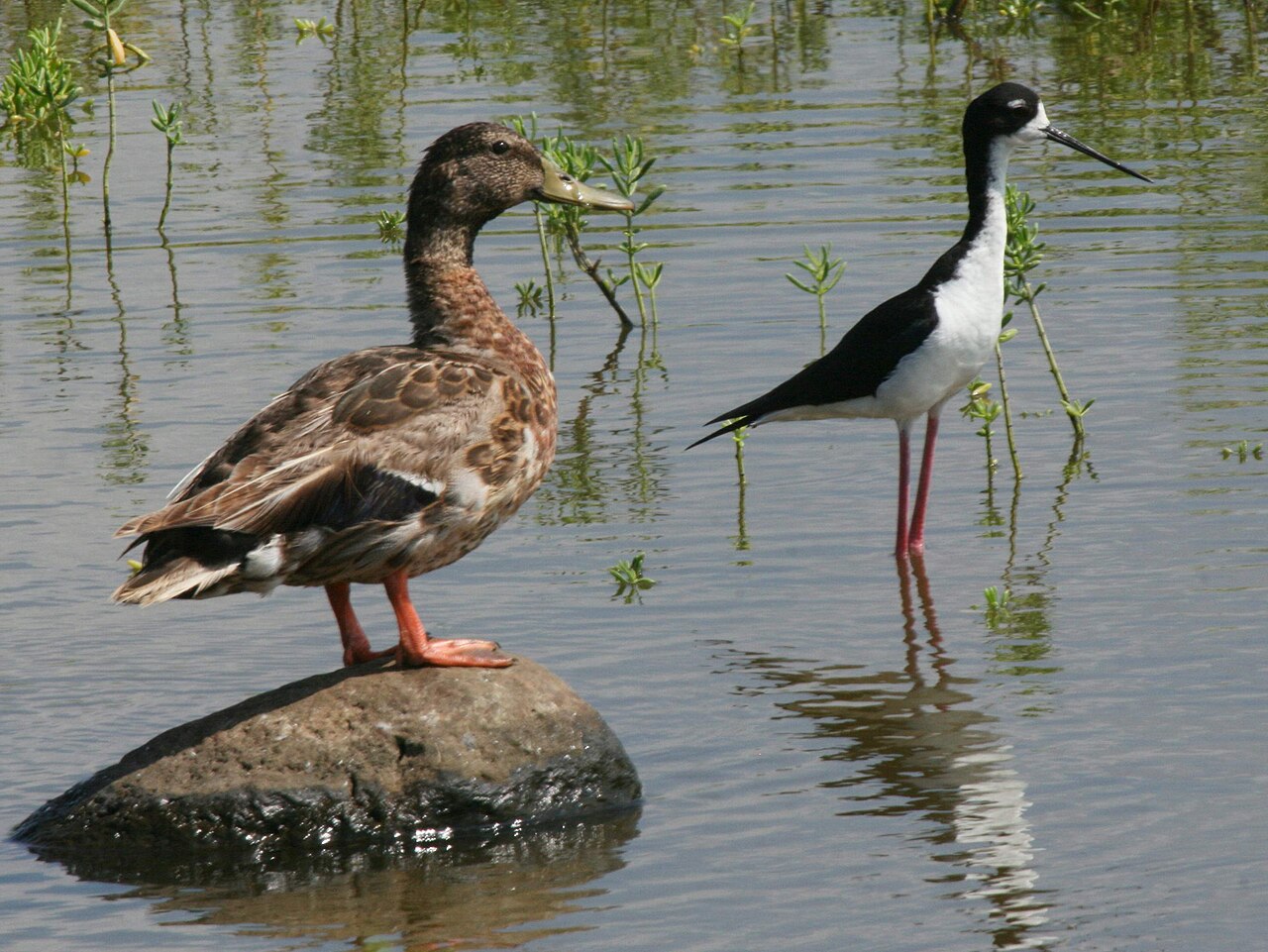
The Hawaiian Duck is the only native duck of the Hawaiian Islands: a stocky, mottled brown duck resembling a small, dull Mallard, but living on mountain streams and in marshes where the Mallard itself does not naturally occur. It is considerably smaller than the Mallard and, unlike that species, shows no separate seasonal plumage. Its greatest threat is not hunting or habitat loss but the Mallard itself: released and feral Mallards hybridize with the Hawaiian Duck on a large scale.
Voice
It quacks like a Mallard, but more softly and far less often: where a group of Mallards keeps up a constant quacking clamour, a group of Hawaiian Ducks stays noticeably quiet. The male gives a more subdued call than the female's louder quack. On the quiet mountain streams where the species lives, any sound carries far, and it is precisely the sparseness of the call that gives searchers a useful signal.
Recording: Phoenix Birder — CC BY-NC-SA 4.0 · Hanalei NWR, Kauai County, Hawaii, United States · xeno-canto
Identification
Both sexes are mottled dark brown, comparable to a female Mallard, but with a dark rather than black-and-white tail and a blue-green speculum bordered white on both sides. The male has a darker head and neck than the female and an olive-green bill; the female is more lightly marked, smaller, and carries a dull orange bill with dark blotches. Both sexes have orange-yellow legs. First-year males resemble an eclipse-plumaged Mallard and can only be told from the female with certainty after the first moult.
Confusion species
The greatest source of confusion is at the same time the greatest threat: the Mallard (Anas platyrhynchos), released on most islands and now hybridizing with the Hawaiian Duck almost everywhere. A hybrid betrays itself through elements of Mallard plumage the Hawaiian Duck itself lacks: a curled uppertail feather, a faint white neck ring, or green patches on the male's head. On Oʻahu the local population today consists almost entirely of such mixed birds, and only on Kauaʻi, where Mallards have remained scarce, is the chance of a pure bird greatest.
Habitat
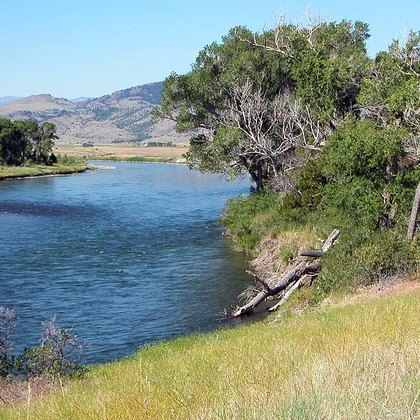
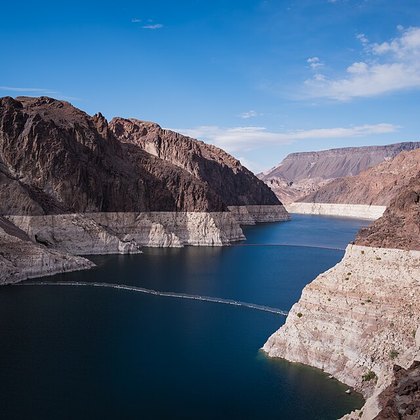
It uses a wide range of fresh water: marshes, flooded grassland, coastal ponds, mountain streams well up into the hills, and traditional taro patches, foraging preferably in water less than fifteen centimetres deep. Unlike the Mallard, which favours lowland country, the Hawaiian Duck also occurs deep in the mountains, along fast-flowing streams within dense rainforest. That preference for remote mountain streams is part of its survival: Mallards reach them less easily, and hybridization stays more limited there than in the lowlands.
Where the bird is most often found, arranged by the USNVC — the vegetation classification of the United States and Canada — and CMECS for sea and coast.



Range and movements
The Hawaiian Duck occurs only on the Hawaiian Islands and nowhere else in the world. It originally inhabited all the main islands except Kahoolawe, but by the mid-twentieth century it had vanished everywhere except Kauaʻi — where it held on partly because mongooses were never introduced there. Since then, captive-bred birds have been released on Oʻahu, Maui, Molokaʻi and Hawaii, but only the original population on Kauaʻi still consists largely of genetically pure birds. It does not migrate: once settled, a bird stays within the same drainage for life.
- Resident
Where and when to look
Kauaʻi is the best place to see the species in its purest form, for example around the Hanalei marshes; look for a quiet mountain stream rather than a resort pond, where the chance of Mallard hybrids is much higher. Focus on the combination of dark tail and blue-green speculum, not on the exact colour of the head — in a hybrid that tells you nothing reliable.
Conservation
The species is vulnerable (VU); the world population is estimated at about 2,200 birds, of which the great majority — some 2,000 — live on Kauaʻi, with the rest mainly on Hawaii; the trend is cautiously increasing. In the first half of the twentieth century the species was nearly wiped out by hunting and the drainage of lowland marshes, and only captive-breeding programmes and releases since the 1950s have saved it. The main threat today is genetic: on most islands where it has been reintroduced, it interbreeds so heavily with feral Mallards that little of the original species remains pure.
Scientific name
Anas wyvilliana | Sclater, 1878
Sclater described the species in 1878 as Anas wyvilliana, in the same genus in which it still stands, hence no parentheses around author and year. Anas is Latin for 'duck', introduced by Linnaeus in 1758. wyvilliana honours Charles Wyville Thomson, chief scientist of the Challenger expedition, during whose 1875 visit to Hawaii the type material was collected. The type locality is recorded no more precisely than 'the Hawaiian Islands'.