All species › Waders, gulls and terns › Skimmers, noddies, terns and gulls › Little Gull
Little Gull | Hydrocoloeus minutus
Dwergmeeuw | Gaviota enana
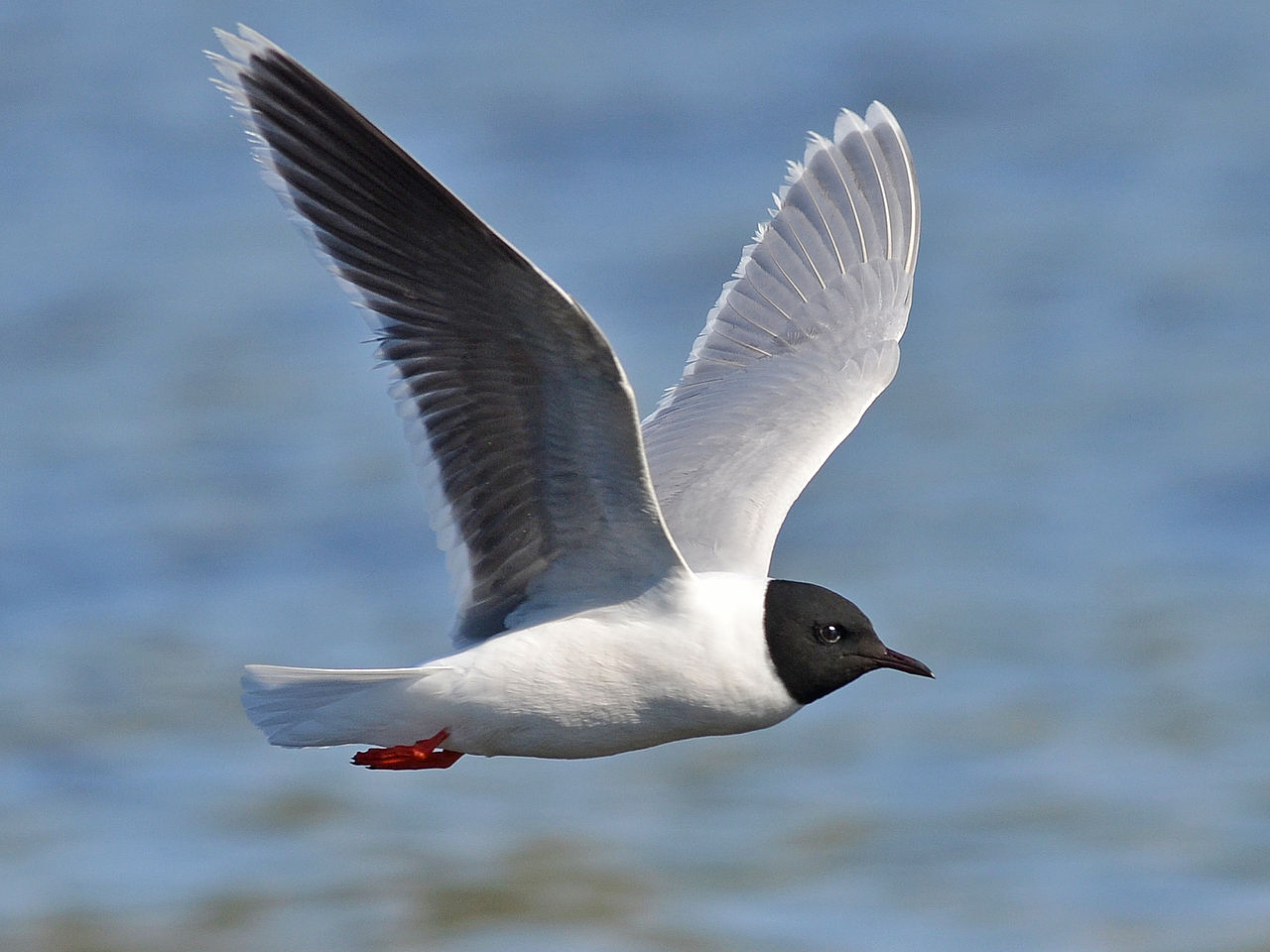
The Little Gull is the smallest gull in the world, hardly larger than a Black Tern and with the same dancing, dipping flight. It belongs to Eurasia; in North America it is a rare but almost annual visitor, above all on the Great Lakes, and since 1962 it has nested there now and then. The surest mark is the underside of the wing: sooty black, with a crisp white trailing edge.
Voice
Away from the colony it is usually silent. At the breeding marsh it gives a fast, repeated, nasal kek-kek-kek and a two-syllable eh-keeh eh-keeh, kept up for long stretches. Between these come muffled chik notes and a louder henk. In North America it is seldom heard: the birds that turn up there are almost always silent singletons among Bonaparte's Gulls.
Recording: Stanislas Wroza — CC BY-NC-SA 4.0 · Tolpanniemi, Finland · xeno-canto
Identification
A small, compact gull with a small round head, a fine black bill and short legs; the wings are fairly broad and rounded at the tip, with no black in the wingtip. In summer plumage a full black hood running down onto the nape, dark red legs, and white underparts sometimes flushed with pink. In winter all that remains is a dark crown smudge and a black ear spot. The adult is pale grey above with a broad white trailing edge, and sooty grey to black beneath the wing — a combination no other gull shows. First-year birds lack that dark underwing and instead carry a black W across the upperwings, a dark crown and a black tail band. The flight is light and erratic, more tern than gull, with much hovering and picking from the surface.
Confusion species
Bonaparte's Gull (Chroicocephalus philadelphia) is the species it hides among: larger, with a pointed wing showing a pale translucent leading wedge, and a white rather than dark underwing. Black Tern (Chlidonias niger) is the same size and flies in the same way, but has a straight pointed bill, a dark body in summer, and no white trailing edge to the wing. In first-year birds the black W recalls Sabine's Gull (Xema sabini) and young Black-legged Kittiwake; the Little Gull is clearly smaller and has a rounded, not forked, tail. On an adult, always look at the underwing first: only the Little Gull's is dark.
Compare gulls: legs, head, bill and wing tip side by side
Habitat
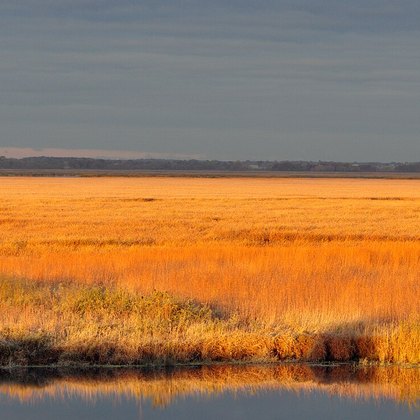
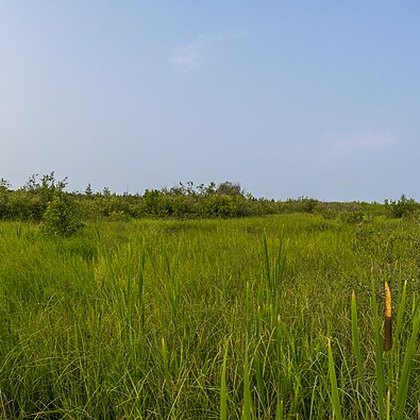
Breeds in shallow freshwater marshes with reed, sedge and floating plants, often among or beside colonies of Black-headed Gulls or Black Terns; the few North American nests lie in the same kind of marsh on the Great Lakes and in the Hudson Bay and James Bay lowlands. On migration it is a bird of large open water: the Great Lakes themselves, river mouths and harbour basins. In winter it stays at sea just off the coast, over shallows and in sheltered bays and estuaries. It avoids deeper water far offshore, and is almost never found on landfills or in towns.
Where the bird is most often found, arranged by the USNVC — the vegetation classification of the United States and Canada — and CMECS for sea and coast.



Range and movements
The heart of the range lies in Eurasia, from the Baltic east to the Sea of Okhotsk. In North America it has been known only since 1819 and has nested sporadically since 1962: a few dozen nests scattered across the Great Lakes, the St. Lawrence valley and the Hudson Bay and James Bay lowlands, rarely for long in the same place. Most birds on the Great Lakes are on passage, peaking in April and May and from September to November; in winter the picture shifts to the Atlantic coast, from Massachusetts to North Carolina. Whether the American breeders form a population of their own or are topped up again and again from Europe has not been settled.
- Resident
- Breeding (summer)
- Winter
- Passage
- dark = core range, pale = thinly spread
Where and when to look
Look for it in October and November on the east side of one of the Great Lakes, at a pier or a river mouth where hundreds of Bonaparte's Gulls are dancing over the water: the Little Gull is smaller, rounder-winged, and gives itself away the moment it banks and shows the dark underwing. A telescope and patience pay better here than driving on — it is one bird in a large flock.
Conservation
Least Concern (LC) worldwide, with the great bulk of the population in Russia and Fennoscandia. The North American breeders, at a few dozen nests, are too few to call a population, and are listed as endangered in several states and provinces. Drainage of marshes and strongly fluctuating water levels are the decisive factors here.
Scientific name
Hydrocoloeus minutus | (Pallas, 1776)
Peter Simon Pallas described the species in 1776 as Larus minutus; because it has since been placed in another genus, author and year stand in parentheses. The genus Hydrocoloeus was introduced by Kaup in 1829; the name means literally water jackdaw, from Greek hudor for water and koloios for jackdaw. minutus is Latin for small, and in this species that is no exaggeration. The type locality is the rivers of Siberia and Russia, later restricted to Berezov in Tobolsk Governorate.