All species › Waders, gulls and terns › Skimmers, noddies, terns and gulls › Ross's Gull
Ross's Gull | Rhodostethia rosea
Ross' meeuw | Gaviota de Ross
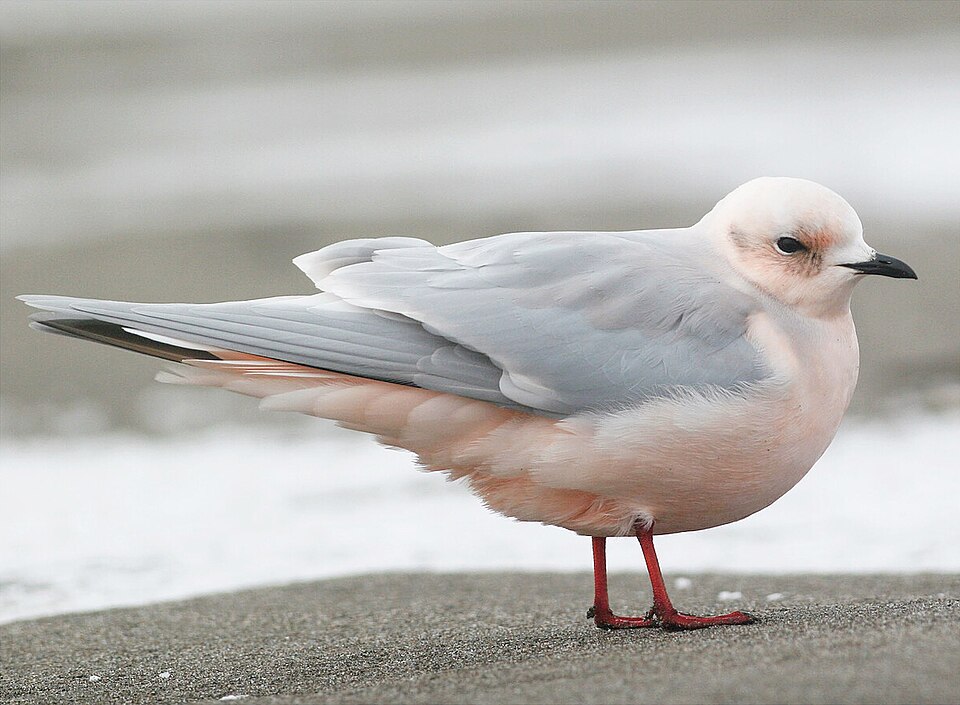
Ross's Gull is the bird people travel to Utqiaġvik for: a small, tern-like gull with a wedge-shaped tail, a narrow black neck ring and a rosy flush over the underparts. It breeds in the high Arctic and spends the winter at the edge of the pack ice, where almost nobody is watching. In northern Alaska, thousands sometimes pass eastward along the coast in late autumn.
Voice
Away from the colony it is almost always silent. At the nesting grounds it gives a soft, high kew, usually in short series, and in display flight a melodious two-note call that the male utters while bending his body into a bow. Anyone watching the passage in Alaska usually hears nothing at all: the birds go by in silence, low over the water.
Recording: Rob van Bemmelen — CC BY-NC-SA 4.0 · Vlissingen, Vlissingen, Zeeland, Netherlands · xeno-canto
Identification
Small and finely built, with long pointed wings, a tiny black bill, a large dark eye and bright red legs. The defining feature is the tail: wedge-shaped, with a lengthened central feather, so that the silhouette resembles no other gull. In summer plumage the upperparts are plain pale grey and the underparts white with a rosy flush that varies from bird to bird, and a narrow, sharply drawn black ring encircles the neck. In winter the ring disappears and a dark crescent behind the eye is all that is left. The underwing is grey, so the bird looks darker against the light than expected. Juveniles carry a black W across the upperwings and a black tail tip, and lack the pink altogether.
Confusion species
Little Gull (Hydrocoloeus minutus) is just as small, but has rounded wings, a straight tail and, in adults, a sooty black rather than grey underwing. Sabine's Gull (Xema sabini) has a forked tail and a three-toned upperwing with a large black tip, which Ross's Gull lacks. Young Black-legged Kittiwakes (Rissa tridactyla) carry the same black W but are larger, with black legs and a straight tail with a black band across its whole width. Whenever in doubt, the wedge in the tail and the red legs settle it.
Compare gulls: legs, head, bill and wing tip side by side
Habitat
Breeds on low, boggy tundra with pools and sedge, often on a drier hummock in a marshy river flat and sometimes among Arctic Terns. Outside the breeding season it is a bird of the ice edge: open leads and holes in the pack ice, where it picks from the surface. On migration it follows the coastline and the rim of the drifting ice. It hardly comes to land then; only after prolonged storms does it end up in harbours and on beaches.
Where the bird is most often found, arranged by the USNVC — the vegetation classification of the United States and Canada — and CMECS for sea and coast.



Range and movements
Most of the world population breeds in northeastern Siberia, from the Taimyr Peninsula to the Kolyma. In North America it breeds only very locally in the far north of Nunavut and rarely in Greenland; the colony at Churchill in Manitoba, for decades the best-known breeding site on the continent, is now only rarely occupied. It winters largely at sea, along the ice edge in the northern Bering Sea, the Sea of Okhotsk and the Beaufort Sea. What makes it visible in North America is the autumn passage at Point Barrow in Alaska, where in October and November thousands of birds sometimes move east to feed in the Beaufort Sea before vanishing westward again.
- Breeding (summer)
- Winter
- Passage
- dark = core range, pale = thinly spread
Where and when to look
The one place with a real chance is Utqiaġvik in Alaska, in the first half of October: sit at Point Barrow with the wind behind you and scan low over the water, where the birds pass east in small parties. Elsewhere in North America it means waiting for a vagrant, usually a first-year bird among Bonaparte's Gulls at a winter harbour wall; then watch for the wedge-shaped tail and not for the pink, which is absent at that age.
Conservation
The world population is put at some tens of thousands of birds, but the colonies lie so scattered and so remote that nobody knows the figure precisely. The species is listed as Least Concern (LC). The concerns are the loss of summer sea ice, to which it is tied outside the breeding season, and oil and gas development in the Arctic seas.
Scientific name
Rhodostethia rosea | (MacGillivray, 1824)
William MacGillivray described the species in 1824 as Larus roseus, from a bird collected by James Clark Ross in 1823 on the Melville Peninsula during Parry's second polar voyage; because it was later moved to a genus of its own, author and year stand in parentheses. That genus, Rhodostethia, MacGillivray himself introduced in 1842; the name is Greek, from rhodon for rose and stethos for breast. rosea is Latin for rosy and says the same thing again. The original description gives no locality; it was fixed afterwards on the Melville Peninsula, where the specimen came from.