All species › Waders, gulls and terns › Skimmers, noddies, terns and gulls › Roseate Tern
Roseate Tern | Sterna dougallii
Dougalls stern | Charrán rosado
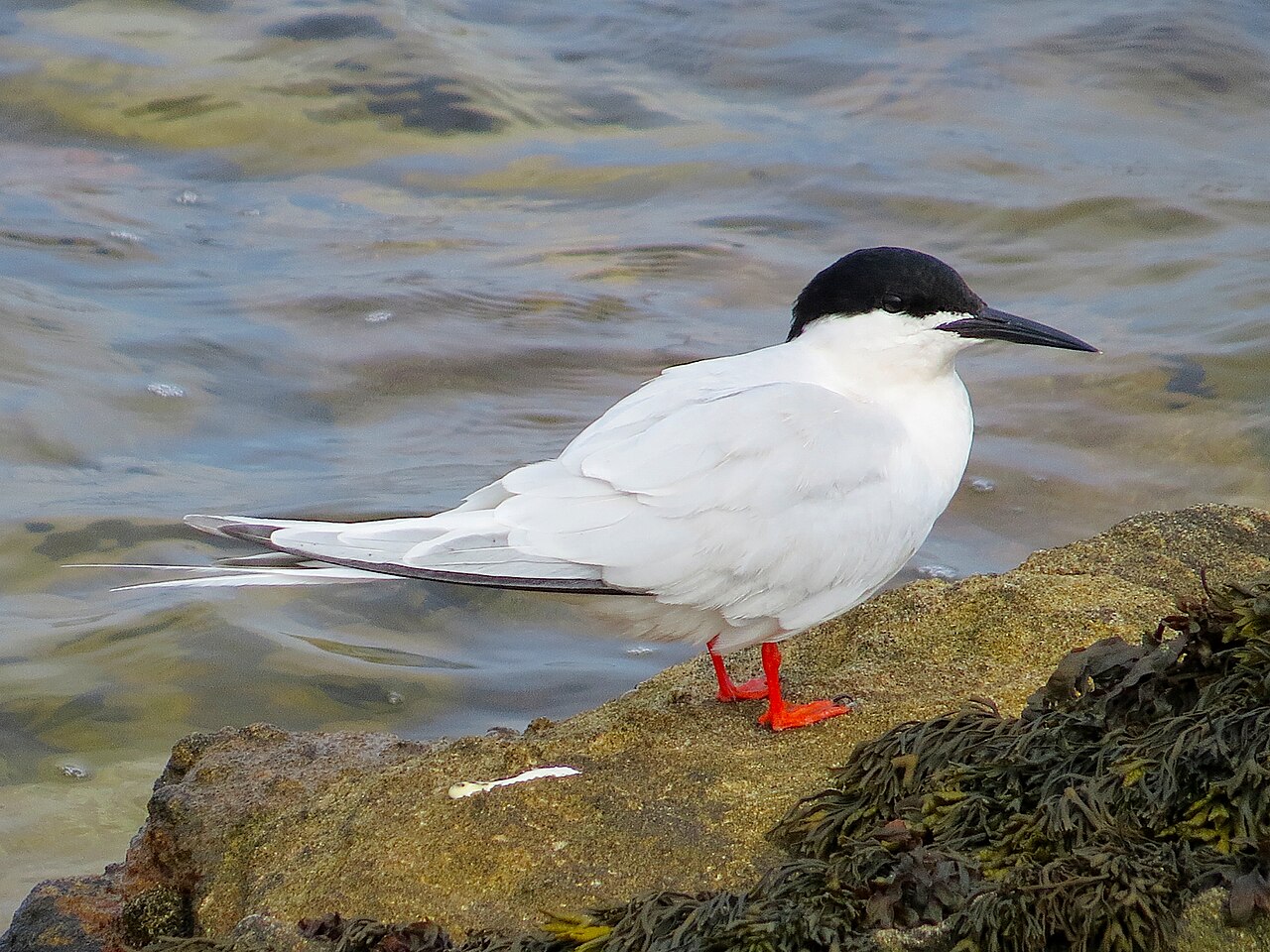
The Roseate Tern is the palest and slenderest tern of the Atlantic coast: almost white, with two long tail streamers that project far beyond the wingtips at rest. The pink flush on the breast that gives it its name is there only early in the season and only in good light. In the United States the northeastern population is listed as endangered; over ninety per cent of it breeds on three islands.
Voice
The characteristic call is a sharp, high keek, shorter and thinner than anything a Common Tern gives, alongside a lower two-syllable kir-ik. When the colony is disturbed this turns into a low, harsh rattle of staccato notes. Classic too is a chu-wit recalling a Spotted Redshank, which stands out at once over a mixed colony. In a flock of terns at sea the voice is often the first thing to betray that a Roseate is among them.
Recording: Ricardo Hevia — CC BY-NC-SA 4.0 · Ortegal (near Cariño), A Coruña, Galicia, Spain · xeno-canto
Identification
The sexes are alike. In breeding plumage it is pale: a light grey mantle set against white, a jet-black cap, and underparts washed with a soft pink early in the season. The bill is long, thin and black, with a red base at the height of the breeding season; the legs are bright orange-red. The tail streamers are white and long enough to project far beyond the wingtips on a perched bird. In flight the upperwing looks almost uniformly pale, with dark confined to the outer two or three primaries; the wingbeat is stiffer, faster and shallower than a Common Tern's. Juveniles are coarsely dark-scaled on the mantle, with a black bill and dark legs.
Confusion species
Common Tern (Sterna hirundo) is greyer on mantle and underparts, has an orange-red bill with a black tip, and tail streamers that reach no further than the wingtip. Arctic Tern (S. paradisaea) has a blood-red bill without a black tip and grey underparts set off by a white cheek stripe. Forster's Tern (S. forsteri) is bulkier, with a heavier bill and, in winter, a black eye mask on a white head. The surest distinction remains the combination of a long dark bill, ice-pale upperparts, and two white streamers trailing behind the bird like threads.
Compare terns: bill, legs, head and tail side by side
Habitat
Breeds on small offshore islands and rocky islets, usually among boulders, driftwood or dense herbage where the nest lies hidden, and nearly always in the company of Common Terns. It feeds further from shore than the other terns, over sandbars, tidal rips and reefs where predatory fish drive small fish to the surface. It barely uses fresh water; of all the terns of these coasts it is the most strictly marine. After breeding, birds gather on sandflats and island points before moving out.
Where the bird is most often found, arranged by the USNVC — the vegetation classification of the United States and Canada — and CMECS for sea and coast.




Range and movements
North America holds two separate populations: a northeastern one from Nova Scotia and the Îles de la Madeleine to Long Island, and a Caribbean one from the Florida Keys through the Bahamas and Puerto Rico to the Lesser Antilles. The northeastern population held about 4,600 breeding pairs in 2019, the great majority on Long Island and two islands in Buzzards Bay. Both populations winter on the northern and eastern coasts of South America, from Trinidad to Brazil; within the map window the species is absent in winter. Outside the Americas it breeds in western Europe, East Africa, the Indian Ocean and the western Pacific.
- Resident
- Breeding (summer)
- Passage
- dark = core range, pale = thinly spread
Where and when to look
Look for it in July and August on a sandflat in southern New England or on Long Island, where hundreds of terns roost together: it is the bird that looks whiter than the rest and drags two long streamers behind it. Do not go onto the breeding islands — they are closed, and disturbance here costs chicks directly.
Conservation
The northeastern population is listed as endangered under the US Endangered Species Act and as threatened under Canada's Species at Risk Act; the Caribbean population as threatened. Globally the species is listed as Least Concern (LC), but Atlantic numbers are a fraction of what they were in the nineteenth century, when the millinery trade wiped out whole colonies. Sea-level rise, predation by gulls and rats, and the building over of nesting islands are now the heaviest threats. The recovery on Long Island and in Buzzards Bay shows what closed and warded islands can achieve.
Scientific name
Sterna dougallii | Montagu, 1813
George Montagu described the species in 1813 as Sterna dougallii; it still stands in the same genus, so author and year carry no parentheses. Sterna comes from Old English stearn, an old name for terns. dougallii honours the Scottish physician Peter McDougall (1777–1814), who sent Montagu the first specimen. The type locality is the Cumbrae Islands in the Firth of Clyde, Scotland. The names part company here: one language names the man who sent the bird in, the other the pink flush on its breast.