All species › Passerines › Reed warblers and allies › Millerbird
Millerbird | Acrocephalus familiaris
Hawaiikarekiet | Carricero familiar
The Millerbird owes its name to its food: it eats miller moths, six to ten of them a day. Its entire world is Nihoa, a steep rock of not quite seventy hectares, two hundred and forty kilometres northwest of Kauaʻi. Since 2011 there has been a second population on Laysan — the island where the species had disappeared a century before.
Voice
The male sings from the top of a bush, loud and far-carrying for so small a bird: a rattling chatter of harsh and full notes, in short phrases repeated two or three times over. Away from those song posts it stays in cover, and then it is mostly short hard calls that betray it. There is little on Nihoa to compete with it: apart from the sea, the wind and the seabird colonies there are only two land birds, and the other — the Nihoa Finch (Telespiza ultima) — sings high and canary-like. Anyone working on the island therefore hears the Millerbird constantly and rarely sees it for long.
Recording: Eric VanderWerf — CC BY-NC-SA 3.0 · Nihoa Island, Hawaii, United States · xeno-canto
Identification
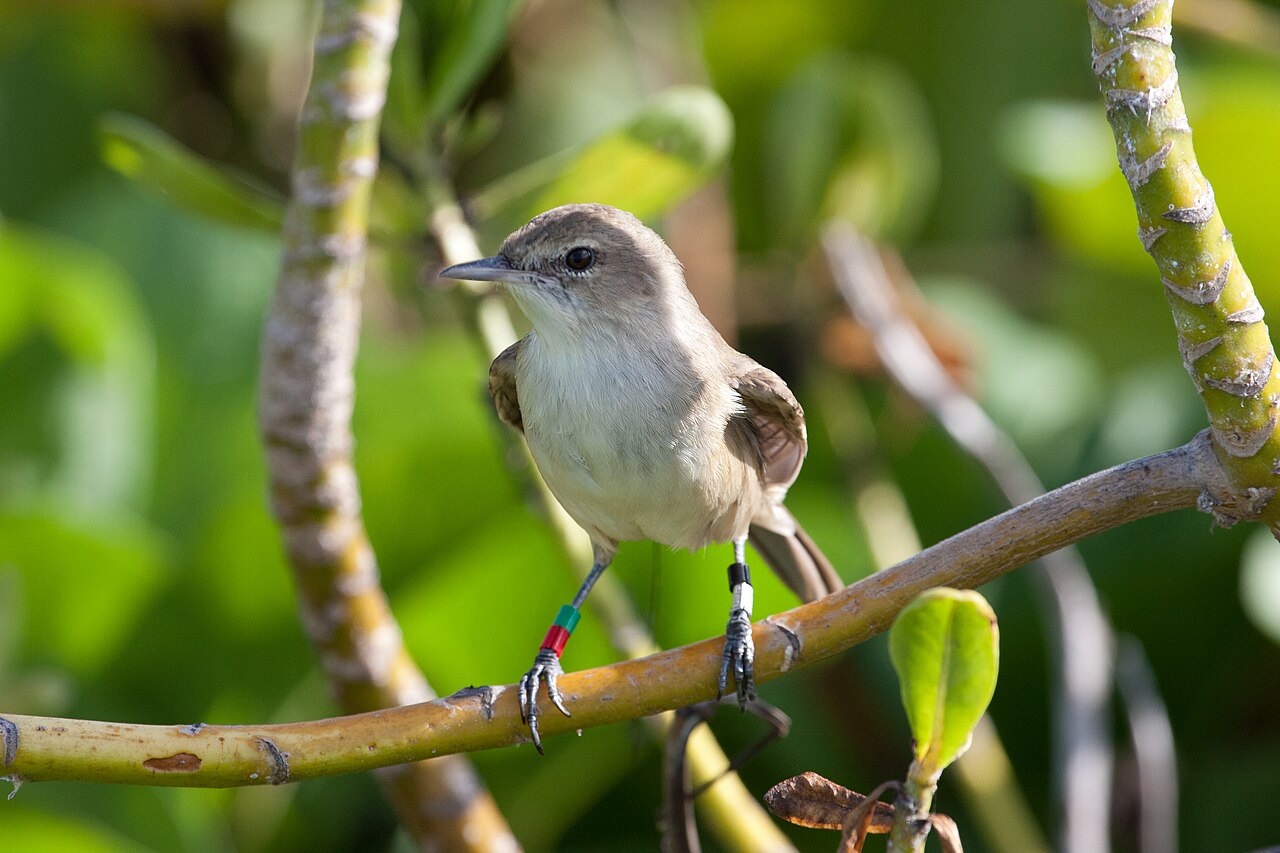
About thirteen centimetres: dark olive-brown above with greyish feather edges, greyish white below with a buff-brown wash on the flanks. The bill is thin and blackish, the legs dark grey, and above the eye there is at most a faint pale line — there is no other marking. Male and female look alike; the female averages a little smaller. The tail is long and often held slightly raised, the wings short and rounded: it flies low and briefly from bush to bush and never far across open ground.
Confusion species
On Nihoa the only other land bird is the Nihoa Finch, on Laysan the Laysan Finch (Telespiza cantans); both are much larger, with a heavy pale seed-eating bill and yellow in the plumage, and both hop about in the open, while the Millerbird stays inside the bush. Beyond that there is nothing to confuse it with: whatever else flies there is a seabird and of an entirely different order of size. The question on these islands is never which species it is, but how many there are.
Habitat
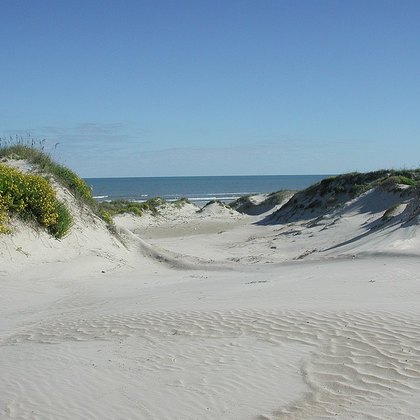
Low, dense shrubs on the terraces and in the gullies of Nihoa — chiefly aweoweo (Chenopodium oahuense) and ilima (Sida fallax), with among them the last palms of the species Pritchardia remota. Only thirty to forty hectares of the island are usable as habitat. It takes its food from leaves, stems, litter and the bare ground beneath, and holds a territory of about a quarter of a hectare for life. On Laysan it uses the Scaevola taccada scrub and the bunchgrass around the salt lake. Reeds grow on neither island.
Where the bird is most often found, arranged by the USNVC — the vegetation classification of the United States and Canada — and CMECS for sea and coast.

Range and movements
The species occurs only on Nihoa and Laysan, both in the northwestern chain of the Hawaiian islands and both closed nature reserves. Those islands lie far outside the eight main islands and therefore do not appear on this guide's island map; on the main map only the state of Hawaii is coloured. On Laysan the bird disappeared around 1923, after introduced rabbits had eaten the island's vegetation away. In September 2011 twenty-four birds were carried by ship from Nihoa to Laysan and in August 2012 another twenty-six; they bred there in the first year.
- Resident
Where and when to look
This is the one bird in this guide you cannot go and look at: Nihoa and Laysan lie within the Papahanaumokuakea monument, and landing is allowed only with a permit for research or management. If you ever get there with a working party, search the vegetated terraces early in the morning, low in the aweoweo scrub, and stand still: the bird is tame and will come of its own accord to a motionless observer. The rest of us watch the counts.
Conservation
Endangered (EN). The whole species was estimated in 2019 at 1,907 birds, with a margin of 1,291 to 2,766, divided over the two islands, and numbers are rising on both; that second population was the reason for moving the species from Critically Endangered to Endangered in 2023. The danger is not persecution but concentration: two small islands and nothing else — a single fire can strip Nihoa, as happened in 1885 when a party that had landed there set the vegetation alight by accident, and a hurricane or a long drought does the same. Between 1999 and 2003 outbreaks of the introduced grasshopper Schistocerca nitens ate the vegetation down to the ground, and were a rat ever to come ashore it would be over; that is why everything that lands is put through a strict quarantine.
Scientific name
Acrocephalus familiaris | (Rothschild, 1892)
Rothschild described the species in 1892 as Tatare familiaris, from birds Henry Palmer had collected for him on Laysan; because it was later placed in another genus, author and year stand in parentheses. The genus Acrocephalus was introduced by the two Naumanns in 1811, from Greek akros, 'pointed, topmost', and kephale, 'head'. familiaris is Latin for 'familiar, of the household', after the tameness of the birds on Laysan. The type locality is therefore Laysan — the island where the species vanished and to which it was brought back in 2011.