All species › Passerines › Larks › Horned Lark
Horned Lark | Eremophila alpestris
Strandleeuwerik | Alondra cornuda
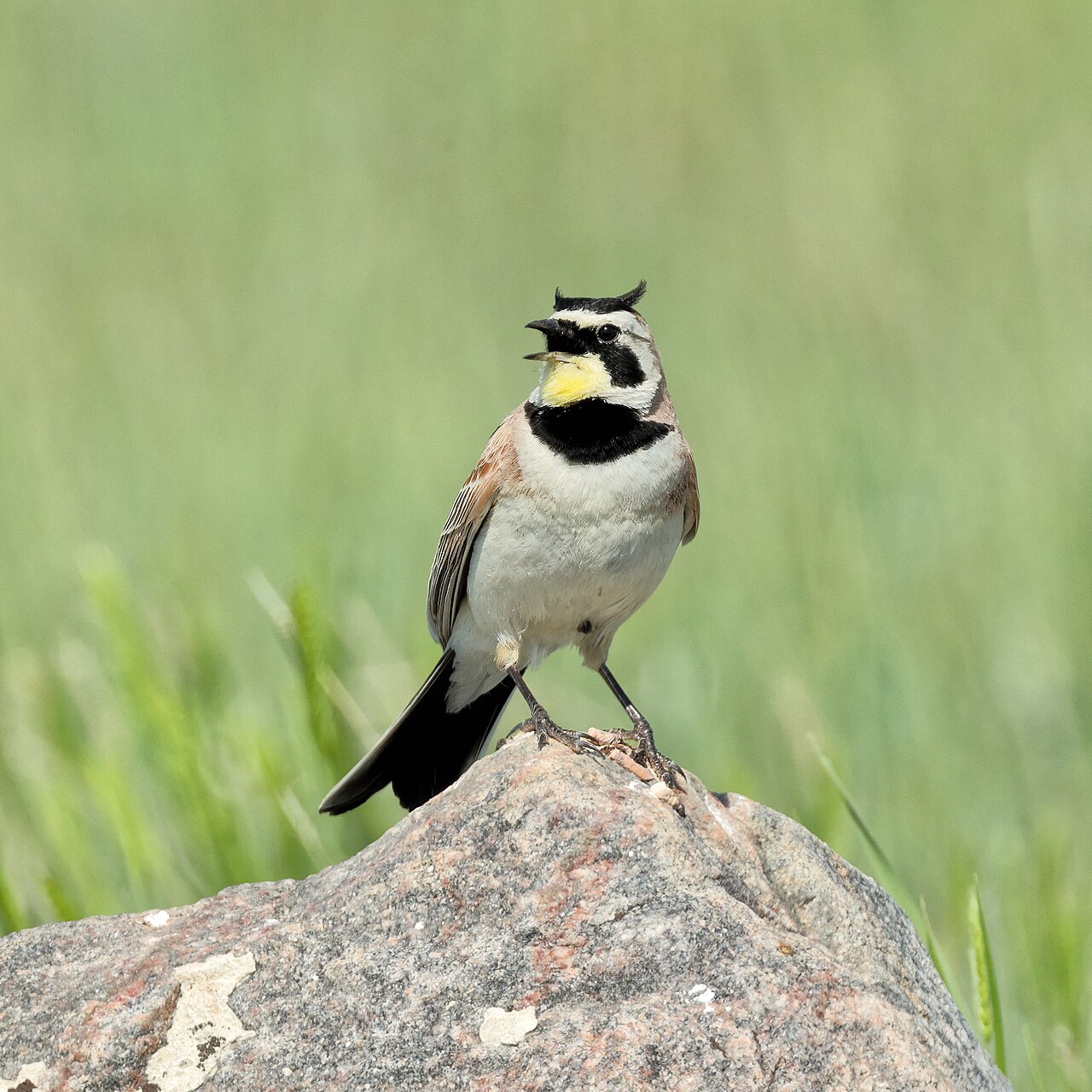
The Horned Lark is the only lark native to North America, and at the same time one of the most widely spread songbirds on the continent: it breeds from arctic tundra and alpine summits to the desert and the ploughland of the Midwest. The black and yellow face pattern and the two small black horns show only at close range; from a distance it is a brown bird walking over bare ground.
Voice
The song is a thin, high tinkling that rises in speed and pitch, as though splinters of glass were being scattered one after another: tsee-tee-tee-tseedelee. It is delivered from a clod, a stone or a fence as readily as from high in the air, after which the bird drops back on half-closed wings. The flight call is a fine, two-syllable tsee-tit, in winter the sound over your head as a flock passes; it gives the birds away almost always before the eye finds them. Song starts as early as February, with snow still lying on the fields.
Recording: Stanislas Wroza — CC BY-NC-SA 4.0 · Oukaimeden, Morocco · xeno-canto
Identification
The face decides it: a yellow to white eyebrow and throat, a black stripe running from the bill below the eye and bending down the cheek, a black band across the forehead and a broad black breast band. On the back of the head stand two small black feather horns, usually laid flat and then invisible. The upperparts are brown, varying by region from pinkish and sandy to grey-brown; the female is duller, with vaguer markings and shorter horns. Juveniles are spotted and lack the head pattern altogether, which causes confusion every autumn. On the ground it walks rather than hops, and at any alarm it flattens itself against the earth.
Confusion species
The American Pipit walks the same bare fields, but is slimmer, thin-billed, constantly pumps its tail and lacks the black and yellow head pattern. Snow Buntings in winter plumage show far more white in wing and tail and have a heavy yellow bill. Longspurs of the genus Calcarius share the same stubble-field flocks in winter; they are rounder and shorter-tailed, have a different flight call, and rise higher into the air when flushed. Young Horned Larks get taken for a pipit or a longspur; then look at the black tail with narrow white outer edges, and at the way the bird walks.
Habitat
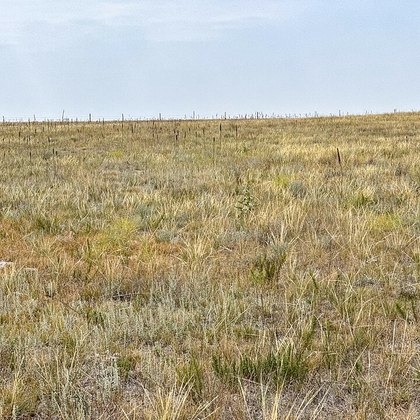
Bare or very short ground, and beyond that it minds little: arctic tundra, alpine ground above the treeline, shortgrass prairie, alkali and salt flats, ploughed fields and stubble, airfields, coastal dunes and the sand flats behind a beach. Where the vegetation grows above its head it goes, and shrubs and trees it avoids entirely. It therefore profits from overgrazing, ploughing and sand extraction, and leaves a site as soon as it closes over. In the desert it keeps to the open flat, not to the scrub.
Where the bird is most often found, arranged by the USNVC — the vegetation classification of the United States and Canada — and CMECS for sea and coast.



Range and movements
From northern Alaska and the Canadian arctic islands to central Mexico, with an isolated population in the Colombian Andes; that last area lies outside the guide area. The same species inhabits northern Europe and Asia, where it is named for the coasts on which it winters. Birds of the far north move out and winter in flocks on fields, road verges and coastal plains in the central and southern United States; in the west, on the prairies and in Mexico it stays put all year. Some twenty subspecies are recognised in North America, matching in colour the ground they breed on: pale on sand, rufous on red earth, dark on volcanic soil.
- Resident
- Breeding (summer)
- Winter
- Passage
- dark = core range, pale = thinly spread
Where and when to look
Look for it on the barest place in the landscape: a ploughed field with a rim of snow, a gravel verge, the edge of a runway. Drive slowly along such roads in winter and watch for birds that flush just ahead of the car and settle again a little further on — the fine flight call is usually the first thing you catch. And in February and March look up over bare fields: the song comes out of the sky, from a bird hanging so high that the naked eye can barely find it.
Conservation
Least Concern (LC), and with an estimated 140 million birds one of the most numerous songbirds on the continent — and at the same time one of the steepest decliners. The Breeding Bird Survey shows a fall of nearly two per cent a year between 1966 and 2019, some 64 per cent in all. The causes are not fully understood, but the loss of bare, short ground plays its part: fields growing over or being reforested, changed farming practice and building. For one form it is already critical: the streaked lark of the northwest coast, Eremophila alpestris subsp. strigata, has been federally listed as threatened in the United States since 2013 and has gone as a breeding bird from British Columbia.
Scientific name
Eremophila alpestris | (Linnaeus, 1758)
Linnaeus described the species in 1758 as Alauda alpestris, among the larks; because it was later placed in Eremophila, author and year stand in parentheses. That genus was introduced by Boie in 1828, from Greek erēmos, 'desert' or 'lonely place', and phileō, 'to love' — the desert lover. alpestris is Latin for 'of the high mountains'. The specimen described came from North America, later restricted to the coast of South Carolina: a wintering bird by the sea, which puts the name a long way off. The Dutch name comes from those same winter beaches, the English one from the feather horns.