All species › Birds of prey › Kites, Old World vultures, eagles and hawks › Mississippi Kite
Mississippi Kite | Ictinia mississippiensis
Mississippiwouw | Elanio de Mississippi
The Mississippi Kite is a slender, pearl-grey raptor that takes almost all its food on the wing: large insects, seized in one foot and eaten in flight. Where most birds of prey hunt alone, this one is thoroughly sociable — it nests in loose colonies, forages dozens at a time over the same field, and migrates to South America in flocks.
Click a thumbnail to switch the photo above.
Voice
The call is a high two-syllable whistle: a short note followed by a longer one that slides down in pitch, roughly phee-phew. It is given both from a perch and high in flight, and it carries a long way over open prairie country. In alarm at the nest the same call comes louder and sharper, and neighbouring birds join in, so that several kites are calling over a colony at once. In contact with mate or young an extra syllable or two may be added. Fledged juveniles beg with a thinner, more persistent version of the same note.
Recording: Brad Banner — CC BY-NC-SA 4.0 · O'Brien, Haskell County, Texas, United States · xeno-canto
Identification
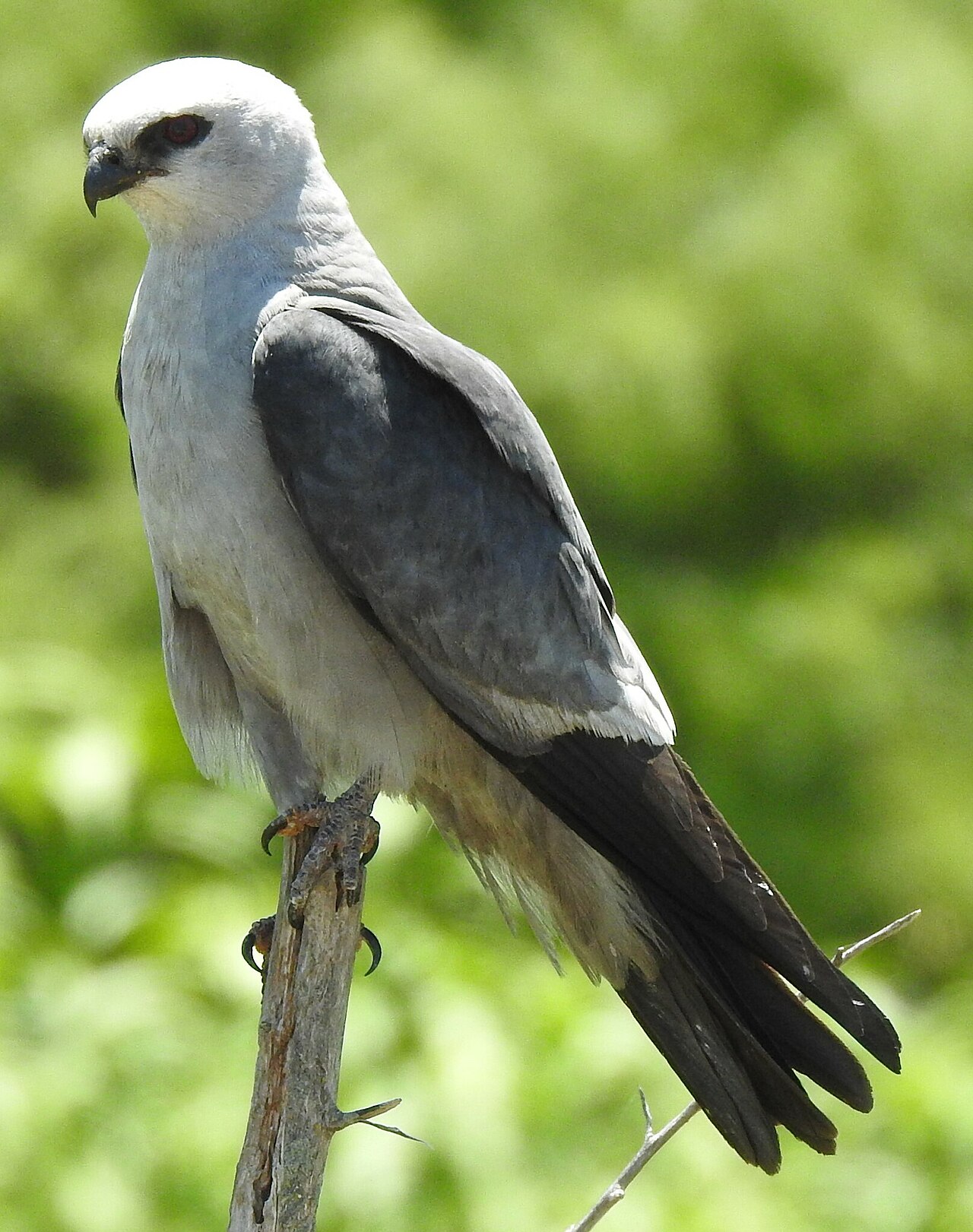
Adults are pale blue-grey, with an almost white head, darker grey wings tipped black, and a black, square-cut tail; the eye is red and set in a dark patch. The sexes look alike in the field, though as in nearly all hawks and kites the female is slightly larger and heavier than the male. Juveniles look quite different: brown-streaked on breast and belly, with mottled underwings and a tail crossed by narrow pale bands, a plumage they keep into their second calendar year. In flight the long pointed wings and long tail give a falcon-like outline. The flight itself gives it away at once: slow, buoyant and full of turns, broken by short stoops at an insect.
Confusion species
White-tailed Kite (Elanus leucurus) is far whiter, has a black shoulder patch and a white tail, and hovers on the spot over a field — something a Mississippi Kite never does. Merlin and Peregrine Falcon share the pointed-winged outline but fly with fast, driving beats and have a banded tail rather than a plain black one. In juvenile Mississippi Kites the streaked underparts recall a young falcon or harrier, but the tail carries narrow pale bands and the birds almost always drift about in company with adults. Finally the hunting flight is itself a mark: floating, apparently aimless circling, then a brief snatch with one foot.
Habitat
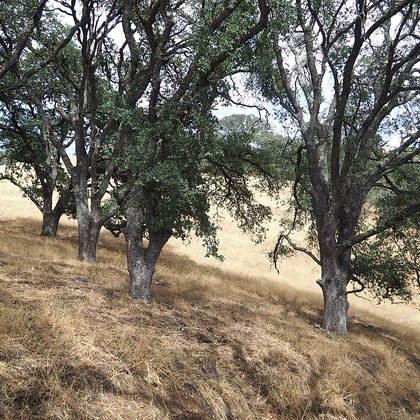
It breeds in two different landscapes: tall bottomland hardwood forest along rivers in the southeast, and in the west the small groves, planted shelterbelts and cottonwoods of the southern prairie states. In the southwest it uses half-open oak and mesquite country. Since the 1970s, in the western part of its range, it has also nested freely in city parks, on golf courses and in street trees of small towns. What it needs is not the wood itself but the open air beside it: a stand of trees to nest in, with pasture, cropland or prairie alongside from which insects rise. Unbroken closed forest with no clearing nearby is avoided.
Where the bird is most often found, arranged by the USNVC — the vegetation classification of the United States and Canada — and CMECS for sea and coast.




Range and movements
A summer bird of the southern United States, from Arizona and New Mexico east to Florida and the Atlantic coast states, and north into Colorado, Kansas and Nebraska. It winters in central South America, mainly in northern Argentina and southern Brazil; within the area of this guide it is seen outside the breeding season only on passage. Eastern and western breeders converge in the extreme south-central United States and then follow the Gulf side of Mexico and Central America. On the southern Great Plains it increased sharply during the twentieth century, helped by planted shelterbelts and town trees, and scattered nesting has since been recorded far into the northeast.
- Breeding (summer)
- Winter
- Passage
- dark = core range, pale = thinly spread
Where and when to look
In July and August look up over a town on the southern prairie in the late afternoon: ten or more will often be circling high in the thermals, making short dashes at dragonflies and grasshoppers. On autumn passage it is one of the four most numerous species in the raptor stream along the coast of Veracruz, where the birds pass in tight groups. Walk too close to a nest in a city park in June and you will meet the species another way: breeding birds swoop low over the heads of passers-by.
Conservation
The world population is estimated at around 700,000 birds, and numbers were stable between 1966 and 2019. The species is listed as Least Concern (LC). Because it nests in planted urban greenery, most of its conflicts with people happen in residential areas: strong nest defence over pavements and golf courses regularly draws complaints, while those same planted trees are what allowed its spread across the prairies.
Scientific name
Ictinia mississippiensis | (Wilson, 1811)
Alexander Wilson described the species in 1811 as Falco misisippiensis, among the falcons; because it was later placed in another genus, author and year stand in parentheses. The genus Ictinia was introduced by Vieillot in 1816 and goes back to Ancient Greek iktinos, 'kite'. The species name simply means 'of the Mississippi'; Wilson wrote it with a single s in the middle, and that original spelling misisippiensis still stands in the literature. The described specimen came from below Natchez, Mississippi.