All species › Tubenoses › Petrels, shearwaters and diving petrels › Northern Fulmar
Northern Fulmar | Fulmarus glacialis
Noordse stormvogel | Fulmar boreal
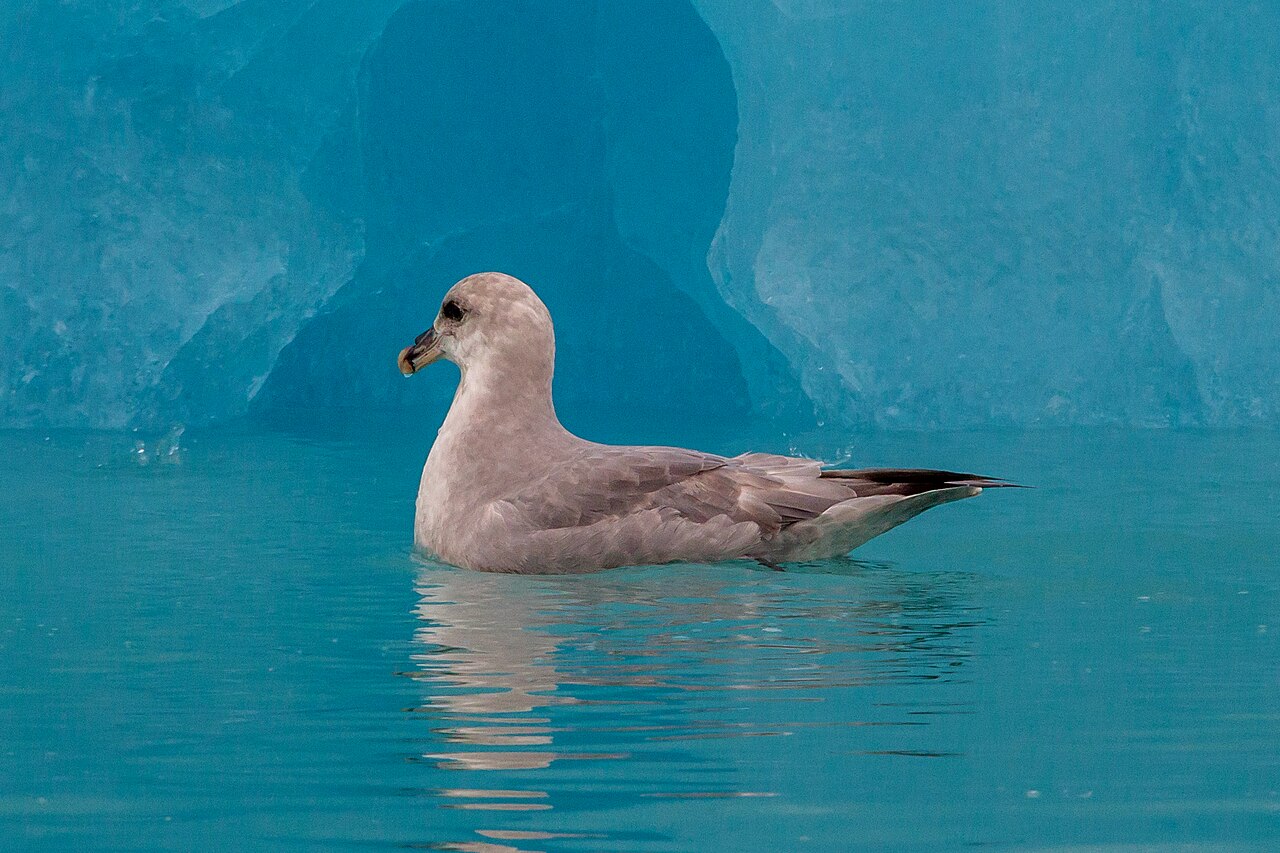
The Northern Fulmar is a stocky, gull-like seabird that spends its entire life over the coldest waters of the Atlantic, the Pacific and the Arctic Ocean, coming to land only to breed on a cliff ledge. Its stiff, inflexible wingbeat and tube-shaped nostrils give it away as no gull, whatever its colouring suggests. In under two centuries its breeding range has grown from a handful of far-northern colonies to hundreds of sites around the Atlantic.
Voice
At the breeding colony the Northern Fulmar is a noisy bird: pairs on the nest ledge perform a harsh cackling or quacking duet, and an intruder is met with a sharp ke-chee just before the bird ejects a jet of foul-smelling stomach oil. At sea it is largely silent, with only an occasional short grunt between birds over food. It is this foul-smelling defence, not song, that sets the species apart among seabirds: every member of the colony — egg, chick and adult alike — can deploy it.
Recording: Roland Arnison — CC BY-NC-SA 4.0 · Mingulay, Na h-Eileanan an Iar, Scotland, United Kingdom · xeno-canto
Identification
The light morph is grey above and white below, with a rounded head and a short, thick, strongly hooked bill bearing tube-shaped nostrils on top. In the North Pacific a dark morph also occurs, uniformly grey to nearly black all over, with intermediates as well. Male and female look alike, and the juvenile resembles the light adult. The silhouette is stocky, with a short neck, large head, broad body and long, stiff wings. In flight it alternates a few quick, stiff wingbeats with long glides low over the wave tops — unlike a gull's flexible stroke.
Confusion species
Gulls cause the most confusion: the light morph resembles a Ring-billed or American Herring Gull in colour pattern, but the stiff wingbeat, thick tube-nosed bill and lack of black wingtips give it away. Among shearwaters, Pink-footed Shearwater is closest in size but is darker overall and lacks the sharp line between grey upperparts and white underparts. Sooty Shearwater is likewise darker and more slender, with longer, narrower wings and a clearly different flight style. It is the fulmar's own dark morph that is most often confused with these last two shearwaters.
Habitat
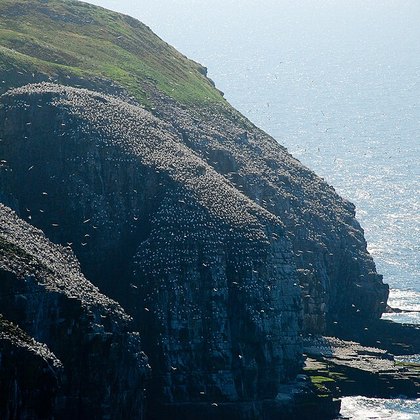
The Northern Fulmar lives over open, cold water above the continental shelf and at upwellings, out to the edge of the pack ice in the Arctic Ocean. For breeding it seeks steep sea cliffs and rock ledges, often in colonies of hundreds to thousands of pairs, laying a single egg on bare rock or in a shallow scrape. It largely avoids shallow water and the shore itself; it is a bird of the ocean, not the beach. Fishing vessels and whales attract it, since it readily gathers at offal and carcasses.
Where the bird is most often found, arranged by the USNVC — the vegetation classification of the United States and Canada — and CMECS for sea and coast.

Range and movements
The species breeds in the high Arctic of Canada, in Greenland, and on the Aleutians and other islands in the Bering Sea off Alaska; a colony has also become established off Newfoundland, on Baccalieu Island. After breeding it disperses south over open ocean, on the Pacific side into the waters off Washington, Oregon and California, on the Atlantic side to off New England and occasionally as far as North Carolina. In under two centuries the Atlantic population has grown and its breeding range expanded greatly — in the early nineteenth century it bred in the North Atlantic almost only on Iceland and St Kilda, whereas hundreds of colonies now ring that ocean. Fishery offal and whaling carcasses are often cited as an explanation, though not everything about the increase is settled.
- Resident
- Breeding (summer)
- Winter
- Passage
- dark = core range, pale = thinly spread
Where and when to look
Look for the Northern Fulmar from a headland or pier after a strong storm, when birds from open water are pushed closer to shore; winter boat trips over deeper water also give good chances. Watch for the stiff, short wingbeats between glides: that alone separates it from any gull at a distance.
Conservation
With a population numbering many millions and a strong, still-continuing increase across the Atlantic part of its range, the species is listed as Least Concern (LC). Bycatch in longline fisheries and disturbance of breeding colonies remain the main risks tied to the species. In parts of the Pacific, numbers are less well known than in the Atlantic.
Scientific name
Fulmarus glacialis | (Linnaeus, 1761)
Linnaeus described the species in 1761 as Procellaria glacialis, among the fulmars and petrels in the broad sense then recognized; because it has since been moved to another genus, author and year stand in parentheses. The genus Fulmarus was introduced in 1826 by Stephens; the name likely derives from an Old Norse word for 'foul gull', after the foul-smelling stomach oil the bird uses in defence. The species name glacialis is Latin for 'icy' or 'of the ice', referring to its polar and subpolar range — the type locality indeed lies within the Arctic Circle.