All species › Tubenoses › Northern storm petrels › Leach's Storm-Petrel
Leach's Storm-Petrel | Hydrobates leucorhous
Vaal stormvogeltje | Paíño boreal
Leach's Storm Petrel is hardly larger than a starling and spends its whole life on the ocean, apart from the nights on which it visits its burrow on an island. Over the waves it swerves and bounces like a bat, with a white rump and a forked tail as the only handholds. The largest colonies in the world lie off Newfoundland, and it is precisely those that have halved within a few decades.
Voice
At sea the bird is almost always silent. At the colony a steady, rhythmic purring begins to come out of the ground after sunset, like a small engine that stumbles every few seconds. Above it comes the flight call: an excited, laughing wik-a-wik-a-wik-a-wheee with a drawn-out flourish at the end. Females call slightly higher than males, and with some practice the two can be told apart. Standing in the middle of such a colony you hear it from every side at once while there is nothing to be seen in the dark.
Recording: Doug Hynes — CC BY-SA 4.0 · Country Island, Nova Scotia, Canada · xeno-canto
Identification
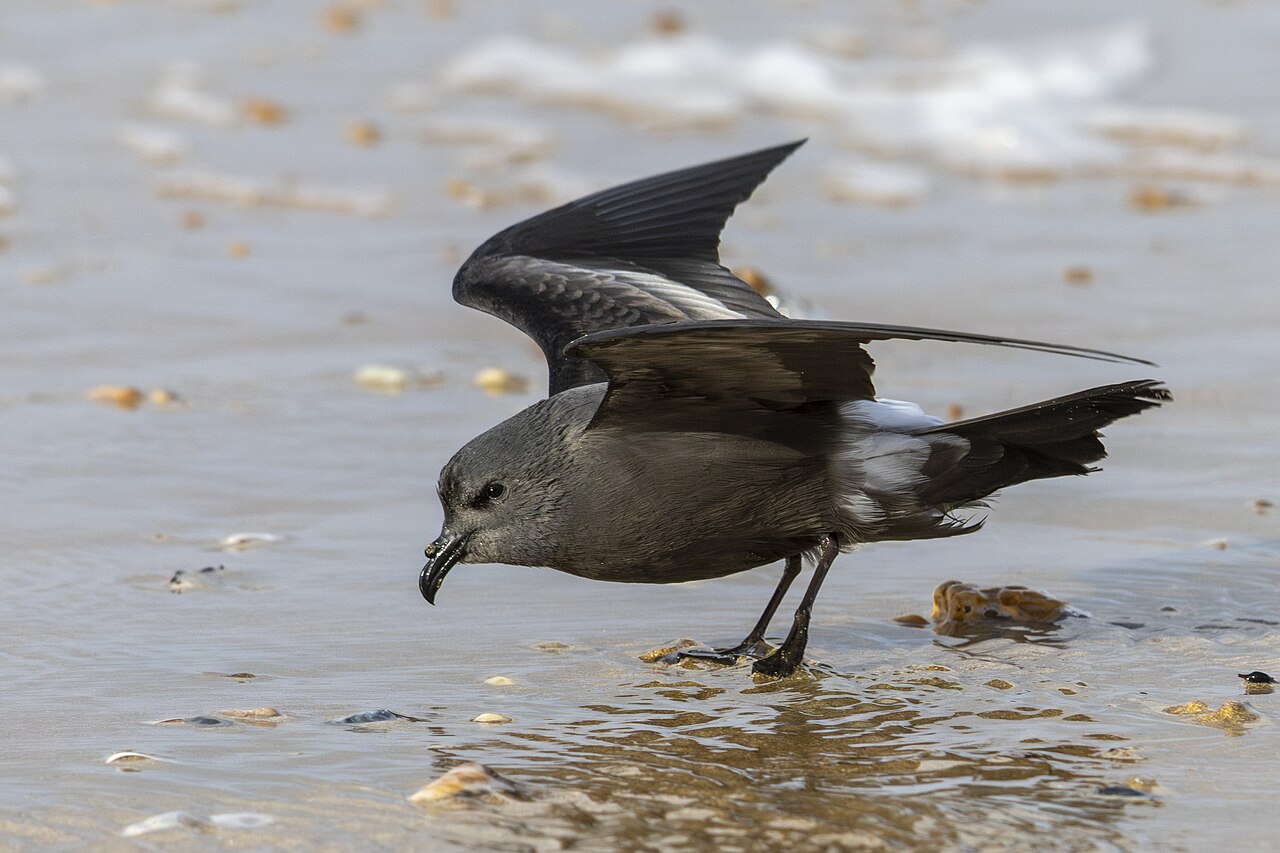
A small, sooty brown seabird with long, angular wings clearly bent at the wrist, and a forked tail that in flight is often held closed. A pale brown band runs across the upperwing from the wrist to the shoulder, which stands out against the dark rest in good light. The rump is white, usually with a narrow dark line down the middle; in the birds of southern California and Baja California the rump is dark instead. The flight is the best character: irregular, with deep beats and sudden sideways swerves, more like a nighthawk than a seabird. The sexes look alike, and young birds cannot be told from adults.
Confusion species
Wilson's Storm Petrel (Oceanites oceanicus) is smaller and more compact, with a square tail, a broad white rump that wraps onto the undertail coverts, and yellow-webbed feet projecting beyond the tail; it flies more evenly and stays closer to the water. Band-rumped Storm Petrel (Hydrobates castro) has a broad, sharply edged white rump band, a shallower fork and a steady, shearwater-like flight. Black Storm Petrel (H. melania) of the Pacific is clearly larger, wholly dark, and flies with slow, deep beats. With the dark-rumped birds off California only the wing shape and the manner of flight are left to go on.
Habitat
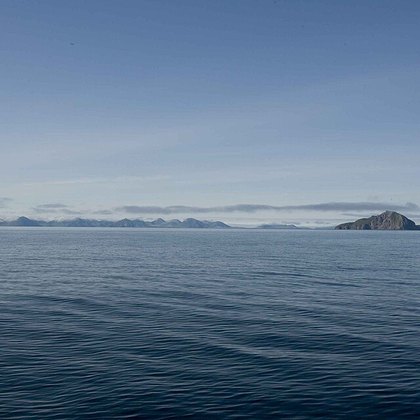
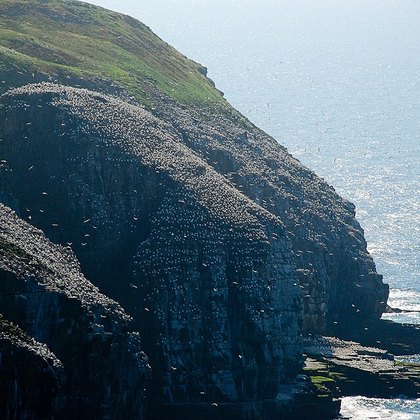
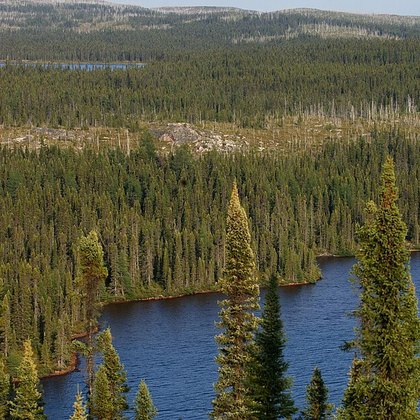
Away from the colony it lives over deep water far from the coast, where currents and fronts bring food to the surface; over the continental shelf and in shallow inshore water it is scarce. To breed it needs an island without rats and foxes, with a loose, well-drained soil in which a tunnel can be dug: under spruce, in turf on a cliff slope, or else a crevice between boulders. From such an island the birds fly four hundred kilometres and more out to sea to feed. It uses neither the mainland nor inland water; only after a severe storm does one occasionally end up inland.
Where the bird is most often found, arranged by the USNVC — the vegetation classification of the United States and Canada — and CMECS for sea and coast.

Range and movements
Breeds on both sides of the continent: in the Atlantic from Labrador and Newfoundland by way of Nova Scotia and the Bay of Fundy to Maine and Massachusetts, and in the Pacific from the Aleutians along British Columbia, Washington, Oregon and California to the islands off Baja California. It does not breed in Greenland, and at sea west of Greenland it is recorded too rarely to hang a map colour on. Outside the breeding season the birds move to tropical water: the Atlantic ones as far as West Africa and Brazil, the Pacific ones to about the equator. They are then outside every map unit, and so the map stops at the colonies and the coastal waters they pass on the way.
- Breeding (summer)
- Winter
- Passage
- dark = core range, pale = thinly spread
Where and when to look
Do not count on seeing it from the beach: this is a bird for a boat trip of half a day or more, out to the edge of the continental shelf. There, watch the flight and not the colour — a small dark bird bouncing over the waves in irregular arcs and changing direction all the time is almost certainly this one. On land only a night visit to a colony is left, or, after a severe autumn gale, an exhausted bird in a harbour.
Conservation
The species has stood as Vulnerable on the Red List since 2016: over three generations the population has fallen by more than thirty per cent, and exactly why is not clear. The large colonies of the North Atlantic have collapsed: on Baccalieu Island off Newfoundland, by far the largest colony in the world, more than three million breeding pairs were estimated in 1984 and fewer than two million in 2013 — over forty per cent down in twenty-nine years. Gulls eating out the colonies, mercury in the food, and the lights of oil platforms and coastal towns that draw young birds in until they drop exhausted are all named as causes. That a bird still numbering in the millions counts as Vulnerable is because the decline is happening across the whole breeding range at once.
Scientific name
Hydrobates leucorhous | (Vieillot, 1818)
Vieillot described the species in 1818 as Procellaria leucorhoa, among the petrels; because it was later moved to another genus, author and year stand in parentheses. The genus Hydrobates was introduced by Boie in 1822, from Greek hudro- 'water' and batēs 'walker' — the bird that walks on water. The specific name is formed from leukos 'white' and orrhos 'rump'; the ending changed from leucorhoa to leucorhous when the name was placed with the masculine Hydrobates, since specific and generic name have to agree in gender. As type locality Vieillot gave the maritime parts of Picardy in northern France. The English name honours the British zoologist William Elford Leach; the name formed after him later turned out to concern the same bird as Vieillot's and so lapsed.