All species › Passerines › Olive warbler › Olive Warbler
Olive Warbler | Peucedramus taeniatus
Oranjekopzanger | Ocotero enmascarado
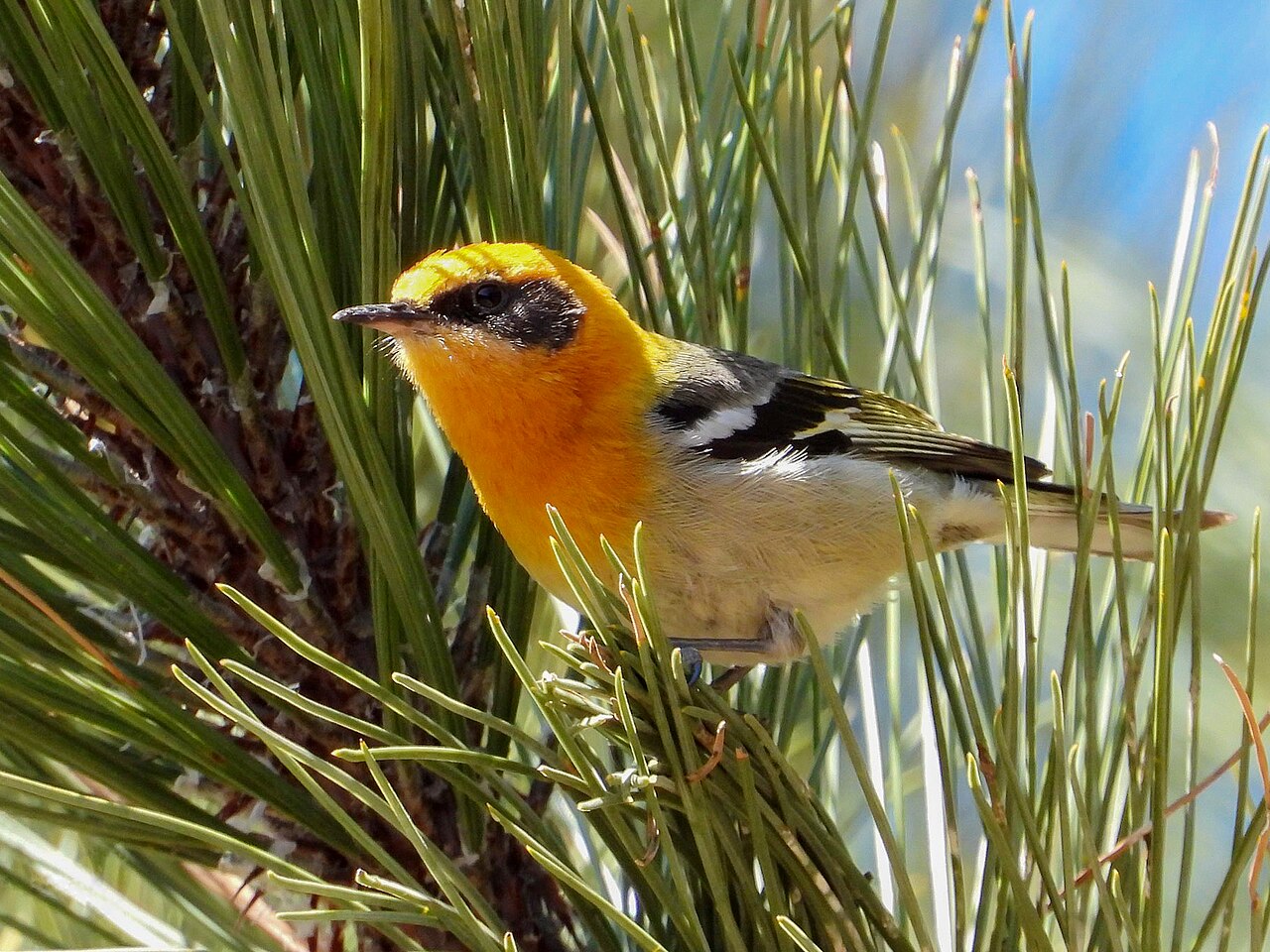
High in the mountains of southeastern Arizona and southwestern New Mexico, in open pine forest above eighteen hundred metres, lives a small grey bird with a warm orange-brown head and a black mask closing around the eye. It is the northernmost outpost of a range that reaches down to Nicaragua. To see it you have to look up: it stays in the crown of the tallest pines and gives itself away above all by its clear whistles.
Voice
The song is a series of five to eight clear, two-syllable whistles on one pitch, roughly peeta peeta peeta or tew-wee tew-wee, slow and even, with a ring that recalls a nuthatch. Song is heard all year but most from late February into May, usually from a high branch in full morning light. The call is a soft, slightly descending pheew that pairs exchange all day and that is the best sign the species is present in a wood. In mixed winter flocks that call is hard to pick out among the notes of chickadees and nuthatches.
Recording: Ryan Douglas — CC BY-SA 4.0 · Rustler Park, Chiricahua Mtns, Arizona, United States · xeno-canto
Identification
The male has an orange-brown head, throat and breast with a black mask running from the bill across the eye onto the ear-coverts; the rest of the body is grey, with a white belly, two broad white wing bars and white patches in the outer tail feathers. The female has the same pattern in dull to olive yellow, with a vague grey eye-stripe instead of a black mask and a yellow-green crown. Young birds resemble the female but are duller and greyer about the head. In every plumage the grey body with the sharp white wing bars stands out, and birds from the south of the range are more brightly coloured than those from Arizona. Flying from branch to branch it looks small and short-tailed.
Confusion species
In the same pines lives Setophaga graciae, an American warbler with a bright yellow throat, a yellow eyebrow and black streaks along the flanks; it is livelier and keeps lower down. Yellow-rumped Warbler, in the same forests in winter, has a yellow rump, yellow side patches and a streaked back. Female and young Olive Warblers are the hard ones: they differ from yellow-headed warblers in the plain grey back without any streaking and in the sharply defined white wing bars. Sound always helps: no warbler of these woods whistles as slowly and as clearly.
Habitat
Open conifer forest high in the mountains: ponderosa, Chihuahua and Apache pine and, higher up, fir, usually above eighteen hundred metres and nearly to the treeline. In Mexico it is pine-oak forest, from semi-arid to humid, and in Central America mountain forest between one and three thousand metres. Hunting is done in the outermost needle clusters of the tallest trees; young plantations, low scrub and closed broadleaf forest are unsuitable. In winter it is often in mixed parties with chickadees and nuthatches, but still in the crown.
Where the bird is most often found, arranged by the USNVC — the vegetation classification of the United States and Canada — and CMECS for sea and coast.


Range and movements
The range runs from central Arizona and southwestern New Mexico south through the mountain chains of Mexico — Sonora, Chihuahua, the Sierra Madre Occidental and Oriental, and the mountains of Oaxaca and Chiapas — to southwestern Guatemala, northern El Salvador, central Honduras and northern Nicaragua. It is a bird of mountains, and its range is accordingly a scatter of islands of high forest rather than one continuous area. In the northern part some birds leave the highest forest in winter, but none goes far: outside the mountains it is hardly ever seen. In the United States it breeds only in the mountains of Arizona and New Mexico, with a handful of records elsewhere.
- Resident
- Breeding (summer)
- Winter
- Passage
- dark = core range, pale = thinly spread
Where and when to look
Go in May at sunrise to a pass or a ridge above eighteen hundred metres with old ponderosa pines — the mountains of southeastern Arizona are the classic place — and search with your ears first. Follow the slow whistling until you are standing under the tree, then work through the outer needle clusters of the crown; what shows first in the binoculars is usually the white wing bar against grey. Come early: after about ten in the morning there is far less song and the bird is nearly impossible to find.
Conservation
The world population is estimated at two million birds and the species counts as not threatened. The forest it lives in is vulnerable, though: large, hot wildfires and the felling of old conifers make whole mountain tops unusable for years, and its range consists of exactly such separate tops. In the United States it is a small population at the edge of the range, which makes every loss weigh more heavily.
Scientific name
Peucedramus taeniatus | (Du Bus de Gisignies, 1847)
Du Bus de Gisignies described the species in 1847 as Sylvia taeniata, among the Old World warblers; because it was later moved to another genus, author and year stand in parentheses. The genus Peucedramus was introduced by Coues in 1875 and is made from Greek peukē 'pine' and dramein 'to run': the bird that runs through the pines. The species name taeniatus means 'banded', after the black mask and the white wing bars. The description gives the type locality only as Mexico; Brodkorb restricted it in 1944 to San Cristóbal in Chiapas, but Zimmer showed in 1948 that the specimen probably came from San Pedro in Oaxaca.