All species › Waders, gulls and terns › Skimmers, noddies, terns and gulls › Ring-billed Gull
Ring-billed Gull | Larus delawarensis
Ringsnavelmeeuw | Gaviota de Delaware
Ring-billed Gull is the gull that has moved furthest inland from the sea: a medium-sized gull with yellow legs and a black band around the bill tip, as familiar today in parking lots and farm fields as on the beach. It breeds in colonies of thousands of pairs on islands in inland lakes and rivers, far from salt water. Few gulls have adapted to humans as successfully.
Voice
The call is a series of sharp, high kyeow or ka-ka-ka notes, higher and thinner than those of American Herring Gull, often given in chorus over a breeding colony or a food source. Begging chicks give a persistent, squeaky peeping. Alarm in the colony brings a short, barking call that can send hundreds of birds into the air at once.
Recording: Tom Cooney — CC BY-NC-SA 4.0 · Baie-du-Febvre, Nicolet-Yamaska, Québec, Canada · xeno-canto
Identification
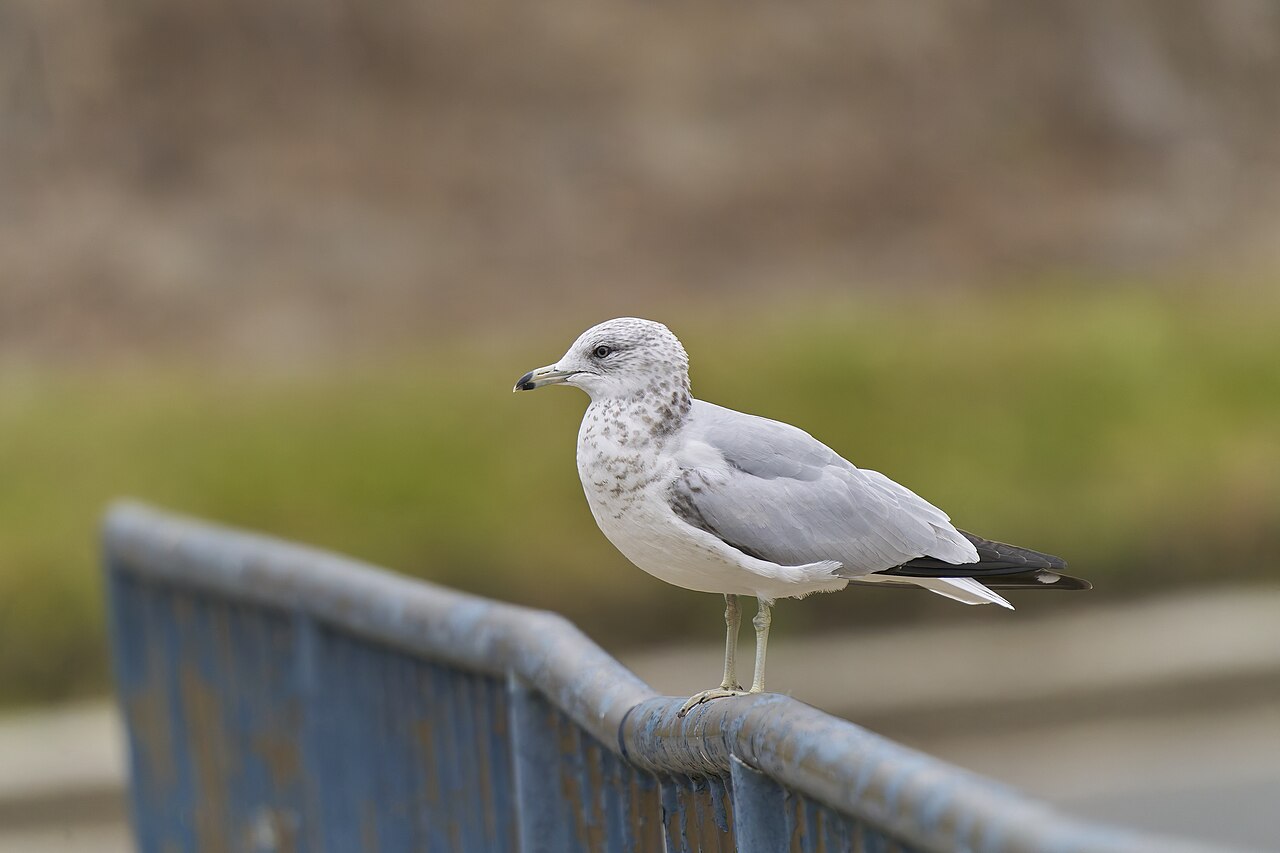
The adult has a white head and underparts, a pale grey mantle, black wingtips flecked with white, yellow legs and a yellow bill with a clear black band just before the tip. In winter the head takes on a light, streaky wash. First-year birds are mottled brown with pink legs and a pink bill tipped black; full adult plumage is not reached until about three years of age. The pale eye and comparatively slim build set it apart from heavier gulls in every plumage.
Confusion species
American Herring Gull is larger and heavier, with pink rather than yellow legs and a red rather than black spot on the bill. California Gull is likewise larger, with a dark eye and greenish legs. Lesser Black-backed Gull has a much darker, slate-grey mantle and a bill with a red rather than black spot.
Compare gulls: legs, head, bill and wing tip side by side
Habitat
It breeds on bare or sparsely vegetated islands in large lakes, rivers and reservoirs, and forages as readily on open water as in parking lots, farm fields, landfills and along highway verges. It avoids dense forest and small, isolated ponds without a human food source. Its ability to exploit human-altered landscape exceeds that of nearly any other gull.
Where the bird is most often found, arranged by the USNVC — the vegetation classification of the United States and Canada — and CMECS for sea and coast.


Range and movements
It breeds inland across Canada and the northern United States, from British Columbia to Newfoundland and around the Great Lakes, and winters along the coast and inland across the southern United States, Mexico and the Caribbean. Nearly wiped out by the feather trade in the nineteenth century, the species grew through the twentieth century, thanks to protection and its ability to exploit human refuse, into one of the most abundant gulls on the continent.
- Resident
- Breeding (summer)
- Winter
- Passage
- dark = core range, pale = thinly spread
Where and when to look
Don't look only near water: shopping-centre parking lots, freshly ploughed fields and landfills often hold the largest numbers, far inland. On any gull, check the bill first for the black band and the legs for yellow — those two features together are enough for a confident identification of the adult.
Conservation
Having nearly been wiped out by the feather trade around 1900, the species has increased strongly, now numbers in the millions and is listed as Least Concern (LC). On some breeding islands it now competes so strongly with other colonial waterbirds for nest space that local management is needed to limit its numbers.
Scientific name
Larus delawarensis | Ord, 1815
Ord described the species in 1815 directly as Larus delawarensis, in the genus Larus that Linnaeus had already introduced for the gulls in 1758 — author and year therefore appear without parentheses, since the species has never changed genus. The species name delawarensis refers to the type locality: the Delaware River, just below Philadelphia. Larus itself is Ancient Greek for a gull-like seabird, already used by Aristotle.