All species › Passerines › Wrens › Rock Wren
Rock Wren | Salpinctes obsoletus
Amerikaanse rotswinterkoning | Chivirín saltarroca
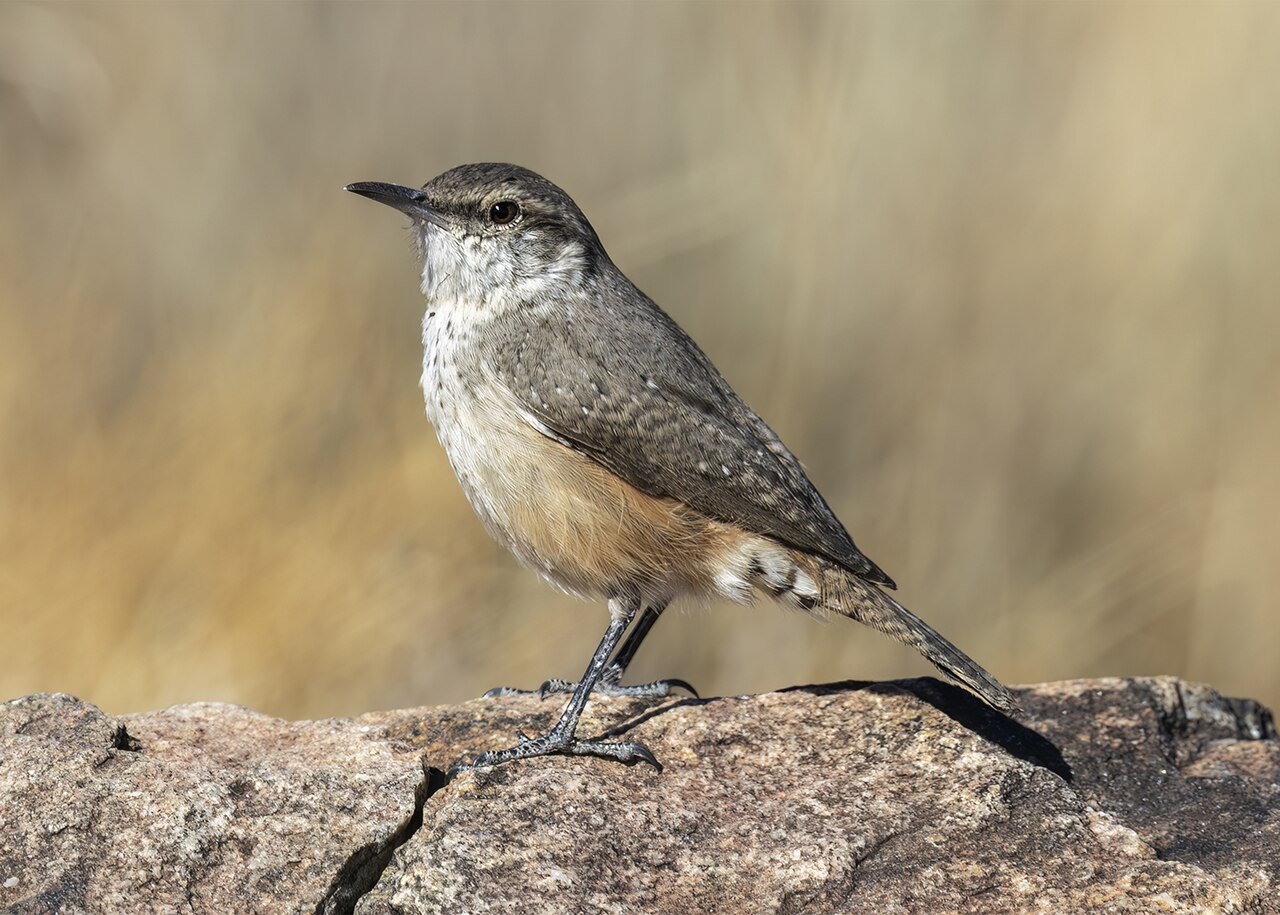
The Rock Wren is the palest wren of the West: a grey-brown bird of bare rock slopes, quarries and scree, rarely found far from exposed stone. It breeds from southern Canada to Central America, and often lays a pavement of small flat pebbles in front of the nest entrance.
Voice
The song is a series of short, dry trills of one to two and a half seconds, with three to five seconds of silence between them; each trill is one syllable repeated four to eight times. The male has a large repertoire — 69 to 119 different syllables have been counted — and delivers them in shifting order from a boulder. Part of the repertoire is taken over from neighbours, so adjacent territories share the same motifs. The alarm call is a hard, metallic tick-keer.
Recording: Manuel Grosselet — CC BY-NC-SA 4.0 · Teotitlán del Valle, Teotitlán del Valle, Oaxaca, Mexico · xeno-canto
Identification
Upperparts grey-brown with fine black and white speckling that blurs at distance; underparts dingy grey with a buff wash on the flanks and a light brown rump. The throat is white and finely speckled rather than plain. The tail is long for a wren, barred crosswise, and carries a broad buff terminal band with black subterminal spots, obvious as the bird flies off. The bill is long, thin and slightly decurved. A distinctive habit is the deep bob: the bird sinks on its legs and rises again, dozens of times in succession, from a stone.
Confusion species
Canyon Wren is more rufous, has an unmarked white throat and breast contrasting sharply with a chestnut belly, and a shorter, square tail without a buff terminal band; its song is a descending series of whistles rather than a trill. Cactus Wren is much larger, coarsely spotted and has a broad white eyebrow. Bewick's Wren has a white eyebrow and white tail corners and sits in scrub, not on bare rock. At distance Rock Wren stands out mainly by the speckled throat and the bobbing.
Habitat
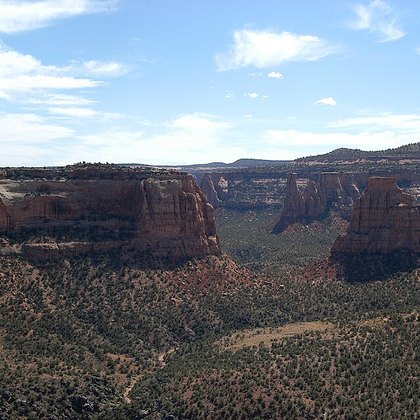
Open, rocky ground without closed vegetation: canyon walls, cliffs, boulder fields, lava flows, erosion gullies and stony slopes, from sea level to about 3600 metres, with the bulk below 2000 metres. Man-made rock is occupied too — road cuts, railway embankments, gravel pits, mine spoil and refuse heaps. It avoids dense vegetation and built-up areas. The nest sits in a crevice or cavity, often fronted by a constructed pathway of hundreds of flat pebbles, small bones and human objects; its function is unknown.
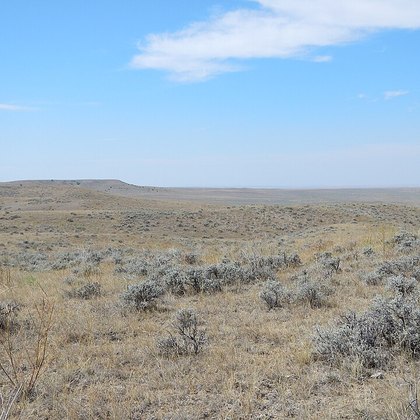
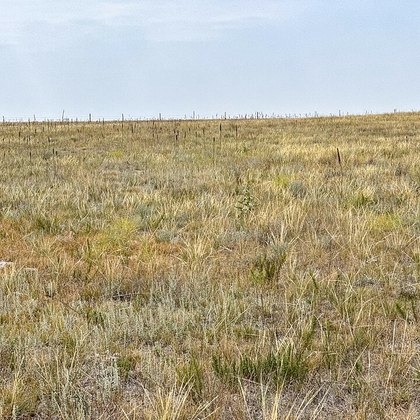
Where the bird is most often found, arranged by the USNVC — the vegetation classification of the United States and Canada — and CMECS for sea and coast.



Range and movements
The breeding range runs from southern British Columbia, southeastern Alberta and southwestern Saskatchewan south through the whole American West into Mexico. Northern and high-altitude populations leave in winter; from California and Nevada southwards, through the Mexican highlands and the Baja peninsulas to Guatemala, El Salvador, Honduras and Nicaragua it is resident. In winter it appears in the lowlands of Oklahoma and West Texas where it does not breed. East of the hundredth meridian it is a rare vagrant.
- Resident
- Breeding (summer)
- Winter
- Passage
- dark = core range, pale = thinly spread
Where and when to look
Look for it early in the morning on a projecting boulder along a road cut or at the edge of a quarry: the bobbing gives it away before you can see the speckling. Follow the dry trill — it carries further across open slope than the bird is visible — and watch for the buff terminal tail band as it flies off.
Conservation
Partners in Flight puts the global breeding population at 4.1 million birds and the species scores 11 out of 20 on the Continental Concern Score. The Breeding Bird Survey shows a decline of about 0.65 per cent per year between 1968 and 2015, and a drop of roughly 13 per cent between 2010 and 2020; the cause has not been established. Known pressures are brood parasitism by Brown-headed Cowbird in parts of the range, and birds becoming trapped in the open pipes of mining-claim markers, of which hundreds of thousands stand across the West.
Scientific name
Salpinctes obsoletus | (Say, 1822)
Thomas Say described the species in 1822 as Troglodytes obsoleta, from a specimen taken at the junction of Plum Creek and the South Platte River in Douglas County, Colorado; because it later moved to another genus, author and year stand in parentheses. Jean Cabanis introduced the genus Salpinctes in 1847, from Greek salpinktes 'trumpeter', after the carrying song. The species name obsoletus is Latin for 'worn out, indistinct' and refers to the drab grey plumage.