All species › Passerines › Swallows › Tree Swallow
Tree Swallow | Tachycineta bicolor
Boomzwaluw | Golondrina bicolor
The Tree Swallow nests in cavities: old woodpecker holes in dead trees along water, and in large numbers in nest boxes. It returns earlier than the other swallows, because it can switch to berries in cold weather, and in autumn it moves along the coast in flocks of tens of thousands.
Voice
The voice consists of clear, liquid chirp notes, often in short series. The song the male gives at the cavity before sunrise is built from three parts: a chirp, a thin whining section and a gurgling close, recombined over and over. Disturbance at the nest brings a fast, hard rattle; a separate alarm call silences the nestlings and makes them crouch in the cavity.
Recording: AUDEVARD Aurélien — CC BY-NC-SA 4.0 · Nome, Nome Census Area, Alaska, United States · xeno-canto
Identification
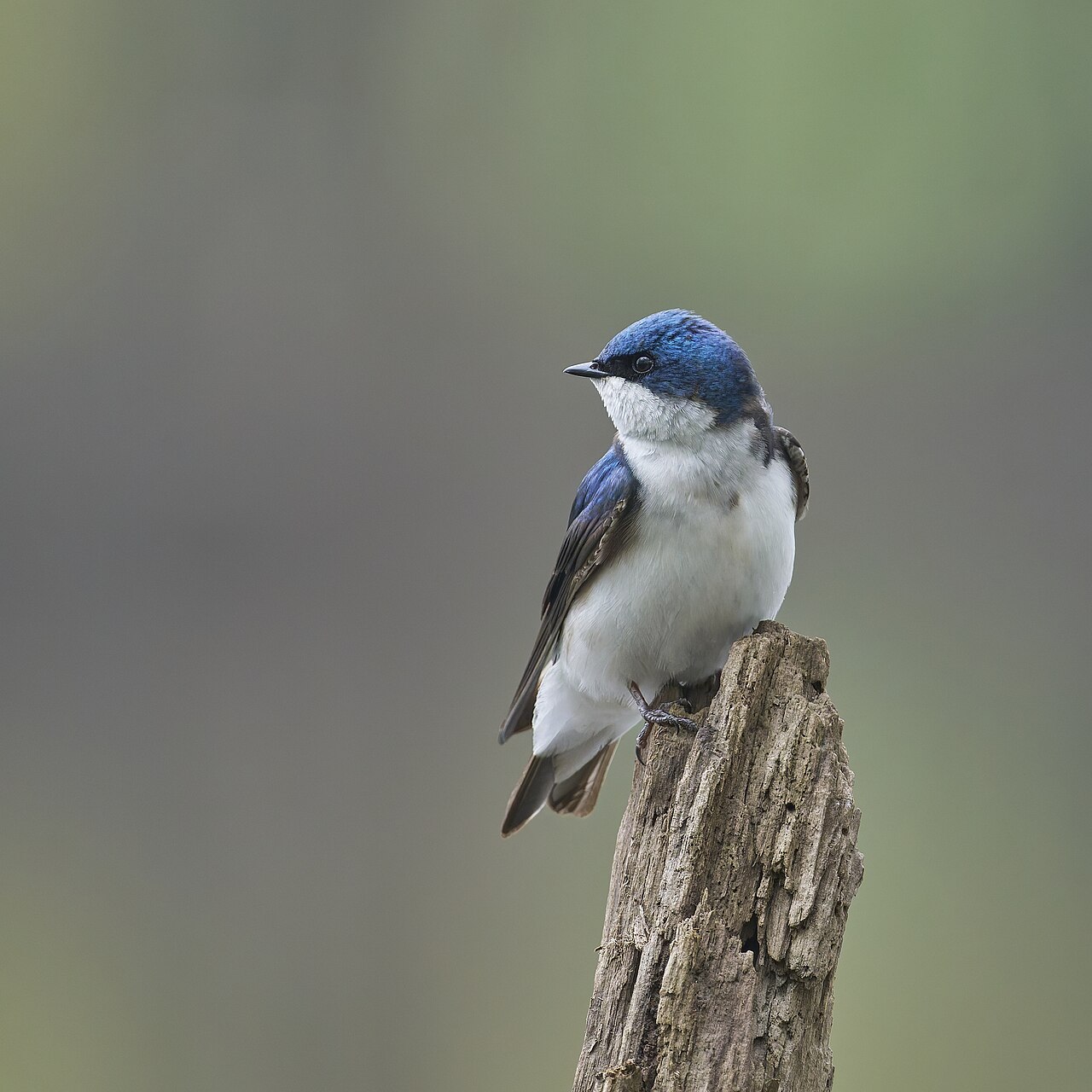
The male is glossy blue-green above, with blackish wings and tail, and clean white below; the white of the cheek reaches to just below the eye but not above it. Females are duller, often with a brown forecrown, and first-year females are largely brown above with scattered blue feathers. Juveniles are plain grey-brown above and white below with a diffuse grey wash across the breast. The tail is shallowly forked. In flight the species glides more than other swallows, in long arcs on raised wings.
Confusion species
Violet-green Swallow is the main confusion species: it has white patches on the sides of the rump that nearly meet above the tail base, white running up above the eye, and a shorter tail with a shallower notch. Tree Swallow lacks both white features. Juvenile Tree Swallows are brown above and can then be confused at a distance with Bank and Northern Rough-winged Swallows; the young Tree Swallow's grey breast wash is diffuse, against the crisp band of Bank Swallow and the brown throat of Rough-winged.
Habitat
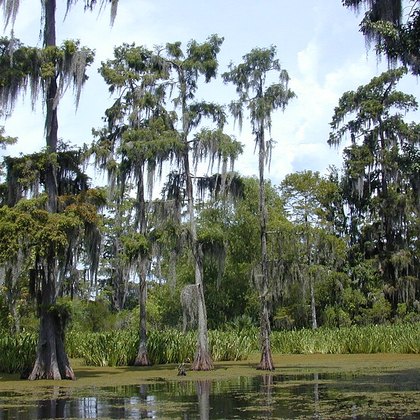
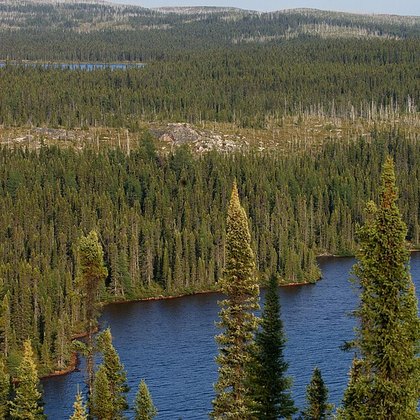
Open country with standing water and dead trees: beaver ponds, wooded swamp, lake and river margins, wet meadow and freshwater marsh. Where nest box trails have been put up along fields and ponds the species occupies them at high density, even far from woodland. Outside the breeding season it roosts in reed beds over water, in gatherings that can run into the hundreds of thousands.
Where the bird is most often found, arranged by the USNVC — the vegetation classification of the United States and Canada — and CMECS for sea and coast.




Range and movements
The breeding range runs from northern Alaska and the Canadian tree line south to Tennessee in the east, Kansas in the centre and California and New Mexico in the west. It winters along the southern coasts of the United States from California and Arizona to Virginia, on along the Gulf Coast, throughout Mexico, in the West Indies and in Central America. Return is early: February and March in the southern part of the breeding range.
- Resident
- Breeding (summer)
- Winter
- Passage
- dark = core range, pale = thinly spread
Where and when to look
In March look over a lake that is still cold: across nearly all of the east the first swallow of the year is a Tree Swallow. On a perched bird watch the edge of the white on the head — if it stops below the eye, this is the species. In September the reed roosts of the Atlantic coast hold the largest concentrations.
Conservation
Partners in Flight puts the global population at about 20 million birds. The Breeding Bird Survey nevertheless shows a decline of roughly 0.7 per cent a year, some 30 per cent between 1966 and 2019, steepest in the northeast. The pressures are the loss of dead cavity trees through clearing of woods and shorelines, competition for cavities with introduced European Starlings and House Sparrows, and spring cold spells that shut down the insect supply. Nest box schemes make up part of the cavity shortfall, and have made this one of the most intensively studied birds in the world.
Scientific name
Tachycineta bicolor | (Vieillot, 1808)
Vieillot described the species in 1808 as Hirundo bicolor; because it was later moved to another genus, author and year stand in parentheses. The genus Tachycineta was introduced by Cabanis in 1850, from Greek takhukinetos 'moving quickly'. The species name bicolor is Latin for 'two-coloured', after the contrast between the dark upperparts and the white underparts. The type locality is given as the centre of the United States, later fixed on New York.