All species › Passerines › Swallows › Violet-green Swallow
Violet-green Swallow | Tachycineta thalassina
Groene Zwaluw | Golondrina verdemar
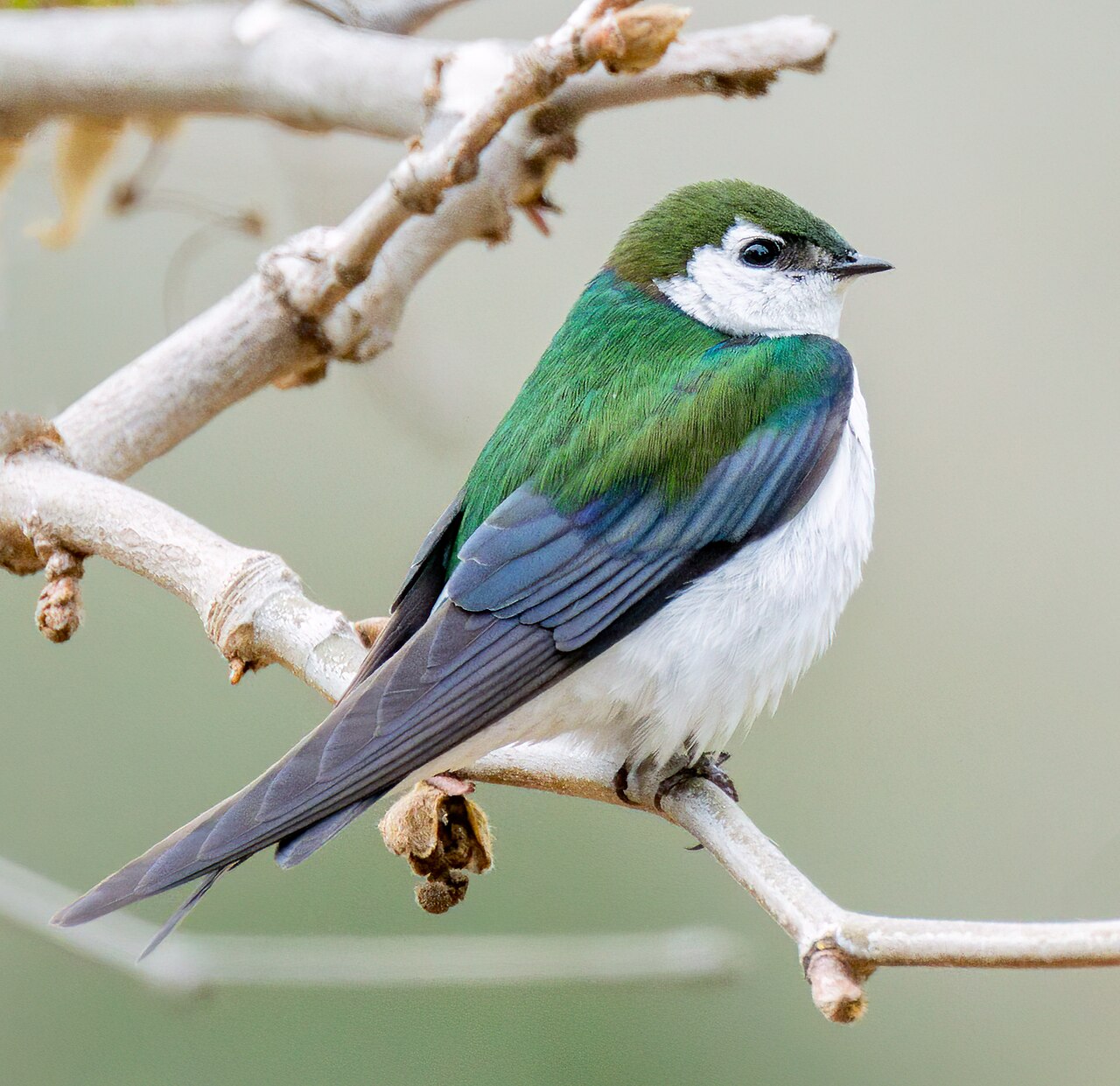
The Violet-green Swallow is the western counterpart of the Tree Swallow: a cavity nester of mountain forest, canyons and cliffs, told by the white patches on the sides of the rump and by white running up above the eye. It breeds from Alaska to the Mexican highlands, also in nest boxes and in holes in buildings.
Voice
Two kinds of sound can be separated. The contact call is a high, two-syllable chee-cheet, given while foraging and in flying flocks. Alongside it is a faster twitter used mainly in courtship and in claiming a cavity; males give it in the dark before sunrise, sometimes an hour before first light. The species has no fixed, rounded song phrase.
Recording: Richard E. Webster — CC BY-NC-SA 4.0 · Lower Penstemon CG, South Hills, Idaho, United States · xeno-canto
Identification
Upperparts are glossy green on crown and mantle, with a violet-bronze sheen on nape, rump and uppertail coverts; underparts are clean white. The marks to look for are the two white patches on either side of the rump, which in flight nearly form a single white band seen from above, and the white of the face closing over the top of the eye. The tail is short with a shallow notch; at rest the wingtips project clearly beyond the tail. Females show more bronze than green on the head and less extensive white on the face; juveniles are grey-brown above but already show the white cheek patch.
Confusion species
Tree Swallow is the one real confusion species: blue-green rather than green with violet-bronze, without white rump patches, and with the white of the cheek stopping below the eye. Tree Swallow has a deeper tail notch and shorter wingtip projection at rest. Juvenile Violet-greens are brown above and are then separable from juvenile Tree Swallows only by the white rump patches and the face pattern. Bank Swallow has a crisp breast band, Northern Rough-winged a brown throat.
Habitat
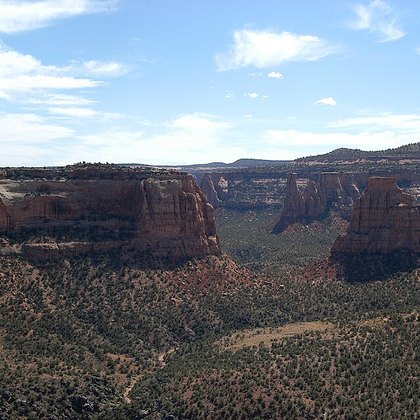
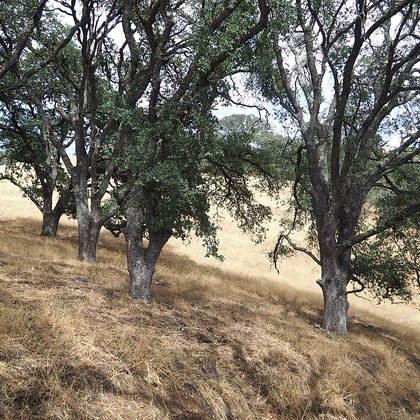
Mountain forest of conifer, oak and aspen, canyons with steep rock walls, and pinyon (low-growing pine of the dry south-western foothills)-juniper belts, from sea level to above 3000 metres. As a secondary cavity nester it uses old woodpecker holes, natural tree hollows and rock crevices; at large cliffs dozens of pairs nest close together, while forest pairs nest apart. In northwestern Mexico holes in columnar cactus are used as well. In towns of the west the species nests in wall crevices and under eaves.
Where the bird is most often found, arranged by the USNVC — the vegetation classification of the United States and Canada — and CMECS for sea and coast.




Range and movements
It breeds from central Alaska and Yukon south through British Columbia and the western United States into Mexico, east to southwestern Alberta, Montana, the Black Hills and West Texas. In the Mexican highlands part of the population is present year-round. The winter range lies almost entirely in Mexico, with small numbers reaching Guatemala and Honduras; north of Mexico only a few birds winter on the California coast. Return is early, reaching the southwest in February.
- Resident
- Breeding (summer)
- Winter
- Passage
- dark = core range, pale = thinly spread
Where and when to look
In the mountains of the west in April and May watch swallows over a cliff top or along a canyon wall and look at the upperside: the two white rump patches show best from above, from a viewpoint. On birds perched on a wire, the wingtips projecting past the tail are a quick mark.
Conservation
The species is listed as Least Concern (LC) and the range is large. The Breeding Bird Survey shows a gradual long-term decline, probably tied to the removal of dead cavity trees from managed forest and to the fall in flying insect numbers. In parts of the west European Starlings and House Sparrows take over suitable cavities. Where nest boxes have been put up in mountain villages and campgrounds they are taken up quickly.
Scientific name
Tachycineta thalassina | (Swainson, 1827)
Swainson described the species in 1827 as Hirundo thalassinus; because it was later moved to another genus, author and year stand in parentheses. The genus Tachycineta was introduced by Cabanis in 1850, from Greek takhukinetos 'moving quickly'. The species name thalassina means 'sea-green', from Greek thalassa 'sea', after the colour of the upperparts. The specimen described came from Real del Monte in the Mexican state of Hidalgo.