All species › Passerines › Swallows › Purple Martin
Purple Martin | Progne subis
Purperzwaluw | Golondrina purpúrea
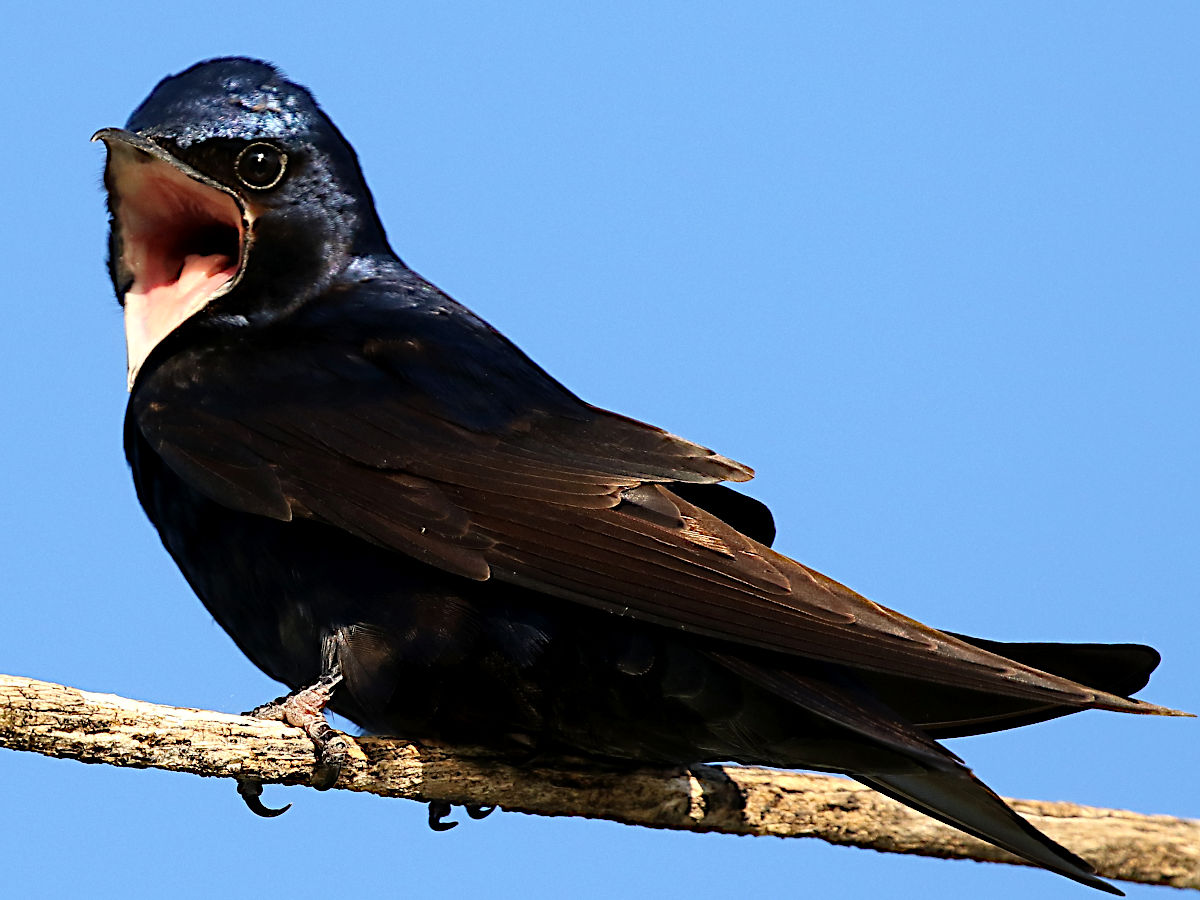
The Purple Martin is the largest swallow on the continent, and in the east virtually the whole population lives in gourds and multi-storey nest boxes put up by people. The adult male is North America's only entirely dark swallow: steel blue with a purple gloss, on the belly and undertail as well.
Voice
The voice is deeper and fuller than that of any other swallow here: a series of rolling, bubbling cher-cher notes and a clear, falling choo the birds call to one another in flight. Well before sunrise an old male climbs hundreds of metres and delivers a separate, croaking phrase that draws young birds to the colony; anyone hoping to start a new colony plays exactly that phrase. Nestlings beg with a shrill, insistent piping that carries out through the mouth of the gourd. The sound of autumn is the roost: thousands of birds at once, a rushing chatter until dark.
Recording: David A. Brinkman — CC BY-NC-SA 4.0 · Harrison Township (near Harrison), Hamilton County, Ohio, United States · xeno-canto
Identification
Large and broad-winged for a swallow, with a short, slightly forked tail and a deep chest; in flight it alternates long glides with short, quick bursts of flapping, more like a small falcon than a Barn Swallow. The adult male is entirely dark: steel blue with a purple sheen on head, back and underparts. Females and first-year birds are duller blue-grey above and dirty grey below, with a grey collar and a lightly mottled belly. Young males reach full dark plumage only in their second year, so a colony always holds patchy intermediates.
Confusion species
Grey-breasted Martin (Progne chalybea) of tropical Mexico is smaller and always has a white belly, males included. Cuban Martin (P. cryptoleuca) and Caribbean Martin (P. dominicensis) are the island counterparts; in both the male is dark with a sharply cut-off white belly, often not visible on a bird passing overhead. Females and young of all these species look much alike and often cannot be named with certainty away from their own range. In practice a dark, sharp-winged swallow over an eastern town is always this species.
Habitat
Open country with plenty of sky above it and water nearby: village edges, pasture, golf courses, lake and river shores, and above all yards and squares where somebody has raised a pole of gourds. Over water and grassland it hunts higher than most swallows, often tens of metres up. Closed forest and dense building without open space go unused. In the west and in northwestern Mexico it still uses old woodpecker holes in dead trees and cavities in giant cacti — the same habitat the species had everywhere before the nest boxes came.
Where the bird is most often found, arranged by the USNVC — the vegetation classification of the United States and Canada — and CMECS for sea and coast.




Range and movements
A summer bird of eastern North America, from Texas and Florida to the Canadian prairie provinces and the Maritimes, with separate and far smaller populations along the west coast, in the Rocky Mountains, in Arizona and in northwestern Mexico. It winters in South America — Brazil, Bolivia and Peru — well beyond this map, which therefore shows only the breeding range and the passage. Migration runs overland, straight through Mexico and Central America, and in autumn the big roosts show up on weather radar as expanding rings. The first birds are on the Gulf Coast in January, while the north is not occupied until May.
- Resident
- Breeding (summer)
- Passage
- dark = core range, pale = thinly spread
Where and when to look
In May and June look for a pole of white gourds or an aluminium nest-box tower at a farm, a lakeside car park or a village square; whatever is flying around it is almost always Purple Martin. From late July watch the roosts: an hour before sunset the birds come in from every direction in ribbons over a reed bed, a bridge or a parking lot. Otherwise a dark swallow high above the meadow points to this species all season.
Conservation
Least Concern (LC) globally, but in the east wholly dependent on people: virtually every pair there nests in a gourd or box that somebody hung, and without that upkeep the species disappears from whole districts. European Starlings and House Sparrows took over the natural cavities during the twentieth century, and the colonies that remained are the colonies somebody looked after. The people who do that work are ageing, and that now counts as the greatest worry for the species. On top of it come cold, wet spells in spring, in which a colony of aerial hunters can starve within a few days.
Scientific name
Progne subis | (Linnaeus, 1758)
Linnaeus described the species in 1758 as Hirundo subis, among the swallows of the Old World; because it was later moved to another genus, author and year stand in parentheses. The genus Progne was introduced by Boie in 1826, after Procne, who in Greek myth was turned into a swallow. subis is a Latin bird name in Pliny, of a bird said to break eagles' eggs. The specimen described came from Hudson Bay.