All species › Passerines › Tyrant flycatchers and allies › Vermilion Flycatcher
Vermilion Flycatcher | Pyrocephalus obscurus
Rode tiran | Mosquero Cardenal
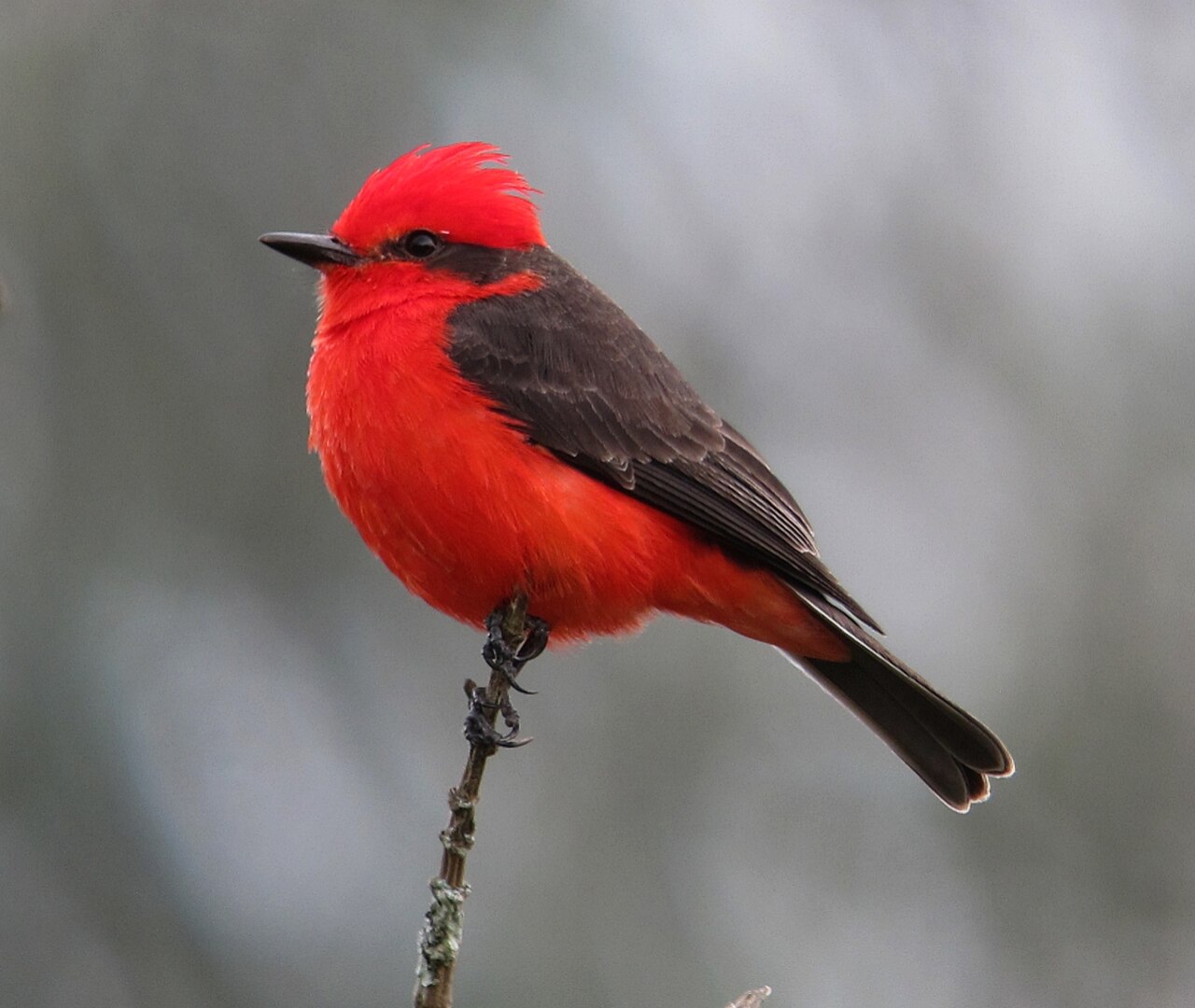
The Vermilion Flycatcher is the only North American tyrant flycatcher with a brilliant red male: red crown and wholly red underparts against a brown-black mask, back and tail. It belongs to water in dry country — streamside woodland, irrigation ditches, stock tanks — from south-western Texas to California and throughout Mexico.
Voice
The male's song is a short, rapid series of sharp notes ending in a trilled flourish, roughly pit pit pit pi-dddrrreeedrr. He sings both from a perch and in a display flight: the male climbs twenty to thirty metres on fast, fluttering wingbeats, hangs there with the red crown feathers raised and singing, then drops back to his perch. The call is a sharp, thin peek. Females usually do not sing.
Recording: Richard E. Webster — CC BY-NC-SA 4.0 · San Bernardino National Wildlife Refuge, Cochise County, Arizona, United States · xeno-canto
Identification
The male has a scarlet to vermilion crown, throat, breast and belly; mask, back, wings and tail are dark brown-black. The crown feathers can be raised into a crest. The female is grey-brown above, with a white breast finely streaked grey and a salmon-pink to yellowish wash on the belly and undertail coverts, plus a pale supercilium. Young males are irregularly blotched red and grey. Both sexes pump the tail and hunt with short, low sally flights from a low perch, often looping back to the same twig.
Confusion species
An adult male is distinctive. For the female, Say's Phoebe is the main confusion: it is larger, plain grey-brown on the breast without streaking, and has an unmarked cinnamon belly rather than a streaked white breast with a pink wash. A female Vermilion is also smaller than any Sayornis and has a finer bill. Young males with scattered red feathers can look like a stained female; check the streaking, which males lose.
Habitat
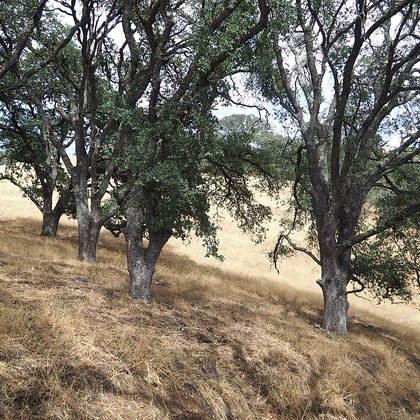
Open, dry country with water and scattered trees: stream and river valleys with willow, sycamore, cottonwood and mesquite (a thorny leguminous shrub of the Southwest that forms dense thickets), plus desert washes, stock tanks, golf courses, mown parks and irrigated land. It needs low perches and open ground to spot flying insects. In Mexico it reaches about 3000 metres. It does not use dense woodland.
Where the bird is most often found, arranged by the USNVC — the vegetation classification of the United States and Canada — and CMECS for sea and coast.






Range and movements
The range runs from the south-western United States — southern California, Arizona, New Mexico, western and southern Texas, with a breeding edge in southern Nevada and southern Utah — through nearly all of Mexico into Central America, and on into parts of South America. Over most of that area it is resident; the northernmost breeders move south in winter, and birds also shift to the Gulf Coast of Texas and Louisiana in winter. Outside the range it appears as a vagrant far to the north and east.
- Resident
- Breeding (summer)
- Winter
- Passage
- dark = core range, pale = thinly spread
Where and when to look
Work a desert stream or stock tank and look low: the bird usually perches under three metres up on a dead branch, a fence or a shrub top, and the red carries for hundreds of metres. The display flight is best watched in March and April, in the first hours after sunrise.
Conservation
Partners in Flight puts the world population at about 15 million birds; the species is listed as Least Concern (LC) and the United States share has been fairly stable since 1969. The pressure point is desert riparian woodland: groundwater pumping, falling water tables and the conversion of streamside woodland to other crops or housing shrink the habitat. Local declines have been recorded in California and Texas where riparian woodland disappeared.
Scientific name
Pyrocephalus obscurus
Gould described the species in 1839 as Pyrocephalus obscurus, from material of the Beagle voyage; the author's name stands without parentheses because the species remains in its original genus. Pyrocephalus comes from Greek pyr 'fire' and kephale 'head', so 'fire-head', after the male's red crown; obscurus is Latin for 'dark' or 'dusky'. Until 2016 the species was lumped with Pyrocephalus rubinus; genetic work split that group, the name rubinus staying with the southern form while the birds of North America, Central America and north-western South America became obscurus.