All species › Tubenoses › Northern storm petrels › Wedge-rumped Storm-Petrel
Wedge-rumped Storm-Petrel | Hydrobates tethys
Galápagosstormvogeltje | Paíño de Galápagos
The Wedge-rumped Storm-Petrel breeds in large colonies on the Galápagos Islands and on a few islands off Peru, making it chiefly a bird of the southern Pacific. In North America it is a great rarity: fewer than ten records, each during years of anomalously warm water off the California coast.
Voice
At sea, where it spends most of its life, it is silent. At the colony it is, by contrast, noisy, with soft growling notes, harsh guttural sounds, whistles and peeping calls all mixed together. Uniquely among storm-petrels, it visits its Galápagos colonies by day rather than by night, likely because its main predator there, the Galápagos race of Short-eared Owl, hunts at night.
Recording: Fabrice Schmitt — CC BY-NC-SA 4.0 · Tocopilla (near El Loa), Tocopilla, Antofagasta, Chile · xeno-canto
Identification
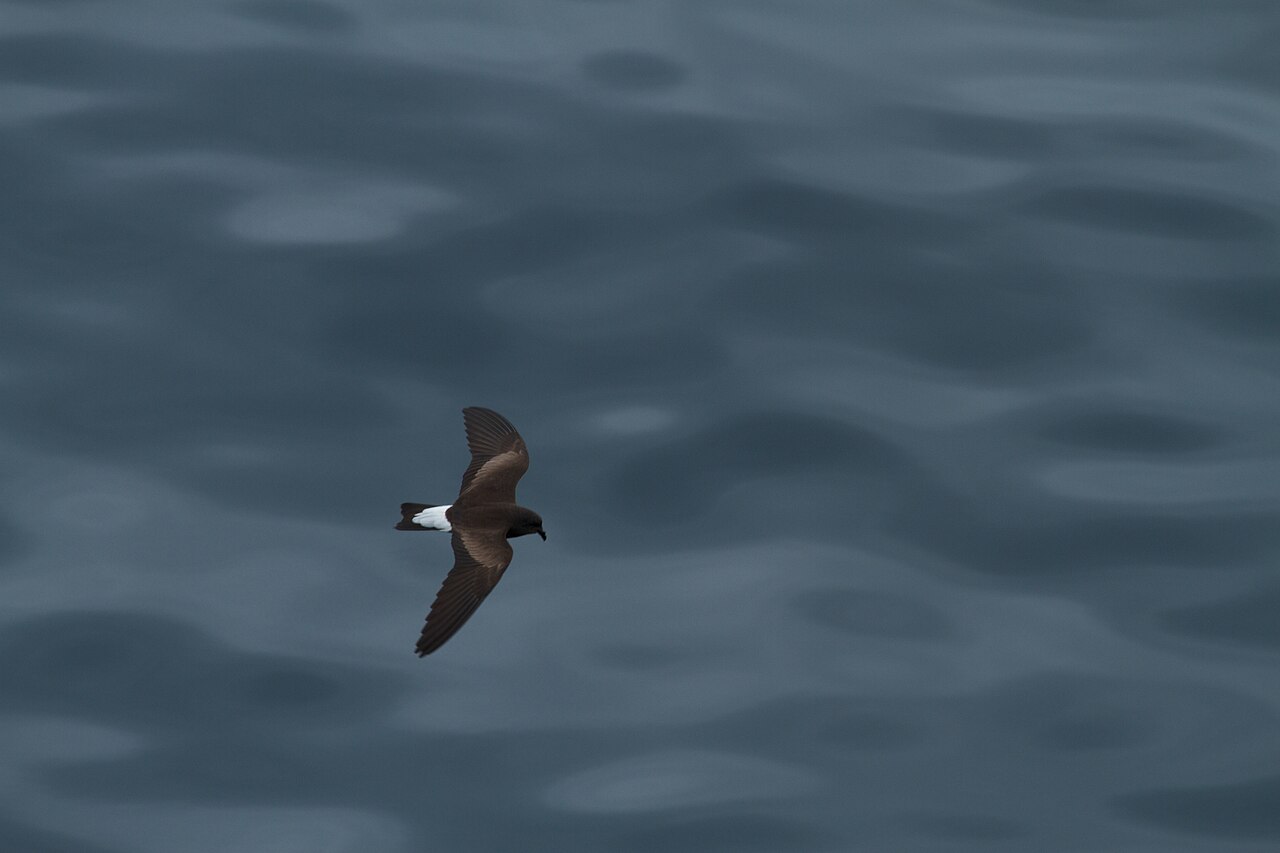
A small, dark storm-petrel with a broad white rump patch that stands out at once in flight and extends onto either side of the tail. The head and upperparts are sooty black, with a pale diagonal band across the upperwing. The flight is fast and light, with characteristic zigzagging swerves low over the water, quite unlike the calm fluttering of the entirely dark storm-petrels.
Confusion species
The white rump makes confusion with the entirely dark Black, Least and Ashy Storm-Petrels virtually impossible. From Leach's Storm-Petrel, which also shows a white rump, it can be told by the shape of the white patch — broader and extending further onto the sides of the tail in Wedge-rumped — and by its faster, more zigzagging flight.
Habitat
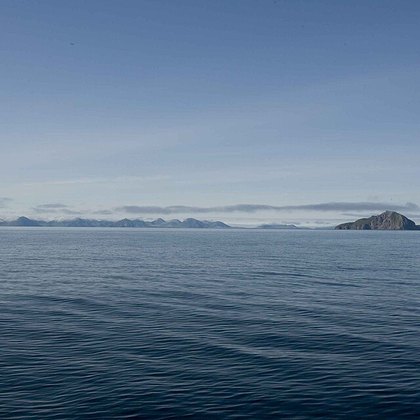
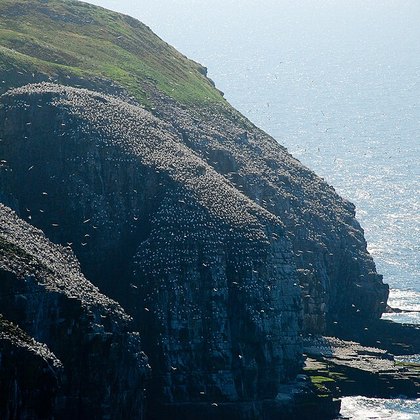
It lives over open tropical and subtropical ocean water, catching small fish, squid and crustaceans by flying low and pattering its feet across the surface. For breeding it uses rock crevices and self-dug burrows on uninhabited volcanic islands. The cold water of the Humboldt Current, to which it moves after breeding, matters to it as much as the colony itself.
Where the bird is most often found, arranged by the USNVC — the vegetation classification of the United States and Canada — and CMECS for sea and coast.
Range and movements
The nominate subspecies tethys breeds on the Galápagos Islands, and kelsalli on Pescadores and San Gallán off Peru. Outside the breeding season it disperses with the Humboldt Current along the west coast of South America. Within this guide's map window it is an extreme rarity: fewer than ten accepted records off California, always in years of anomalously warm water, such as during the 2015 El Niño. That is too few and too irregular for a fixed place on the map.
Where and when to look
The odds of finding this storm-petrel off the American coast can be counted on one hand; it only appears during exceptionally warm years, on pelagic trips out of central California. Watch then for the broad white rump patch and zigzagging flight, which set it apart at once from the entirely dark species.
Conservation
The IUCN lists the world population as Least Concern (LC); the Galápagos colonies lie largely within protected areas. Introduced rats and cats still pose a risk to eggs and chicks on some islands.
Scientific name
Hydrobates tethys | (Bonaparte, 1852)
Bonaparte described the species in 1852 as Thalassidroma Tethys; it has since been placed in another genus, hence the parentheses around author and year. Tethys is the name of a Titaness of Greek mythology, a goddess of the sea — a fitting name for a bird that spends almost its entire life over the open ocean. The type locality is the Galápagos Islands.