All species › Birds of prey › Kites, Old World vultures, eagles and hawks › White-tailed Eagle
White-tailed Eagle | Haliaeetus albicilla
Zeearend | Pigargo europeo
The White-tailed Eagle is the big brown eagle with a short white wedge of a tail and a heavy yellow bill that lives along the coasts of Eurasia; within this map area it breeds only in Greenland. A population of its own, present all year, holds 150 to 170 pairs along the west coast there. On Attu in the Aleutians it bred from the late 1970s until 1984, but not since.

Click a thumbnail to switch the photo above.
Voice
A far-carrying barking call, given mostly in display and at the nest, which travels a long way over the water along the cliff coasts of Greenland. The male calls higher, roughly kri-kri-kri, the female deeper and slower, krau-krau-krau-krau. In alarm it gives three or four short, loud klek notes. In winter the species is largely silent, except when squabbling over carrion.
Recording: Esperanza Poveda — CC BY-NC-SA 4.0 · Norrköping Municipality, Östergötland County, Sweden · xeno-canto
Identification
The adult is greyish brown with a paler, buff head and neck that in old birds looks almost white, and a short white tail tapering to a wedge. Bill, feet and iris are yellow, and the bill is deep and heavy. Juveniles are darker brown with pale feather edges, a grey-cream tail with a dark tip, a dark bill with a yellowish base and dark eyes; adult plumage is not complete until about the eighth year. The female can be a quarter heavier and about a seventh larger in linear measurements than the male. In flight the wings are broad and straight-edged, fingered at the tip and held flat — the outline that older field guides compare to a flying door.
Confusion species
Bald Eagle is the same size; the adult has a pure white head and an evenly white, square-cut tail, while the White-tailed Eagle has a dull buff head and a wedge-shaped tail. Juveniles of both are brown and awkward: the White-tailed already shows a paler tail base and a deeper bill with a yellow base. Steller's Sea-Eagle is heavier and blacker, with white shoulder panels and a far deeper orange-yellow bill. Golden Eagle is slimmer built, with a longer tail, narrower wings held in a shallow V, and legs feathered to the toes.
Habitat
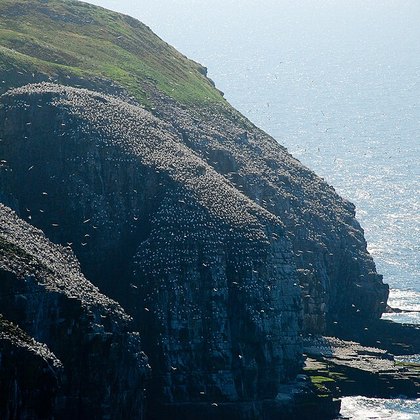
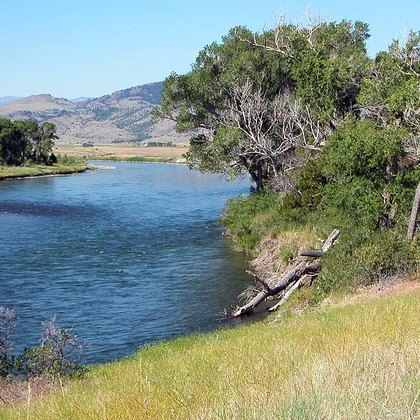
Coast and fjord: rocky shores, sea cliffs, islets and river mouths, and in Eurasia also large inland lakes and rivers with woodland round them. In Greenland it hunts almost entirely at sea and along the shore, unlike the other raptors there, and nests on rock ledges and on islets in the fjords. It needs open water that does not freeze over in winter and a perch with a clear view. It makes no use of deep inland country without water, or of closed forest without openings.
Where the bird is most often found, arranged by the USNVC — the vegetation classification of the United States and Canada — and CMECS for sea and coast.


Range and movements
The range runs from Greenland and Iceland east through northern and eastern Europe and Siberia to Hokkaido. Within this map area only the Greenland population is settled: it breeds along the west coast from Cape Farewell north to Nordre Strømfjord, with one site near Ilulissat, and has been spreading north in recent years. Adults stay all year; many young birds move to southern Greenland to winter. The nesting on Attu in the western Aleutians, from 1977 to 1984, has not been repeated, and the species has been a rare visitor there since.
- Resident
- Winter
- Passage
- dark = core range, pale = thinly spread
Where and when to look
In Greenland it is often seen at the settlements themselves: it often perches on the rocks above harbours and villages along the west coast, where fish waste is landed. Watch the tail — white, short and wedge-shaped — and the slowness of the wingbeat; at range the flat, broad plane of the wings is the first thing to register. In winter the open leads in the fjord ice are the best places.
Conservation
The Greenland population is put at 150 to 170 pairs and has been fully protected since 1973. The main threats there are illegal shooting, lead poisoning from shot in prey such as eiders, and disturbance at the nest between 1 March and 1 July. In Europe numbers fell between the nineteenth century and the Second World War through persecution and afterwards through DDT; with protection and reintroductions in Scotland and Ireland among other places they have risen again, and the Red List now rates the species as Least Concern (LC).
Scientific name
Haliaeetus albicilla | (Linnaeus, 1758)
Linnaeus described the species in 1758 as Falco albicilla, among the falcons; the type locality was later restricted to Sweden, after his Fauna Suecica. Because it was moved to another genus, author and year stand in parentheses. Haliaeetus is formed from Greek hals, 'sea', and aetos, 'eagle'. albicilla is made from albus, 'white', and cilla, a medieval misunderstanding: that word comes from the name of the wagtails and was taken to mean 'tail', so that the name reads as 'white-tailed'.