All species › Cranes, rails and allies › Rails and crakes › Eurasian coot
Eurasian coot | Fulica atra
Meerkoet | Focha común
The Coot is an abundant, pugnacious, noisy rail with lobed toes shared in Europe only with the grebes. In early spring the birds fight over their territories.
Click a thumbnail to switch the photo above.
Voice
A wide range of loud, short calls: an explosive kowk, a sharp pitts and metallic clicking notes. They carry far across water and are heard all year, but most of all in spring during boundary disputes, including at night.
Recording: Beeld en Geluid — CC BY-SA 3.0 · Wikimedia Commons
Identification
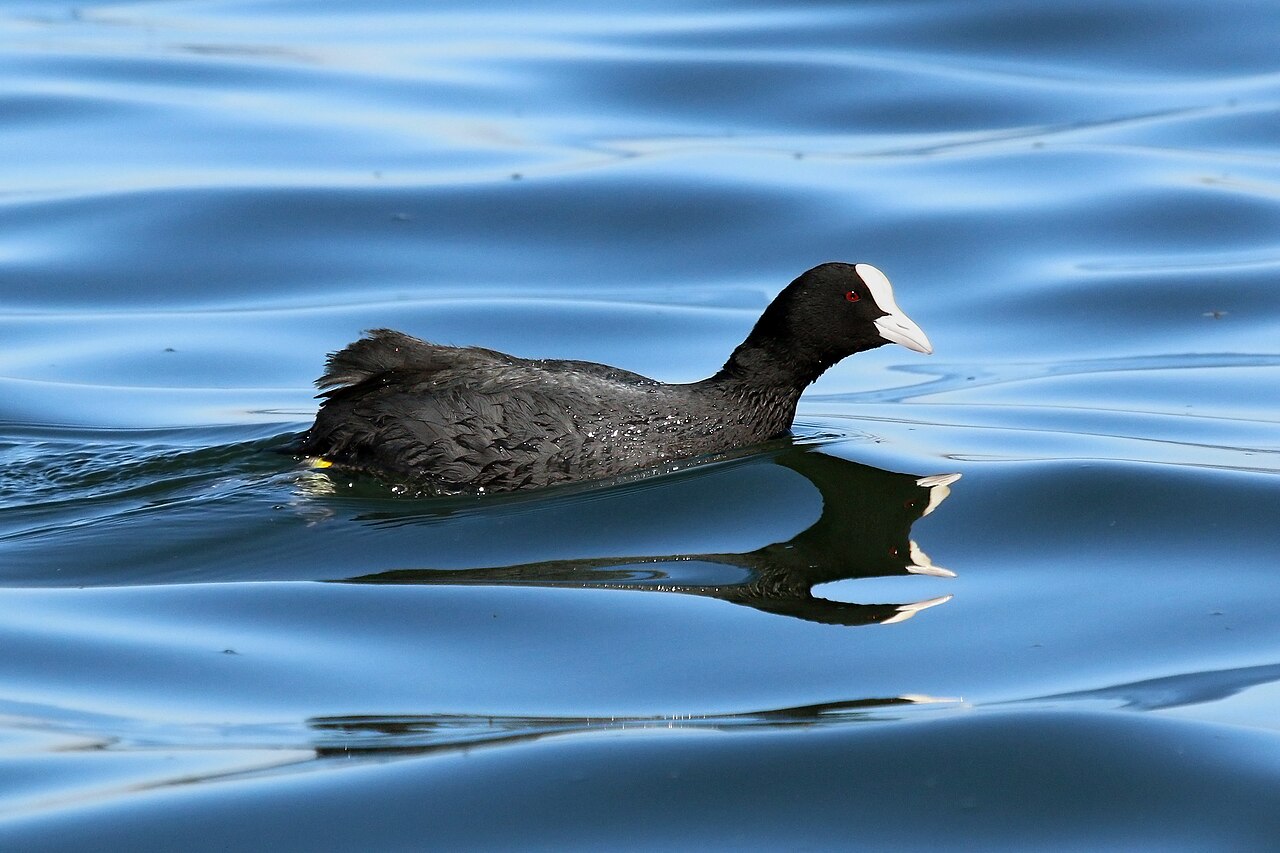
Uniformly sooty black waterbird with a striking white bill and frontal shield and a red iris. In flight — rare, and only after a long pattering run — a narrow white trailing edge to the secondaries shows and the big grey-green lobed feet trail beyond the tail. Juveniles are dull grey with a whitish throat and no shield.
Confusion species
Moorhen is smaller and browner, with a red and yellow bill, a white flank stripe and white sides to the undertail coverts. A lone Coot at sea is sometimes claimed as a scoter, but head and bill shape settle it. In Iberia the real pitfall is red-knobbed coot, with two red knobs above the shield.
Habitat
Almost any fresh water with some fringing vegetation: ditches, lakes, canals, town ponds, rivers and large reservoirs. In winter also on shallow brackish water, and sometimes grazing in flocks on adjoining grass and playing fields.
Where the bird is most at home, classified with EUNIS — the European standard for habitats.




Range and movements
Breeds throughout Europe; in the Netherlands on virtually every waterway right into city centres, and in Spain likewise a common breeder on lagoons, rice fields and reservoirs. Northern and eastern birds move ahead of the frost and gather on ice-free water in western Europe and Iberia; the largest winter concentrations lie along the Mediterranean coast, in the La Mancha lagoons and along the Guadalquivir.
- Resident
- Breeding (summer)
- Winter
- Passage
- dark = core range, pale = thinly spread
How and when to look
Visit a pond or lake with many pairs early on a March morning: that is when the fights happen, two birds rearing back in the water and striking at each other with their feet. For the red-headed chicks, May is the month.
Conservation status
Common and not threatened, though numbers fluctuate locally with hard winters, botulism outbreaks and the clearing of bankside vegetation. It benefits from nutrient-rich and urban waters; in southern Europe the loss of lagoon habitat is the main concern.
Scientific name
Fulica atra | Linnaeus, 1758
Linnaeus described the species in 1758 and placed it straight away in the genus where it still stands. He introduced the genus Fulica in that same work. Fulica is the Latin word for a coot. atra is Latin for 'black', after the dark plumage. The specimen the first description was based on came from Sweden.