All species › Waterfowl › Ducks and geese › African Pygmy Goose
African Pygmy Goose | Nettapus auritus
Afrikaanse dwerggans | Gansito Africano
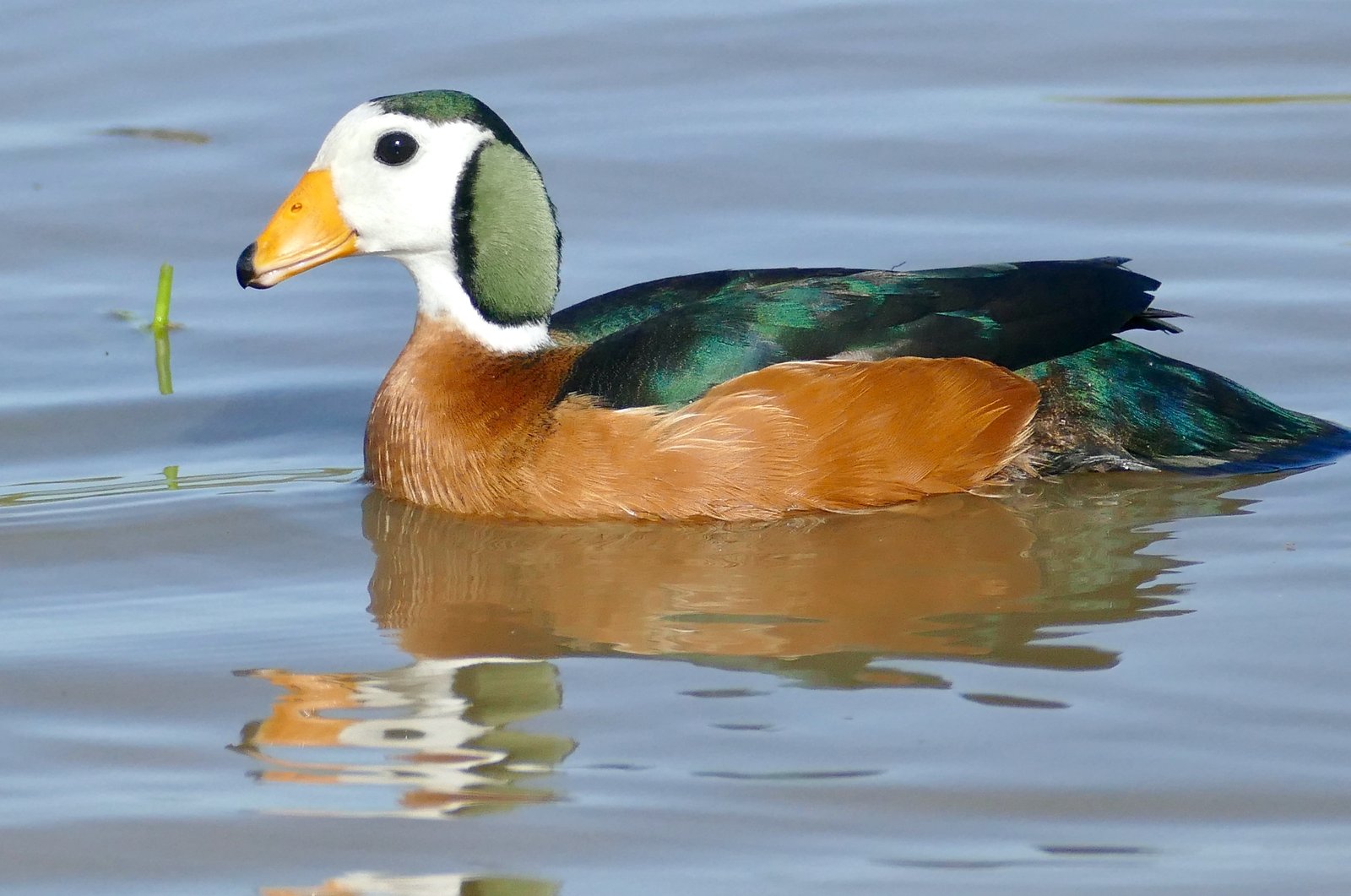
The African Pygmy Goose is the smallest duck in the region: a jewel of a waterbird with a white face, a green ear patch and an orange-chestnut breast, which remains almost invisible among the leaves of water lilies. It is not a true goose but a small, tree-nesting duck with a short, goose-like bill.
Voice
The male gives a soft, squeaky, whistled twittering, choo-choo-pee-wee, mainly on take-off; the female a weak quack. Usually silent.
Recording: Andrew Spencer — CC BY-NC-SA 4.0 · converted to mono · xeno-canto
Identification
30–33 cm, with a short, deep bill. The male has a white face with a black-edged, glossy apple-green patch on the side of the neck, a dark green crown and back, orange-chestnut breast and flanks and a white belly; the bill is bright yellow with a black tip. The female is duller, with a grey-mottled face, a dark eye stripe, no green neck patch and a less bright bill. In flight, which is fast and low, a white patch on the secondaries stands out against the dark green wing. Juveniles resemble the female.
Confusion species
No real confusion is possible within the region. Blue-Billed Teal Spatula hottentota is just as small and occurs in the same habitat, but has a dark cap above a creamy face, a blue bill and no green or orange. Female Knob-Billed Ducks Sarkidiornis melanotos are much larger and black and white without orange tones.
Habitat
Quiet, clear fresh water with plenty of floating vegetation, especially water lilies: lagoons, isolated pans, quiet river backwaters and dams with open water and fringing vegetation. It eats mainly the seeds of water lilies, also other aquatic plants and small invertebrates, dabbling among the leaves. It nests in tree cavities, in old nests of Hamerkops or woodpeckers and sometimes in termite mounds, up to some distance from water.
Where the bird is most at home, classified by the vegetation units of southern Africa.

Range and movements
Local in the north and east of the region: the Okavango, the Kwando, the Linyanti and the Chobe, the Zambezi Region of Namibia, Zimbabwe, Zambia, Malawi, Mozambique and Angola, and in South Africa in northern KwaZulu-Natal, Mpumalanga and Limpopo; absent from the dry west and south. Beyond the region it occurs over much of sub-Saharan Africa and on Madagascar.
- Resident
- Summer visitor (c. Oct–Mar)
- Winter visitor (c. Apr–Sep)
- Passage (Mar–Apr, Oct–Nov)
- dark = core range, pale = thinly spread
How and when to look
In calm weather scan the edges of water-lily beds, preferably from a boat or a mokoro in the Okavango, or on the pans of Zululand. The birds lie still among the leaves and only show up when a male turns its head and reveals the white face. When disturbed they tend to swim away among the plants rather than fly.
Conservation status
Not threatened, but scarce in South Africa and declining with the loss of water lilies, the draining of pans and the felling of old trees with cavities. Still common in the great wetlands of the Okavango and the Zambezi.
Scientific name
Nettapus auritus | (Boddaert, 1783)
Boddaert described the species in 1783 as Anas aurita; because it was later moved to another genus, the author and year stand in brackets. The genus Nettapus was introduced in 1836 by Brandt. Nettapus comes from the Greek nētta, 'duck', and pous, 'foot' — 'duck-foot', for these small, goose-like ducks. auritus is Latin for 'eared', for the green, ear-shaped patch on the side of the male's head. The specimen the first description was based on came from Madagascar.