All species › Waterfowl › Ducks and geese › Knob-Billed Duck
Knob-Billed Duck | Sarkidiornis melanotos
Knobbeleend | Pato Crestudo Afroasiático
The Knob-Billed Duck is a large black-and-white duck of pans and floodplains in savanna, which perches in trees as often as it sits on the water. The male carries a conspicuous black knob on the bill, which swells considerably in the breeding season. The species arrives with the rains and leaves when the pans dry out.

Voice
Usually silent. In the breeding season the male gives a low, hoarse grunting and whistling, and a harsh kwak is sometimes heard in flight; the female quacks softly.
Recording: vir joshi — CC BY-NC-SA 3.0 · converted to mono · xeno-canto
Identification
56–76 cm; the male is much larger than the female. The head and neck are white with dense black speckling, the underparts white, sometimes with a yellow tinge on the sides of the neck; the flanks are pale grey. The upperparts and wings are black with a blue-green and bronze gloss. The male has a large, rounded black knob on top of the bill, the female does not. In flight the wings are entirely black, with no white panel. Juveniles are brown with a pale supercilium and a dark eye stripe, and pale brown below.
Confusion species
Spur-Winged Goose Plectropterus gambensis is larger and mostly black, with a red bill, pink legs and a white panel on the forewing. Juvenile Knob-Billed Ducks can suggest a female Fulvous Whistling Duck Dendrocygna bicolor or other brown ducks, but have a dark eye stripe and soon show the dark, glossy wings.
Habitat
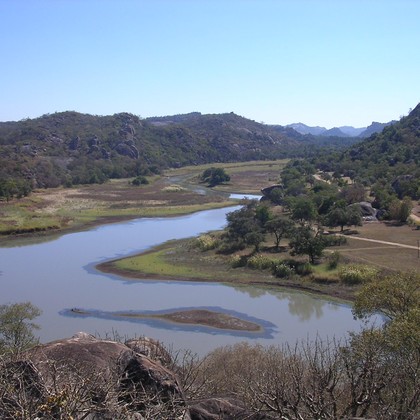
Pans, vleis, floodplains, rivers and dams in wooded savanna, often with dead or tall trees in or by the water. It dabbles and grazes for seeds, aquatic plants and invertebrates, also on newly flooded grassland and fields. It nests in tree cavities, sometimes high up, and in old nests of Hamerkops or raptors; males keep several females.
Where the bird is most at home, classified by the vegetation units of southern Africa.

Range and movements
Mainly in the north and east of the region: the Okavango, the Chobe, the Zambezi Region of Namibia, Zambia, Malawi, Zimbabwe, Mozambique and Angola, and northern and eastern Botswana; in South Africa in Limpopo, Mpumalanga, North West and northern KwaZulu-Natal, and further south in wet summers. Beyond the region it occurs in sub-Saharan Africa, on Madagascar and in southern and south-eastern Asia.
- Resident
- Summer visitor (c. Oct–Mar)
- Winter visitor (c. Apr–Sep)
- Passage (Mar–Apr, Oct–Nov)
- dark = core range, pale = thinly spread
How and when to look
After the first heavy rains, from November to March, on temporary pans in the lowveld, the Kruger and around the Okavango and the Chobe. Also look in dead trees by the water, where groups rest. In the dry season the birds gather on permanent water and a male with a full knob is seen less often.
Conservation status
Not threatened and widespread. It is hunted locally and is sensitive to the loss of old trees with cavities and the draining of seasonal pans. In South Africa numbers vary strongly with rainfall.
Scientific name
Sarkidiornis melanotos | (Pennant, 1769)
Pennant described the species in 1769 as Anser melanotos; because it was later moved to another genus, the author and year stand in brackets. The genus Sarkidiornis was introduced in 1838 by Eyton. Sarkidiornis comes from the Greek sarkidion, 'small piece of flesh', and ornis, 'bird' — for the fleshy knob on the male's bill. melanotos is from Greek melas, 'black', and notos, 'back', so 'black-backed', for the glossy black upperparts. The specimen the first description was based on came from Sri Lanka.