All species › Waterfowl › Ducks and geese › Spur-Winged Goose
Spur-Winged Goose | Plectropterus gambensis
Spoorwiekgans | Ganso Espolonado
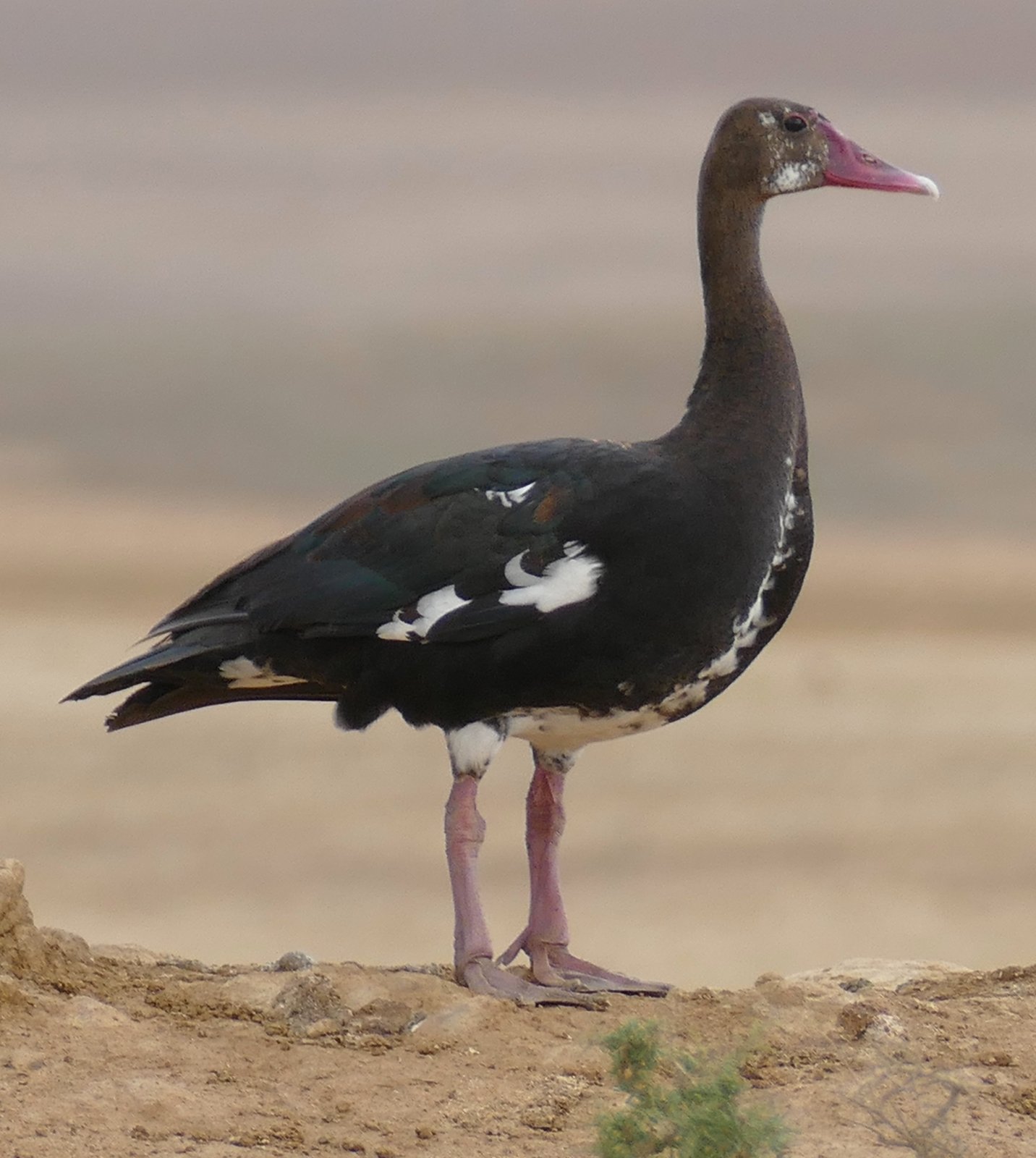
The Spur-Winged Goose is the largest member of the duck family in Africa: a heavy, long-legged, glossy black goose with white on the face and belly and a sharp spur at the bend of the wing. Flocks graze on floodplains and fields and rest on sandbars and in dead trees.
Voice
A weak, high, whistled cher-weet or choo-weet, mainly in flight and on take-off; when threatened a wheezing hiss. Remarkably soft for so large a bird.
Recording: Sander Bot — CC BY-NC-SA 3.0 · converted to mono · xeno-canto
Identification
75–100 cm; the male is clearly larger than the female. The plumage is black with a green and bronze gloss; in southern Africa (subspecies niger) the white is restricted to a small patch on the face, the throat and the lower belly, while birds further north show more white. The bill and the bare skin around the eye are pink to red; the male has a red knob on the forehead that grows with age. The legs are long and pink. In flight the white panel on the forewing is clearly visible; the flight is heavy with slow wingbeats. Juveniles are browner, without a knob and with little white.
Confusion species
Knob-Billed Duck Sarkidiornis melanotos is smaller, with a white head and neck, black speckling on the head, white underparts and a black rather than red bill; in flight the wings are entirely black. Egyptian Goose Alopochen aegyptiaca shows an equally large white wing panel, but is buff-brown with a dark eye patch.
Habitat
Large rivers, floodplains, marshes, pans and reservoirs in open country, with grassland and farmland nearby for grazing. It eats grass, seeds, aquatic plants and, at harvest time, grain and tubers in fields. It nests on the ground in dense vegetation, in old nests of Hamerkops or raptors, in tree cavities and sometimes in termite mounds.
Where the bird is most at home, classified by the vegetation units of southern Africa.

Range and movements
Across most of the region: most numerous in the Okavango, along the Zambezi and the Chobe, in Zambia and Malawi, and further in Zimbabwe, Mozambique, Angola, northern and eastern Botswana and in South Africa mainly in the east, on the highveld and in the Western Cape. In Namibia mainly in the north. Scarce in the Karoo and the dry west. Beyond the region it occurs across almost all of sub-Saharan Africa.
- Resident
- Summer visitor (c. Oct–Mar)
- Winter visitor (c. Apr–Sep)
- Passage (Mar–Apr, Oct–Nov)
- dark = core range, pale = thinly spread
How and when to look
In the dry season, from July to October, moulting flocks of hundreds of birds can be seen in the Okavango and on large dams; they are briefly flightless then and keep to open water. In a flock, note the differences in size and knob between males and females.
Conservation status
Not threatened and increasing locally with the building of dams and irrigation. It is hunted for its meat; in birds that eat certain blister beetles, the flesh can be poisonous from the cantharidin they absorb. Locally regarded as a pest on grain fields.
Scientific name
Plectropterus gambensis | (Linnaeus, 1766)
Linnaeus described the species in 1766 as Anas gambensis; because it was later moved to another genus, the author and year stand in brackets. The genus Plectropterus was introduced in 1824 by Stephens. Plectropterus comes from the Greek plēktron, 'spur', and pteron, 'wing' — for the sharp spur at the bend of the wing. gambensis means 'from Gambia', the country the type material came from. The specimen the first description was based on came from Gambia.