All species › Waterfowl › Ducks and geese › Egyptian Goose
Egyptian Goose | Alopochen aegyptiaca
Nijlgans | Ganso del Nilo
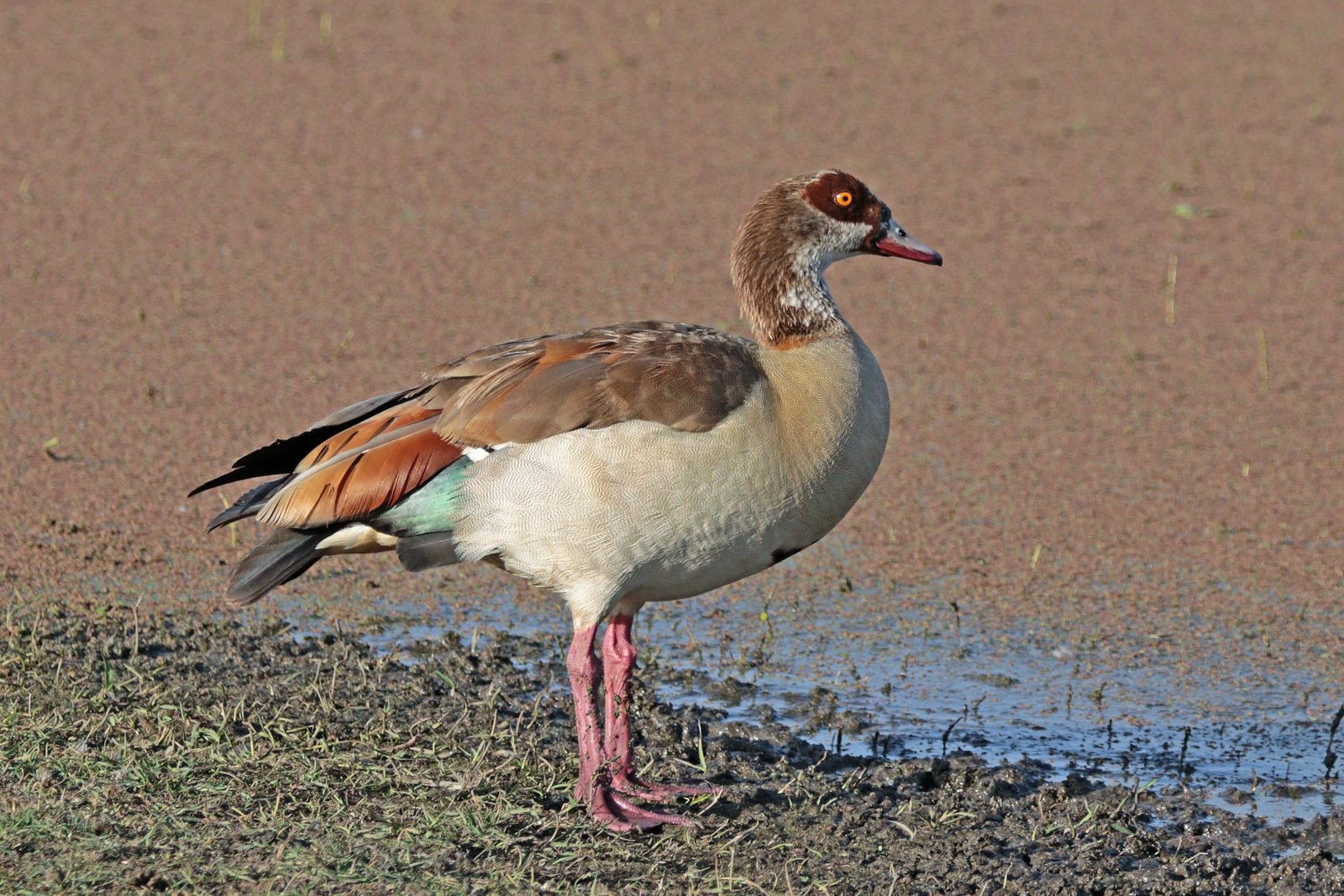
The Egyptian Goose is a long-legged, pale buff-brown shelduck with a dark eye patch and a dark blotch in the centre of the breast. In flight it opens an extensive white wing panel that is completely hidden on the ground. It is the most numerous large waterbird of open water in the region, and it is loud at every border dispute.
Voice
The male gives a hoarse, wheezing hiss, the female a loud, rasping, nasal honking in series: hur-hur-hur-hur, faster and louder as a dispute escalates. It also calls in flight and on take-off. Paired birds call alternately side by side in greeting.
Recording: Sonothèque ADVL — CC0 · converted to mono · xeno-canto
Identification
63–73 cm, with a long neck and long red legs. The plumage is pale grey-brown to buff-brown, with a dark brown patch around the eye, a chestnut ring low on the neck and a dark chestnut blotch in the centre of the breast. The bill is pink with black cutting edges. In flight the forewing is entirely white, with a green speculum and black flight feathers. The sexes are alike in plumage; the male is larger and heavier, and the female's voice differs. Juveniles lack the eye patch and breast blotch and are dull grey-brown with a grey crown.
Confusion species
South African Shelduck Tadorna cana closely resembles this species in flight, showing the same white forewing, but has a uniform rufous body and a grey head in the male or a white face in the female; the dark eye patch and breast blotch are absent. Ruddy Shelduck Tadorna ferruginea, a rare vagrant, is smaller and entirely orange-brown with no eye patch.
Habitat
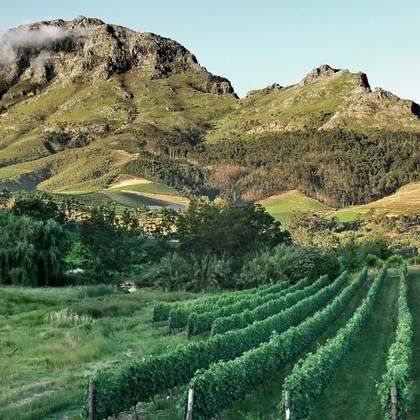
Almost any open water: rivers, farm dams, reservoirs, pans, estuaries, sewage works and town parks, with grassland, cropland or lawns nearby for grazing. It nests in old nests of large raptors and Hamerkops, in tree cavities, on cliff and rock ledges, and on roofs and buildings.
Where the bird is most at home, classified by the vegetation units of southern Africa.

Range and movements
Across almost all of southern Africa, from the Cape to Angola, Zambia and Malawi; densest on the South African highveld and in the Western Cape, and along the rivers and pans of Namibia, Botswana, Zimbabwe and Mozambique. Only the core Namib and the driest Kalahari remain empty. Beyond the region it occurs across most of Africa south of the Sahara and along the Nile, with established introduced populations in western Europe.
- Resident
- Summer visitor (c. Oct–Mar)
- Winter visitor (c. Apr–Sep)
- Passage (Mar–Apr, Oct–Nov)
- dark = core range, pale = thinly spread
How and when to look
Year-round at any farm dam. Early morning and late afternoon the pairs graze along the shore, and that is when the breast blotch and eye patch show best. In the breeding season there are fierce aerial chases over the water; also look up at rock ledges and thick tree forks, where the nests are, and watch for ducklings dropping from a great height.
Conservation status
Not threatened; numbers are increasing and the range is expanding with the spread of farm dams and irrigation. On grain fields and young crops the species is locally regarded as damaging, and licensed control is carried out. Outside Africa it has established itself as an introduced bird in western Europe.
Scientific name
Alopochen aegyptiaca | (Linnaeus, 1766)
Linnaeus described the species in 1766 as Anas aegyptiaca; because it was later moved to another genus, the author and year stand in brackets. The genus Alopochen was introduced in 1885 by Stejneger. Alopochen comes from the Greek alopex, 'fox', and chen, 'goose' — a 'fox-goose', for the reddish-brown colour that recalls a fox. aegyptiaca is Latin for 'Egyptian', after Egypt, where the species was first scientifically described in 1766. The specimen the first description was based on came from Egypt.