All species › Waders, gulls and terns › Sandpipers and snipes › Red Phalarope
Red Phalarope | Phalaropus fulicarius
Rosse franjepoot | Falaropo Picogrueso
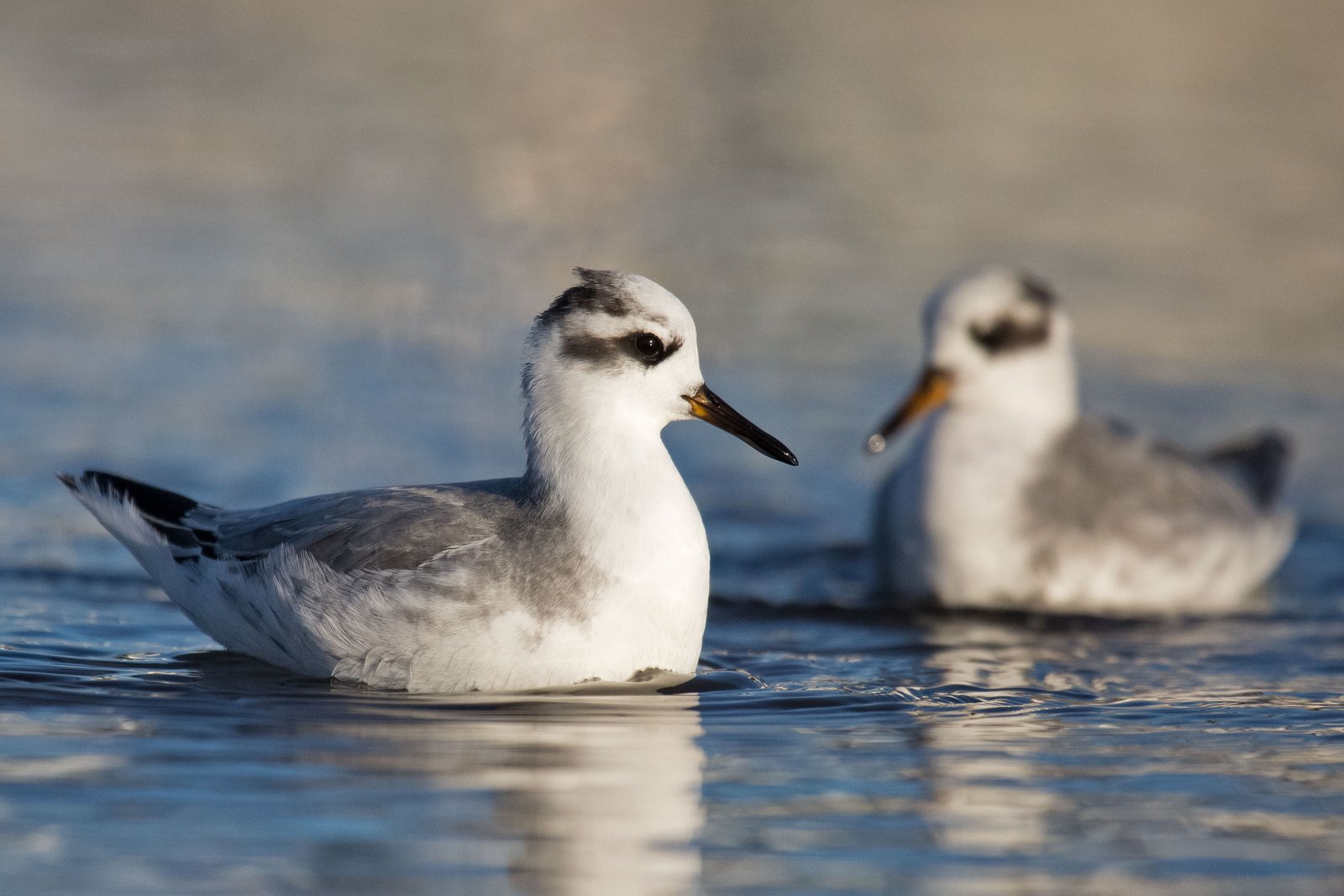
The Red Phalarope is a wader that lives on the open ocean outside the breeding season. It nests on Arctic tundra and winters in cold, productive upwelling zones, such as the Benguela Current off Namibia and western South Africa. In the region it is seen almost only in non-breeding plumage, bobbing like a small white cork on the water.
Click a thumbnail to switch the photo above.
Voice
Rather silent outside the breeding season. A short, high, sharp pik or twit, mainly when groups take off at sea.
Recording: Avery Bartels — CC BY-NC-SA 4.0 · converted to mono · xeno-canto
Identification
20–22 cm. In non-breeding plumage the head and underparts are white, with a black eye patch extending back from the eye and a dark rear crown. The upperparts are plain pale grey, lacking the pale stripes of Red-Necked Phalarope. The bill is short, rather thick and often yellowish at the base; the toes are lobed. In flight it shows a clear white wing bar. In breeding plumage the female is chestnut-red below with white cheeks and a yellow bill, brighter than the male; in the region this plumage is seen only partly, on early arrivals or late departures. It swims high on the water and often spins to draw prey to the surface.
Confusion species
Red-Necked Phalarope Phalaropus lobatus is smaller, with a needle-fine black bill and darker grey upperparts with pale mantle stripes. Wilson's Phalarope Phalaropus tricolor is larger, with a long needle-like bill, no dark eye patch in non-breeding plumage and a white rump without a wing bar, and often walks on the shore. At distance, Sanderling Calidris alba in non-breeding plumage can look similar, but it does not swim and runs along the surf.
Habitat
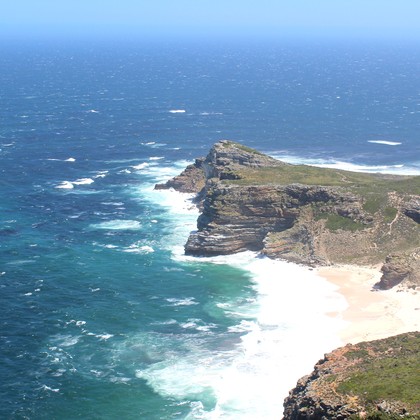
Open sea, especially over the continental shelf and along fronts where cold upwelling water concentrates plankton. After storms it sometimes turns up in bays, lagoons, salt pans and coastal sewage ponds, and exceptionally far inland. It eats small crustaceans and other plankton, picked from the surface while swimming.
Where the bird is most at home, classified by the vegetation units of southern Africa.
Range and movements
Mainly at sea off Namibia and the west coast of South Africa, east to beyond the Cape of Good Hope; scarce and irregular off the south and east coasts. There are scattered inland records in South Africa, Namibia and Botswana, usually after severe storms. Beyond the region it breeds right around the Arctic and winters mainly off West Africa, Chile and Peru.
- Passage (Mar–Apr, Oct–Nov)
- dark = core range, pale = thinly spread
How and when to look
The best chance is a pelagic trip out of Cape Town or Walvis Bay between November and March; look for small white birds resting in groups on the water and flying off low over the waves. After winter storms it pays to check the Walvis Bay salt works and the lagoons of the Cape west coast.
Conservation status
Not threatened; the world population is large. Numbers are declining locally on the breeding grounds, probably because of changes in the marine ecosystem. At sea the species is vulnerable to oil pollution.
Scientific name
Phalaropus fulicarius | (Linnaeus, 1758)
Linnaeus described the species in 1758 as Tringa fulicaria; because it was later moved to another genus, the author and year stand in brackets. The genus Phalaropus was introduced in 1760 by Brisson. Phalaropus comes through French phalarope from Greek phalaris 'coot' and pous 'foot': like coots, phalaropes have lobed toes. fulicarius derives from Latin fulica 'coot', for those same lobed toes. The specimen the first description was based on came from Hudson Bay.