All species › Rodents › Mice and rats › Anderson's Gerbil
Anderson's Gerbil | Gerbillus andersoni
Gerbillus andersoni | Gerbillus andersoni
Anderson's Gerbil (Gerbillus andersoni) is a gerbil of coastal dunes, from the Tunisian Sahel to the Egyptian Mediterranean coast and on across Sinai to the dunes of Israel. There is no established Dutch or Spanish name. It is one of the best-studied desert rodents: much of what is known about the coexistence of rodent species has been measured on the dunes of the Negev, where this species lives alongside related species.

Tracks
In its habitat signs are more useful than sightings of the animal. In fine, damp morning sand lie the tracks of a bounding gerbil: pairs of elongated hind-foot prints each 1 to 1.5 cm long, with the fore feet between them when moving slowly and without fore feet in fast bounds. Because the soles are haired, the print is a blurred, filled impression without a sharp toe pattern. Between two bound marks there is often a thin, continuous tail drag; narrow and faint in a gerbil, absent in a jerboa. The burrow is a tunnel system in a semi-stabilised dune slope or in the lee of a shrub, with a few entrances 2 to 3 cm across, a fresh spoil fan in front, and a plugged entrance by day; for this reason no open burrows are visible on a gerbil dune by day, but they are after sunset. At the burrow lie seed coats and empty husks and gnawed fruits of coastal plants, including Thymelaea. Droppings are small (2 to 3 mm), dark, hard and dry, and lie scattered, not in a latrine. In dune slacks there are scratch marks from digging and foraging: gerbils sift sand for seed and leave pits a few centimetres across, the clearest sign that the sand is occupied.
Identification
A slim gerbil of 7 to 11.5 cm head-body length, with a tail longer than the body (9 to 13.5 cm) ending in a darker tuft. The back is sandy orange to orange-brown, warmer in tone than in most related species; the belly is pure white, with a sharp boundary along the flank. The ears are medium-sized (14 to 18 mm), the eyes large and black. The hind legs are long and the hind foot measures 25 to 32 mm, with haired soles that give grip on loose sand. Males are larger than females and have a longer tail. Weight 16 to 38 g. The chromosome number (2n = 40) is decisive; on external characters alone the species cannot be identified with certainty.
Similar species
Gerbils of the genus Gerbillus often cannot be told apart in the field. The Lesser Egyptian Gerbil (Gerbillus gerbillus) is the closest relative and the most difficult to separate: about the same size, with the same haired soles and the same hind-foot measurement, but paler on average and with a proportionally longer tail (135 to 145 per cent of head-body length, against about 120 per cent). Flower's Gerbil (Gerbillus floweri) lives on the same dunes in Sinai and the Negev but is heavier and has a large hind foot of 31 to 38 mm; this is the most usable field character within the group. Gerbillus dasyurus differs in habitat: it lives on rock and grit, is greyer yellow and has a smaller hind foot (20 to 27 mm). The Fat-tailed Gerbil has a short tail and a stocky build. The spiny mice have a spiny coat, make short bounds and live on stone. Certainty requires karyotype or DNA.
Habitat
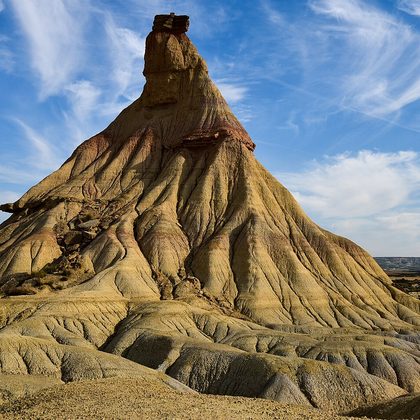
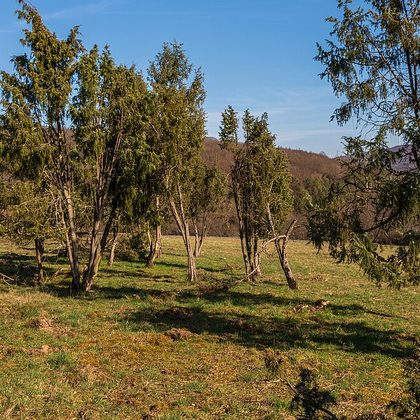
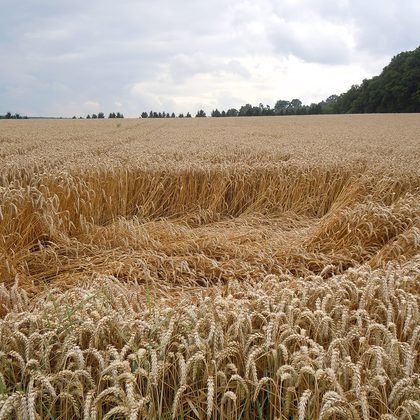
Sand with some stabilisation: semi-stabilised coastal dunes and dune slacks, sandy margins of wadis, sandy mountain slopes, plains of drifted sand with sparse shrub cover, and in oases and along the coast date groves and field margins. Loose, fully mobile sand is avoided more than by the Lesser Egyptian Gerbil, which lives there; stabilised sand with some shrub cover is the habitat of this species. In Israel it is the gerbil of the coastal plain and of the semi-stabilised dunes of the north-western Negev, up to the edges of towns.
Where the animal is most at home, classified with EUNIS — the European standard for habitats.

Distribution
Two separate parts. The nominate form lives in the North African coastal strip from Tunisia through Libya to Egypt, with the type locality at Mandara east of Alexandria. The form allenbyi inhabits Sinai, Israel, Palestine and western Jordan. The range thus includes the Tunisian Sahel, the coast of Cyrenaica, the Egyptian Mediterranean coast, Sinai, and the Israeli coastal plain and Negev. The species has many synonyms and may prove to be a species complex; the Mammal Diversity Database provisionally treats it as one species with two subspecies.
- Native
- dark = core range, pale = thinly spread
Way of life
Nocturnal and entirely ground-living; by day the animal stays in a self-dug burrow with a plugged entrance. Omnivorous; in studied diets green plant material makes up about 42 per cent, seeds 35 per cent and insects 20 per cent, so this species eats less exclusively seed than related species. Seeds of shrubs, including Thymelaea, are a regular component. The species is solitary and aggressive towards conspecifics; food is fought over, and home ranges are small. On the dunes of the Negev this species and a larger related species have been used to study how two rodents share the same dune: they divide not so much the food as the times and places at which the risk of owl predation differs, and adjust their activity to moonlight, cover and each other's presence. Breeding falls in the winter half-year and spring, roughly January to June; after a gestation of 20 to 22 days three to seven young are born. There is no hibernation; the species is active at night in January too.
Where and when to look
Search a dune after dark with a lamp. Semi-stabilised dunes with shrubs in the north-western Negev, along the Egyptian Mediterranean coast and in the Tunisian Sahel are suitable areas; the first two hours after sunset are best, and a dark, moonless night produces many more animals than a bright one, because gerbils keep to cover in moonlight. Drive at walking pace along a sand track or walk with a torch along the foot of a dune and watch for the orange eyeshine. By day, signs provide information: walk the sheltered side of the dune and count fresh spoil fans, sifting pits and bound tracks in the morning sand before the wind erases them. Identification to species is usually not possible in the field; record the genus Gerbillus.
Conservation status
Least Concern (LC, 2016) and common throughout its range. Pressure is local and of two kinds: overgrazing, which removes the shrubs under which the species finds cover and seed, and building on coastal dunes, which in Israel and along the Egyptian coast affects precisely the habitat with the highest densities. Coastal dune has become the scarcest ground type throughout the Mediterranean, and a species tied to it loses habitat without its global status changing. There is also taxonomic uncertainty: if this complex is split into several species, the status of some of them may differ from that of the whole today.
Scientific name
Gerbillus andersoni | de Winton, 1902
De Winton described the species in 1902 and placed it straight away in the genus where it still stands. Gerbillus is a diminutive of gerbo, the old name of the jerboa, from Arabic yarbūʿ: the jerboa's little cousin. andersoni honours the Scottish zoologist John Anderson (1833–1900), whose Zoology of Egypt de Winton completed after his death, describing the animal in that work. The specimen the first description was based on came from Egypt, Alexandria.