All species › Rodents › Mice and rats › Wagner's Gerbil
Wagner's Gerbil | Gerbillus dasyurus
Gerbillus dasyurus | Gerbillus dasyurus
Wagner's Gerbil (Gerbillus dasyurus) is a gerbil of rocky terrain: limestone cliffs, sandstone hills, gravel wadis and thorn scrub, from southern Turkey deep into Arabia. Most related species live on sand; this one does not. It is the commonest gerbil of the Levantine uplands and the gerbil seen at night among the boulders in Petra, Wadi Rum and the Judean Desert.
Tracks
On hard rock no tracks remain; they are found where there is sand or dust: sand pockets between boulders, the dusty edge of a wadi bed and the lee under an overhang. There lie the bound tracks: pairs of elongated hind-foot prints just over 1 cm long, side by side, with up to 15 cm between the pairs, and between them a thin drag mark of the long tail. The burrow of this species is simple: not an extensive system but a single tunnel of 0.5 to 3 m, usually under a stone, in a rock crevice or in the sandy margin under a shrub, with a small spoil fan and a plugged entrance by day. Droppings are small, dark, hard and dry, 2 to 3 mm, and lie scattered around the burrow and along foraging routes, not in a latrine; this distinguishes them from those of the spiny mouse on the same rock, which does make latrines. The feeding signs are those of a seed-eater that feeds from the surface: small pits where sand or gravel has been sifted, empty seed coats and husks of annual herbs under a shrub, and at the burrow entrance gnawed remains of succulent plant parts. Pellets of Barn Owl and Scops Owl in an abandoned building or under a rock ledge quickly establish its presence in a wadi.
Identification
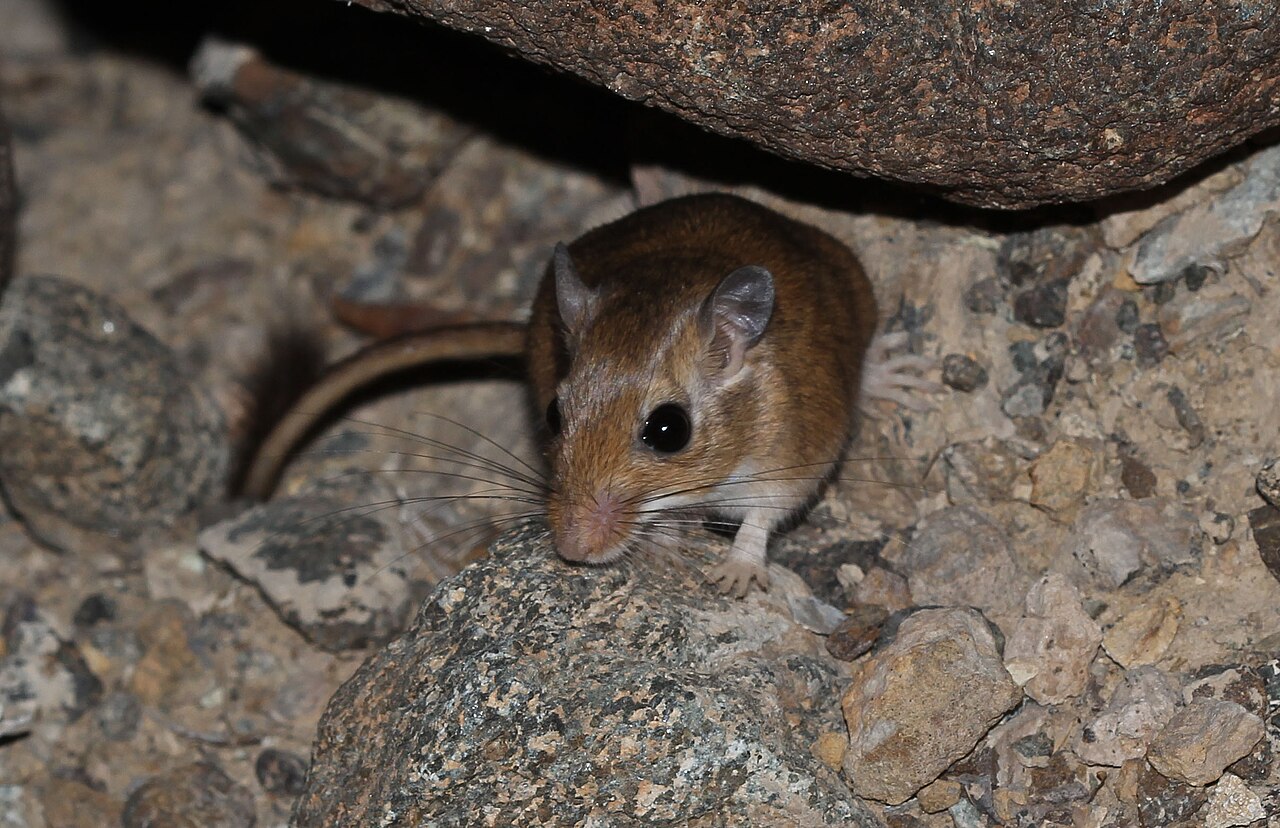
A small, finely built gerbil of 7 to 11 cm head-body length, with a long, densely haired tail of 8.5 to 14 cm (122 to 155 per cent of head-body length) ending in a distinct tuft. The fur is dense and soft, the back pale greyish yellow, the belly pure white. The face carries white patches, and above the eye runs a dark eyebrow stripe that separates the species from the sand-dwelling gerbils. The ears are small for a gerbil (9 to 16 mm) and the hind foot is short: 20 to 27 mm, against 25 to 38 mm in the gerbils of loose sand. The short foot is an adaptation to life on rock and gravel. Females have four pairs of teats; the chromosome number is 2n = 60.
Similar species
Of the gerbils of the Levant this is the most recognisable, because of its habitat: on rock and gravel it is almost always the only Gerbillus. The Lesser Egyptian Gerbil (Gerbillus gerbillus), Flower's Gerbil (Gerbillus floweri) and Gerbillus andersoni all live on sand, have a much larger hind foot (25 to 38 mm) and lack the dark eyebrow stripe; where a dune abuts a rocky slope they may occur side by side, and then the hind foot and habitat are the only clues. The jirds of the genus Meriones live in the same rocky landscape but are clearly larger and heavier, with a shorter, thicker tail. The spiny mice use the same rock crevices; they have a rough spiny coat, a tail no longer than the body and without a tuft, and they run where the gerbil bounds. When in doubt, record only the genus Gerbillus.
Habitat
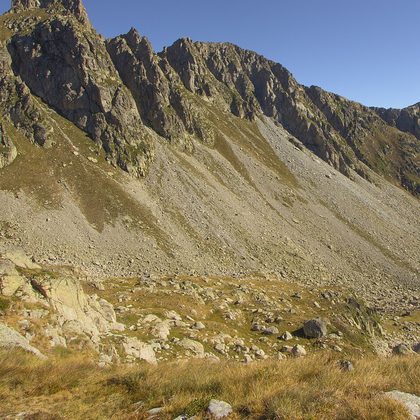
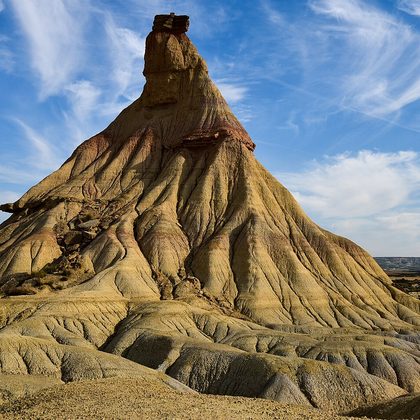
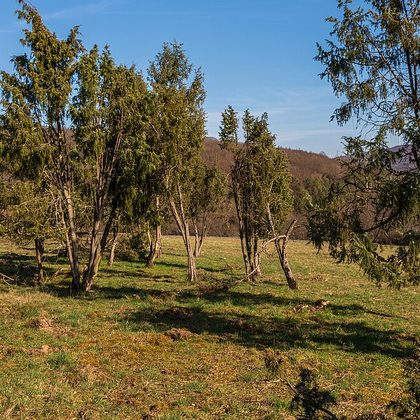
Rock, gravel and thorn scrub, and explicitly not dunes: limestone cliffs and plateaus, sandstone hills, scree, gravel wadi beds with low vegetation, thorn scrub and the stony steppe beyond; in Israel from about 500 to 2000 m. The species sits under stones, in crevices or in the sandy margin under a desert shrub, and also occurs in the dry-stone walls of old terraces and in scree along roads. Loose drifting sand is avoided; this is the sharpest ecological boundary within the group: in the Levant the Gerbillus species are divided into species of sand and species of stone, and this species belongs to the latter.
Where the animal is most at home, classified with EUNIS — the European standard for habitats.


Distribution
From southern Turkey through Syria, Lebanon, Israel, Palestine and Jordan to Sinai, and east through Iraq across the whole Arabian Peninsula to Oman and the United Arab Emirates. The north-western part of the range includes the southern edge of Anatolia, the Syrian and Lebanese mountain margin, the Levantine rock country (the Judean Desert, the gorges above the Dead Sea, Petra, Wadi Rum) and Sinai. In suitable terrain there it is the commonest gerbil: densities of just over 7 to over 32 animals per hectare have been measured, depending strongly on the rainfall of the preceding winter half-year. After a wet winter densities in a wadi are high; after two dry years the species is hardly to be found.
- Native
- dark = core range, pale = thinly spread
Way of life
Strictly nocturnal and entirely ground-living. Food is mainly vegetable: seeds of annual herbs taken from the soil surface, as well as succulent plant parts and occasionally an insect. Stores are laid up in the tunnel. The species digs, but modestly: one tunnel of 0.5 to 3 m, usually under a stone or shrub. Breeding runs from February to October, with a peak in spring after the winter rains; gestation is 18 to 22 days in Israel and four to six days longer in Saudi Arabia, and the litter comprises four to eight young. Unlike those of spiny mice, the young are born naked and blind: the eyes open on day 22 and they are weaned around day 40. In the wild the species lives two to five years, in captivity over four. There is no hibernation; in the cold, wet weeks of the Levantine winter the species is most active, because seedlings and fresh seeds are then available.
Where and when to look
After sunset drive at walking pace along a gravel track in a wadi or walk with a lamp along the foot of a limestone cliff; in Wadi Rum, the Judean Desert, around Petra and in the southern Negev this is the gerbil that is seen, with orange-red eyeshine. The first two hours after nightfall and a moonless night are best. Note the silhouette: long tail with tuft, small ears and a springy bound over the gravel. By day, search under stones along a wadi edge for the single tunnel with a fresh spoil fan, and in the dust for bound tracks with the fine tail line between them. The best years are those after a wet winter: between good and bad years densities in this species differ by a factor of four.
Conservation status
Least Concern (LC, 2016), common and widespread; of the gerbils of the region this species is the least dependent on a vulnerable habitat, since rocky terrain is rarely built on or ploughed. Numbers fluctuate strongly with rainfall; this is a natural fluctuation and not a decline. The nomenclature needs attention: in version 2.5 the Mammal Diversity Database moved the species back from Dipodillus to Gerbillus, and much literature, field guides and recording databases still use Dipodillus dasyurus. When older and newer sources are compared, both names refer to the same species.
Scientific name
Gerbillus dasyurus | (J. A. Wagner, 1842) (GBIF: Dipodillus dasyurus)
J. A. Wagner described the species in 1842 as Meriones dasyurus; because it was later moved to another genus, the author and year stand in brackets. Gerbillus is a diminutive of gerbo, the old name of the jerboa, from Arabic yarbūʿ: the jerboa's little cousin. dasyurus is Greek for 'shaggy-tailed', from dasys, 'hairy, shaggy', and oura, 'tail', after the long hairs on the end of the tail. The specimen the first description was based on came from Egypt, Sinai.