All species › Rodents › Mice and rats › Balkan Short-tailed Mouse
Balkan Short-tailed Mouse | Mus macedonicus
Macedonische huismuis | Ratón Macedónico
The Balkan Short-tailed Mouse (Mus macedonicus) is a wild mouse of the eastern Mediterranean that matches the House Mouse in build, pointed muzzle and the notch in the upper incisor, but does not live in buildings. In the Balkans and Anatolia the House Mouse occupies villages and barns; the Balkan Short-tailed Mouse lives in the surrounding country: fields, orchards, shores and dunes.

Tracks
There are no signs that separate this species from the House Mouse. The droppings are those of a Mus: three to eight millimetres, spindle-shaped with pointed ends, black and glossy when fresh, scattered and not in latrines. They lie outdoors, along field margins, under straw heaps, in bankside vegetation and among the roots of olive trees, not along skirting boards or in drawers. Smear marks and urine pillars, the characteristic signs of the House Mouse in buildings, are absent, because the species does not come indoors. Gnawing signs with paired tooth grooves about a millimetre wide occur on seeds, grain and fruit; the seed is hollowed out and the husk left behind. Prints of less than a centimetre, with four toes in front and five behind and a tail drag, can be seen in dust on threshing floors or in fine silt along streams. Locality is the best indication: a Mus living outdoors in the Balkans or the Near East, in farmland, reeds or dunes, is probably this species.
Identification
A mouse of six and a half to nearly ten centimetres, with a tail distinctly shorter than head and body; this gives the species its English name. The back is pale to dark grey-brown, the belly white to greyish white and fairly sharply demarcated. Ears nine to sixteen millimetres, hind foot twelve to eighteen. Females are heavier than males and have five pairs of teats. Weight is eleven to thirty grams; large individuals are heavier than an average House Mouse. The upper incisor has on its back the notch found in Mus species; this character places the species in the genus but does not separate it from related species.
Similar species
The House Mouse (Mus musculus) is the species most often confused with it. The distinction rests on two characters. The first is the tail: as long as head and body in the House Mouse, noticeably shorter in this species. The second is the belly: grey to yellowish white with a gradual transition in the House Mouse, whiter and more sharply bounded in this species. Both differences are slight; locality is the most reliable indication, because this species is not caught in houses, whereas in the eastern Mediterranean the House Mouse is caught mainly there. The Mound-building Mouse (Mus spicilegus) is the sister species, closely resembles it and comes into contact with it in the Balkans; it builds earth mounds and does not occur further south than Greece. On Cyprus the wild field mouse is not this species but Mus cypriacus, with clearly larger ears and eyes. The Wood Mouse and the Eastern Broad-toothed Field Mouse are larger and more russet, with much larger eyes and ears, a pure white belly, a bounding gait and a long tail.
Habitat
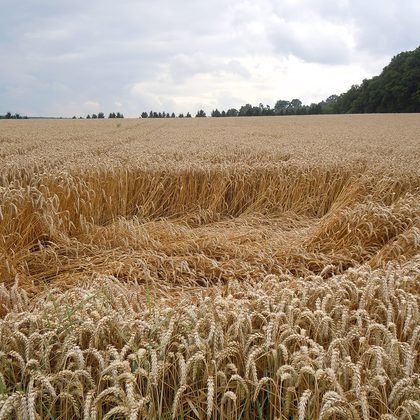
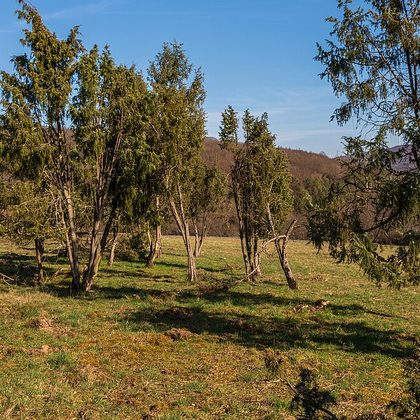
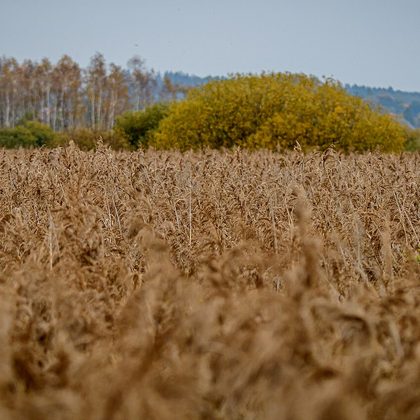
Almost all open and half-open habitats, but not woodland or buildings. The species has been found in dunes and shore vegetation, in reed beds along lakes and rivers, in orchards, fields, vegetable gardens and scrub, and on abandoned, overgrown plots, up to about fifteen hundred metres. Where the House Mouse occupies the village, the Balkan Short-tailed Mouse lives in the surrounding farmland, so that the two species often live a few tens of metres apart without mixing. Dense, closed forest is avoided.
Where the animal is most at home, classified with EUNIS — the European standard for habitats.



Distribution
The eastern Mediterranean and the Caucasus: Albania, Kosovo, North Macedonia, Bulgaria and Greece including Samothrace, Lesbos, Chios, Samos and Rhodes, the whole of Turkey including Gökçeada and Bozcaada, and further Armenia, Georgia, Azerbaijan, north-western Iran, Syria, Lebanon, Israel, the West Bank and Jordan; probably also Iraq. In Europe the range is restricted to the Balkans and the Aegean islands; the species is absent from western, central and northern Europe.
- Native
- dark = core range, pale = thinly spread
Way of life
Nocturnal and entirely ground-dwelling. The diet consists of seeds and other plant material; the species eats less animal food than the House Mouse in buildings. Breeding takes place in spring and summer and stops in winter; the House Mouse breeds all year indoors, and this difference is linked to the outdoor way of life. Embryo counts average six to seven in the Balkans and seven in Anatolia. Almost nothing has been published on territories, social organisation or movements. It does not hibernate.
Where and when to look
In spring or late summer, at dusk, search with a torch along the ground at field margins, olive groves or overgrown plots in northern Greece, Bulgaria or Anatolia; a small grey-brown mouse with a short tail that runs rather than bounds is probably this species. In villages it is usually the House Mouse. On the Aegean islands the species occurs along terrace edges and dry-stone walls. Only an animal in the hand gives certainty: measure the tail against head and body and note how sharply the belly colour is bounded. The species also occurs in Barn Owl pellets from Thrace and Anatolia.
Conservation status
Least Concern (LC, 2016); widespread and locally numerous. Agricultural intensification, the loss of small-scale orchards and the conversion of shore and dune vegetation to fields or buildings reduce the habitat, but because the species is common and undemanding this does not amount to a threat. As an agricultural pest it is of little significance. In the laboratory it is, with the Mound-building Mouse and the Algerian Mouse, one of the wild species against which House Mouse genetics are compared; more is therefore known about its genome than about its life in the field.
Scientific name
Mus macedonicus | B. Petrov & Ružić, 1983
B. Petrov & Ružić described the species in 1983 and placed it straight away in the genus where it still stands. Mus is the Latin word for 'mouse', cognate with Greek mys. macedonicus means 'Macedonian'; Petrov and Ružić described the animal from Valandovo in what is now North Macedonia. The specimen the first description was based on came from North Macedonia, Valandovo.