All species › Rodents › Mice and rats › House mouse
House mouse | Mus musculus
Huismuis | Ratón Casero
The House Mouse has spread around the world with people: with the first grain stores, by ship to islands and other continents, and it now occurs almost everywhere people live. It is a commensal in the strict sense, not a wild animal that occasionally comes indoors. In north-west Europe the species barely survives the winter outside buildings; in the Iberian Peninsula, where the Algerian Mouse occupies open country, it is even more closely tied to buildings than in central Europe.
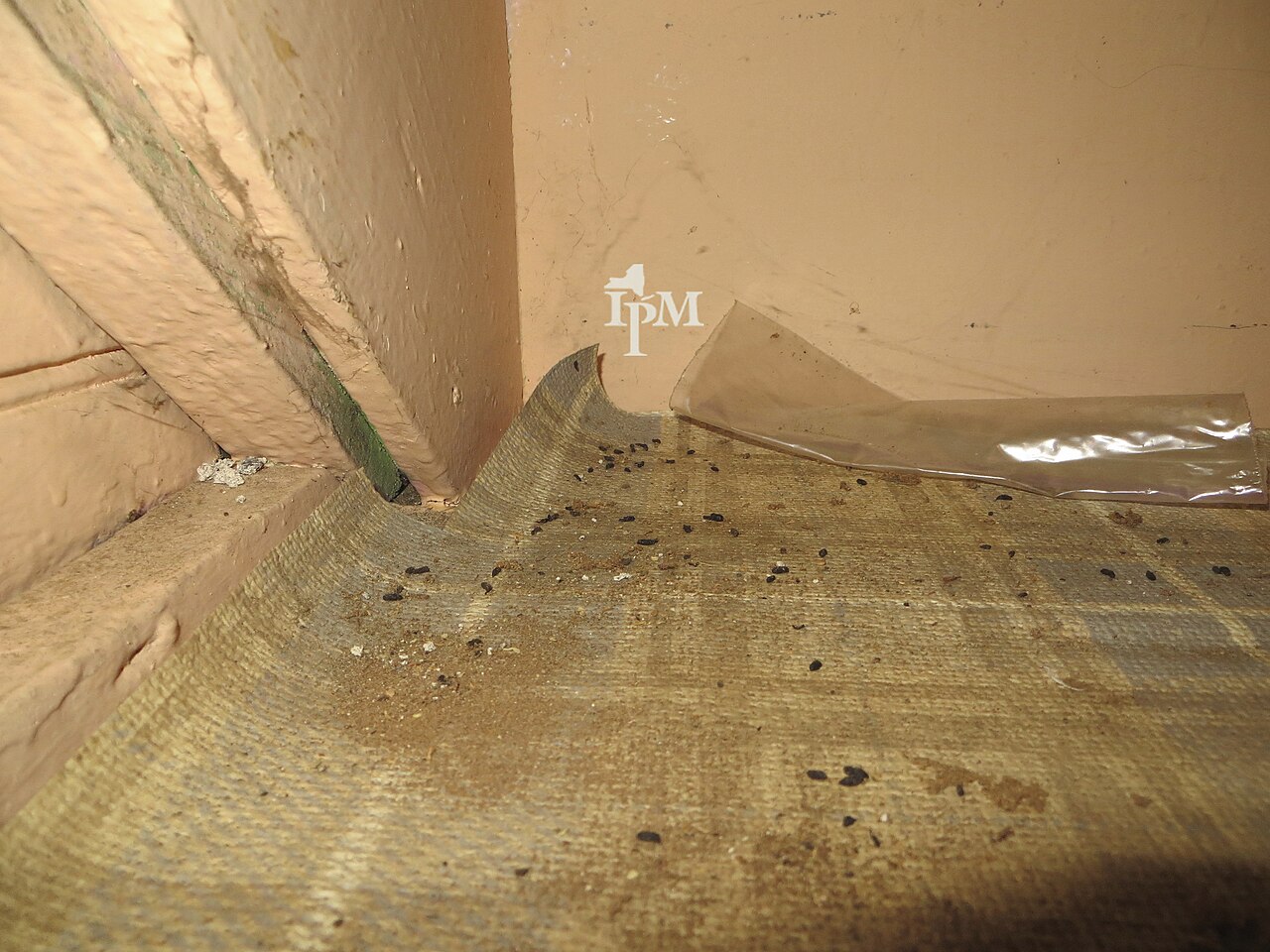
Tracks
Of the House Mouse, signs are almost always found rather than the animal. The droppings are 3 to 8 mm long, spindle-shaped with pointed ends, black and glossy when fresh, hard and dull when old, and lie scattered rather than in a latrine; one mouse leaves dozens a day, along skirting boards, in drawers and on shelves. Rat droppings are two to three times as large and blunter. Along regular routes smear marks form: dark greasy streaks at the foot of a wall, around a hole or over a beam, where dirt from the fur mixes with urine and grease. Where a route is used for a long time, urine pillars sometimes form: hard little columns half a centimetre to several centimetres high of dried dirt and urine, a sign found in no other European mammal. In dust and flour the prints show: four toes on the forefoot and five on the hind foot, together less than a centimetre, often with a thin tail drag between them. Gnawing is irregular and recognisable by paired grooves about 1 mm wide in cardboard, wood, insulation, soap, candle wax and cable sheathing; grain is hollowed out and the husks left, and hazelnuts get a round hole with tooth marks on the rim. The nest is a globular wad of shredded paper, textile, insulation wool and plastic, in a cavity wall, behind an appliance, in a mattress or under a floor. At night rustling, scratching and a fine, high squeaking can be heard in an occupied room; most House Mouse vocalisations are ultrasonic and inaudible to people.
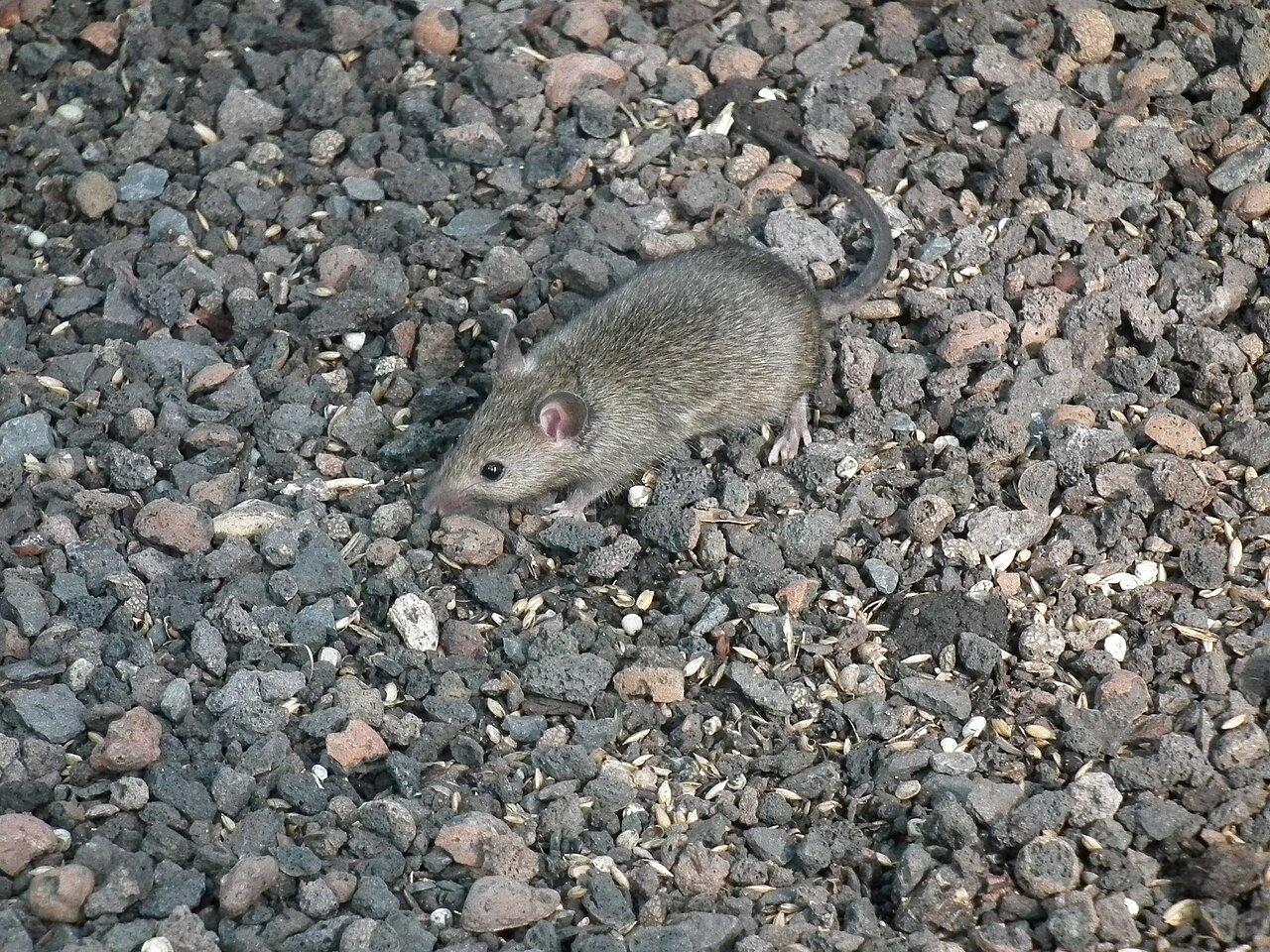
In its habitat

The young

Identification
A small, slender mouse with a pointed muzzle, bulging black eyes and large, round, thin ears. The coat is grey-brown to dull brown. The decisive character is the belly: grey to yellowish white, grading gradually into the back colour, with no sharp line and never pure white. Animals living indoors are darker and have greasier fur than those from the fields. The tail equals head and body together, is almost naked, scaly and clearly ringed, and is not bicoloured. The species walks and runs low over the ground, climbs well along rough walls and cables, and jumps only when necessary. An occupied room has a sweet, pungent mousy smell, a reliable indication. In the hand the upper incisor is decisive: in Mus the back of the incisor has a small notch that other mice lack.
Similar species
The Wood Mouse is the most frequent confusion, especially in sheds and houses near woodland: it has larger eyes and ears, is warm russet above and sharply demarcated pure white below, has a bicoloured tail and moves in long bounds rather than running. The Harvest Mouse is much smaller and orange-brown, with a prehensile tail. A young Brown Rat has a proportionately much heavier head, smaller ears and much larger feet than an adult House Mouse of the same weight. Shrews, such as the Greater White-toothed Shrew, are insectivores with a long pointed snout, very small eyes and velvety fur. In southern Europe, and especially in the Iberian Peninsula, the Algerian Mouse (Mus spretus) is the main confusion species: the other species of the genus and there the mouse of open country. It has a tail clearly shorter than head and body, a more sharply defined pale belly and slightly smaller ears, and lives in fields, margins, scrub and banks, where the House Mouse comes only in summer. As a rule of thumb, which does not always hold: indoors a House Mouse, in Mediterranean open country an Algerian Mouse.
Habitat
All places where people store or spill food: houses, farms, barns, stables, silos, mills, bakeries, warehouses, shops, cold stores, zoos, ships and refuse tips. In the warm season the House Mouse moves outdoors into cereal fields, allotments, rough corners, log piles and reedbeds, and in autumn it comes back indoors; this annual movement is the normal pattern in north-west Europe. In the Mediterranean region and on islands it can live outdoors all year, although much of the open country there is occupied by the Algerian Mouse. In warmer countries it reaches about two thousand metres in the mountains, always near people.
Where the animal is most at home, classified with EUNIS — the European standard for habitats.


Distribution
Originally a species of the steppe and semi-desert margins of the northern Indian subcontinent and the Middle East. The House Mouse is a commensal species: not a bred domestic animal but a wild species that attached itself to human grain stores at the beginning of agriculture and spread around the world from there. With grain and shipping it reached the eastern Mediterranean in the Bronze Age and north-west Europe in the Iron Age and Roman period, and later, with European shipping, the Americas, Australia and almost every island in the world. Two forms occur in Europe: the western House Mouse (M. m. domesticus) in western Europe, the British Isles, Iceland and the Mediterranean region, including the Iberian Peninsula, and the eastern form (M. m. musculus) in eastern Europe and Scandinavia, with a narrow, much-studied hybrid zone across Jutland and Germany. The species occurs throughout Britain and Ireland, in towns and on farms; everywhere in the Netherlands and Belgium, including the Wadden Islands and the Flevopolders, which it colonised in the 1950s; and in Spain throughout the mainland, the Balearics and the Canary Islands, tied to villages, towns, farms and stores. In well-insulated new buildings with strict hygiene it is less common than formerly; on farmyards, in old town centres and at food businesses it is still numerous.
- Established introduction
- dark = core range, pale = thinly spread
Way of life
Nocturnal, with a peak in the first part of the night, but also active by day in a quiet, dark building. An omnivore with a strong preference for seeds and grain, and also bread, fat, cheese (less than is commonly assumed), nuts, insects and indoors almost anything edible. The House Mouse drinks little and can live on dry food using the moisture it contains. It lives in small family groups with a dominant male that defends a territory of a few square metres to a whole room and marks it with urine. Indoors the species breeds all year round, with five to ten litters a year of four to eight young after a gestation of nineteen to twenty-one days; the young are fertile at six weeks. This capacity for rapid reproduction is the core of the nuisance it causes. Outdoors breeding stops in winter. There is no hibernation. In the wild a House Mouse rarely lives longer than a year, in captivity two to three years. The laboratory mouse is derived from this species, which makes the House Mouse one of the best-studied mammals.
Where and when to look
Listen and smell rather than look. Sit quietly in a barn or stable in the evening with one weak light and wait: the rustling along the walls usually begins within half an hour, and the mouse can be followed with a red torch. By day, signs provide the evidence: dust a thin layer of flour or talc on a shelf along a wall and look the next morning for prints and the tail drag. Search along skirting boards for smear marks and droppings, and in old buildings for urine pillars. Outdoors the House Mouse can be found in late summer in cereal fields or allotments, but there a Wood Mouse, or in the Mediterranean an Algerian Mouse, is more likely; check the belly and tail. To keep the species out, sealing gaps is more effective than poison: a House Mouse can pass through an opening of six millimetres.
Conservation status
Least Concern (LC, 2021) and one of the most numerous mammals on earth. The main issue with this species is not its survival but the damage it causes: the House Mouse fouls and destroys stored food, gnaws cables and insulation and is a known cause of fires through gnawed wiring, and it transmits salmonella, leptospirosis and mousepox virus, among others. Control with anticoagulants leaves residues in Barn Owls, Kestrels and Stone Martens, which is increasingly leading to restrictions in Europe; exclusion, by sealing gaps and closing stores, works better and for longer. On islands the introduced House Mouse causes great damage: on subantarctic and Atlantic islands, notably Gough Island, it eats petrel and albatross chicks alive, and on some islands it has been targeted by large-scale campaigns. The St Kilda House Mouse, a large, distinctive island form that lived entirely in and around the village on Hirta, became extinct within a few years of the island's evacuation in 1930; the St Kilda Field Mouse, which did not depend on the houses, still occurs there. In the Iberian Peninsula the division of village and open country between House Mouse and Algerian Mouse is a much-studied example of two closely related species partitioning their habitat.
Scientific name
Mus musculus | Linnaeus, 1758
Linnaeus described the species in 1758 and placed it straight away in the genus where it still stands. Mus is the Latin word for 'mouse', cognate with Greek mys. musculus is Latin for 'little mouse', the diminutive of mus. The specimen the first description was based on came from Sweden, Uppsala.