All species › Rodents › Voles and hamsters › Field vole
Field vole | Microtus agrestis
Aardmuis | Topillo Agreste
The Field Vole is a vole of damp, rank, unmown grassland. Its range extends from Britain and the Atlantic coast into Siberia and from Lapland to the Alps and the Carpathians. Over much of it the species lives alongside the Common Vole, which it closely resembles; separating these two is the starting point for identification within the group.
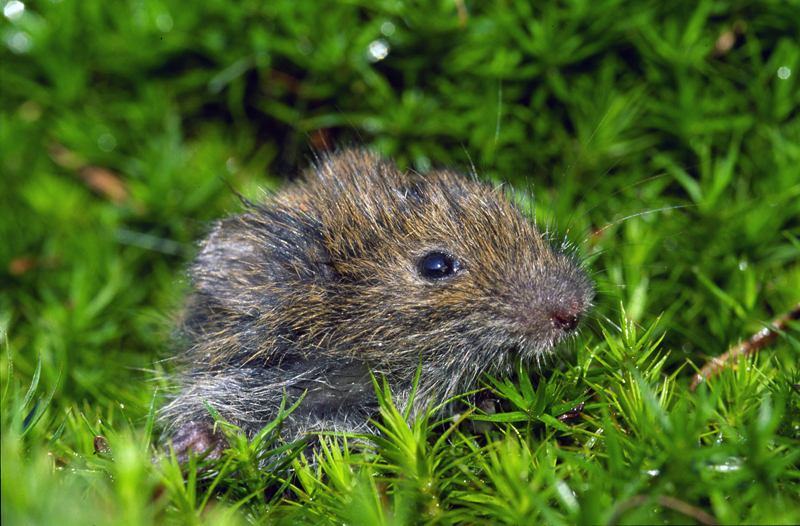
Tracks
The most visible sign is the runway system in unmown grass. Under the tussocks lies a network of channels three to four centimetres wide, worn down to the root mat, with the burrow entrances between them: round holes about three centimetres across, usually without a spoil heap. Unlike the Common Vole the Field Vole digs little; its tunnels are shallow, at most twenty to thirty centimetres deep, and most of the system lies above ground, under the vegetation. The nest is a ball of finely shredded grass about twenty centimetres across, built in a shallow scrape under a tussock or under snow; after the thaw these balls lie uncovered on the field. Along the runs lie clipped grass stems of two to five centimetres, bitten off at an angle and heaped at the side, and the droppings: blunt-ended cylinders of four to seven millimetres, grass green when fresh and brown later, in small latrines at fixed points. In winter and at high densities it gnaws bark at the base of young trees and shrubs; in British and Scandinavian forestry plantations it is the rodent species that causes the most damage. Barn, Long-eared and Short-eared Owls take the species in large numbers, and pellet analysis is the most reliable source for the entire group. Microtus cheek teeth are flat, folded into sharp zigzag prisms and grow throughout life, whereas those of the Bank Vole develop roots and wear; within the genus the Field Vole is recognised by the second upper molar, which carries an extra inner triangle that is always separated from the rest.
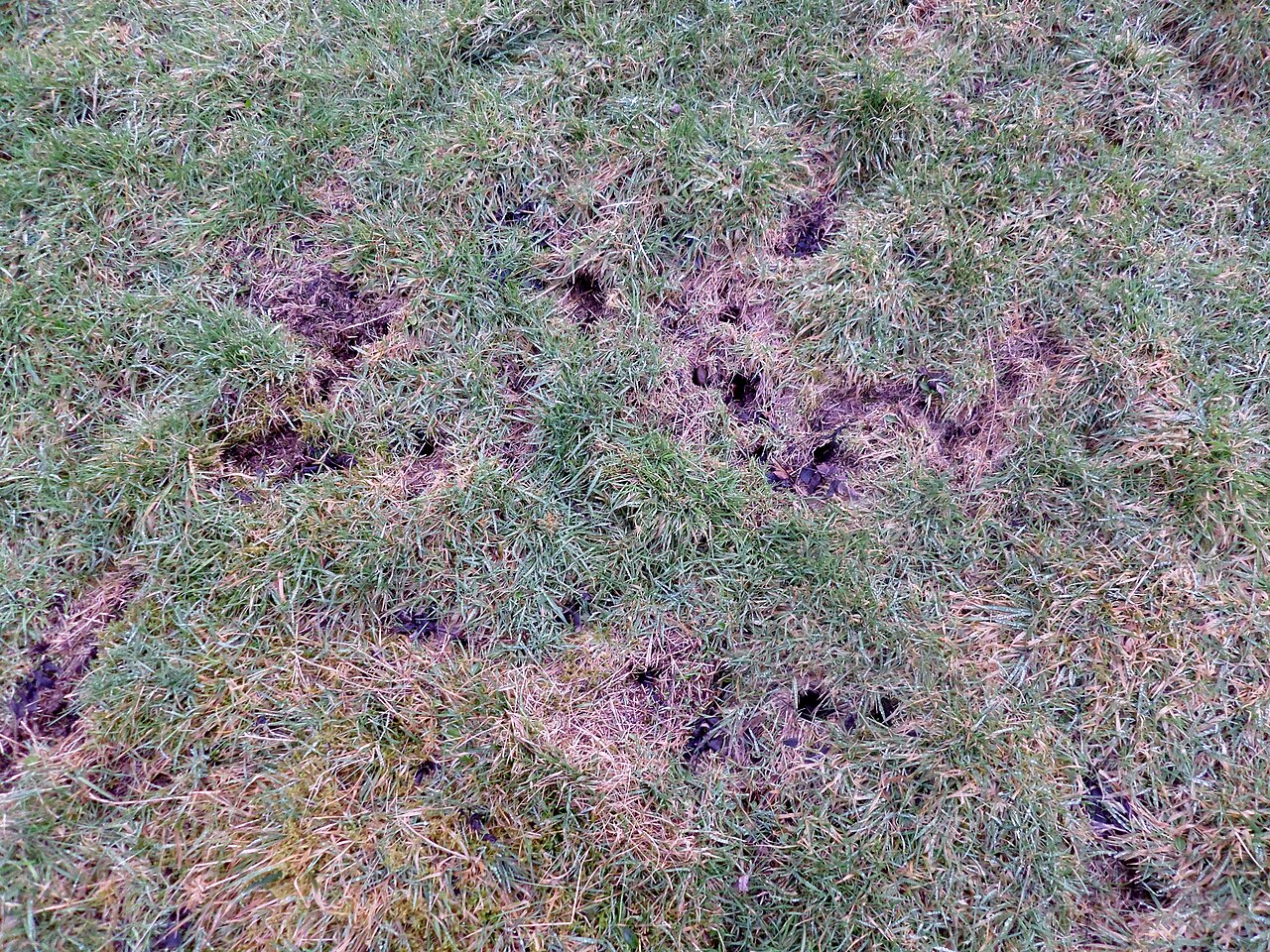
In its habitat
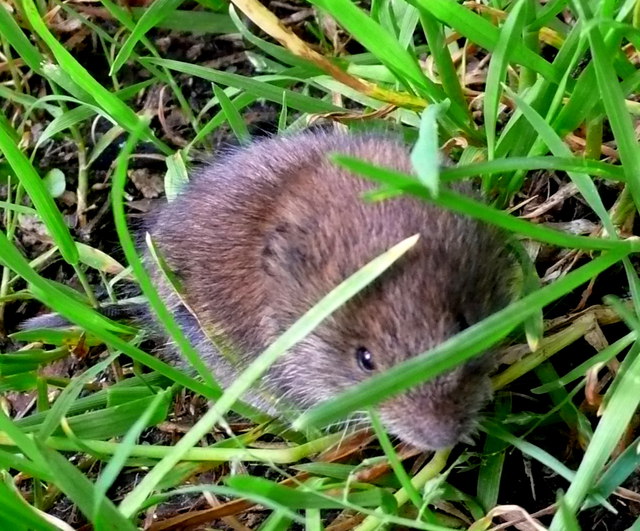
Head close-up
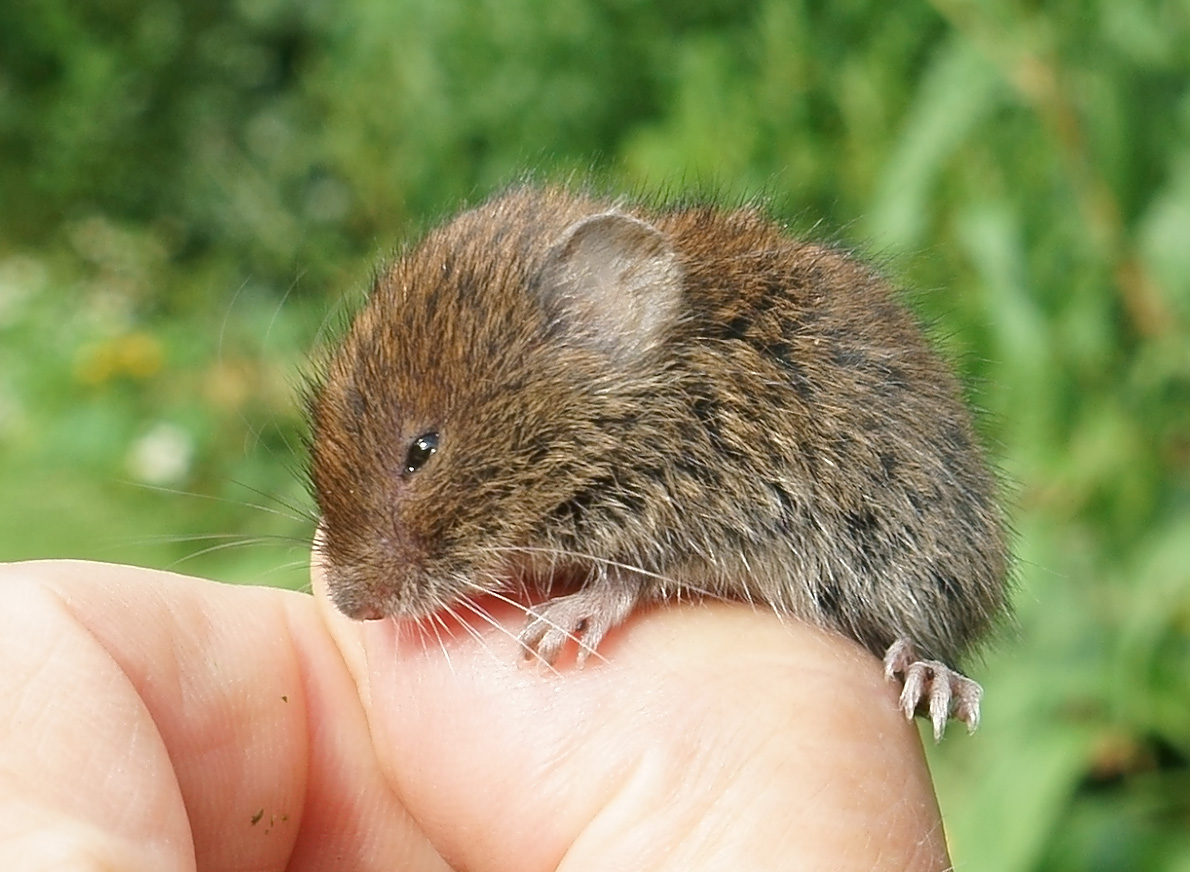
The young
Identification
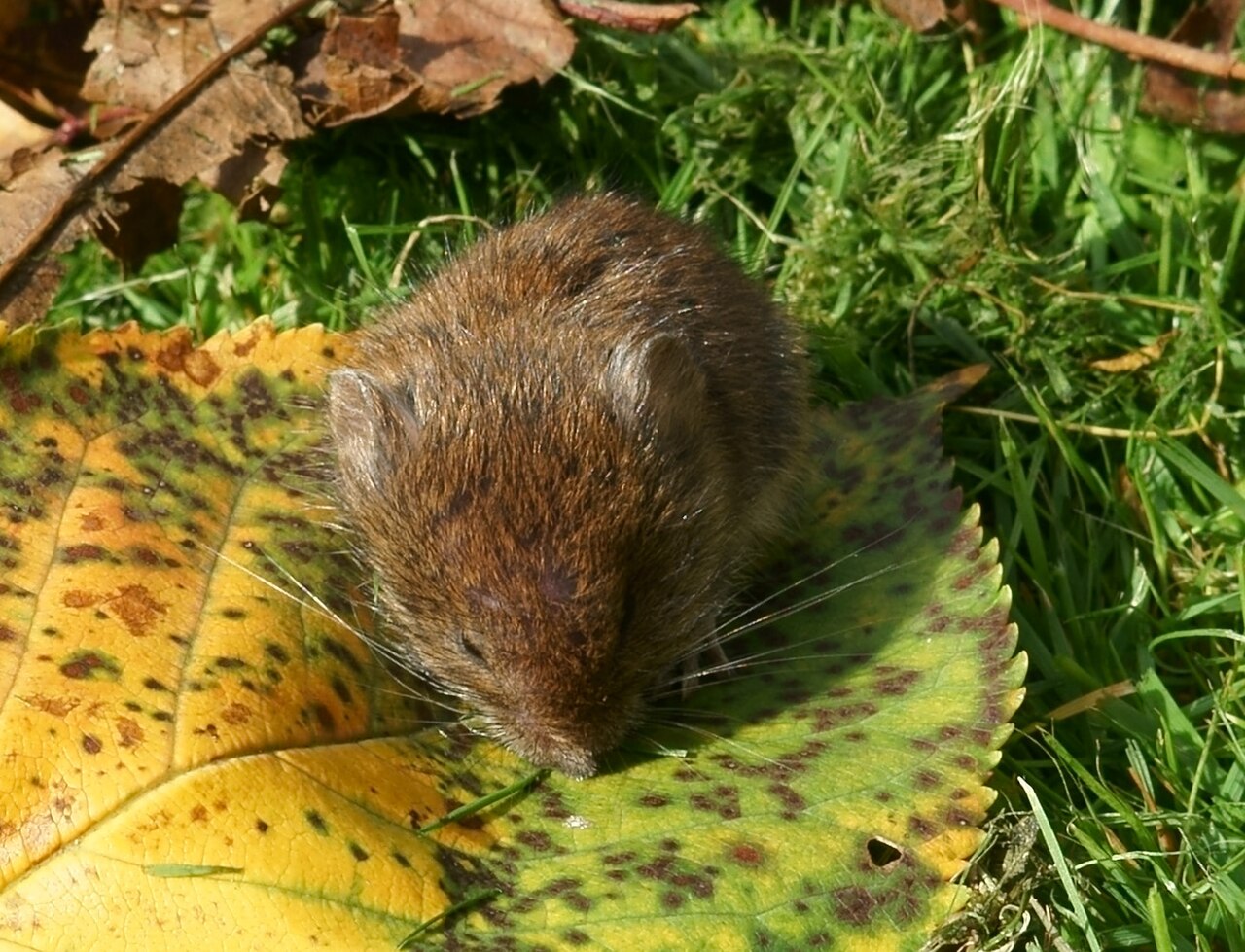
A thickset vole with a blunt, rounded head, small eyes and a short tail of 2.7 to 4.7 cm, about a third of the head-body length. The coat is long, soft, shaggy and dark, greyish to chestnut brown above, often with a dull blackish wash along the flank, and cream-grey below; long guard hairs stand clear of the underfur, so that the coat looks fluffy and uneven. The tail is distinctly two-coloured, dark above and pale below, and haired. The most usable character is on the head: the ears are small, rounded, half hidden in the long hairs at their base, and hairy on the inside. In the Common Vole they project just clear of the fur and the inside is bare. This difference can only be assessed with the animal in the hand and in good light, not through binoculars.
Similar species
Field identification of this species usually gives no certainty. Where the Common Vole occurs in the same area, as in the Netherlands, Belgium and on the European mainland, a vole running through grass cannot be identified, and a sharp photograph of a vole in a verge usually cannot either. On the British mainland the Field Vole is the only Microtus; the Common Vole occurs there only on Orkney and Guernsey, so that confusion is limited to Bank Vole and Wood Mouse. An indication comes from the combination of coat and ground: darker, shaggier and longer-haired in damp, unmown, tussocky grass, against smoother, yellower and shorter-coated in short, dry, grazed sward. In a wet meadow corner, a rough ditch bank or a young plantation the Field Vole is the likely species, on short pasture the Common Vole; this gives no certainty. In the hand, ear size and the hairy inner surface of the ear are useful, and in case of doubt the teeth. The Root Vole is larger, darker and longer-tailed, lives in wet, marshy ground and overlaps with the Field Vole in reedbed and fen. The Bank Vole has a reddish-brown back, large eyes, clearly projecting ears and a tail twice as long, and lives in woodland and scrub; the Wood Mouse has very large ears, bulging eyes and a tail as long as the body, and moves by bounding; the Harvest Mouse is very small and orange-yellow, with a prehensile tail. In southern and south-western Europe two species have been split from the Field Vole that cannot be distinguished from it morphologically: Microtus lavernedii in southern France, northern Italy, the Alps and northern Spain (from Cantabria and the Basque Country along the Pyrenees to Catalonia) and Microtus rozianus in north-western Iberia (Galicia, western Asturias and León and northern Portugal). The boundary between the two lies at about six degrees west and has been established only genetically. Assignment there is based on locality; in the narrow contact zone in the Swiss Jura even that is not possible.
Habitat
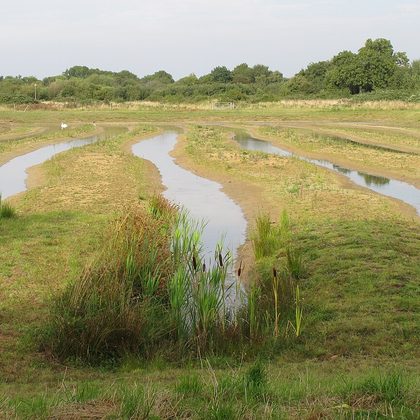
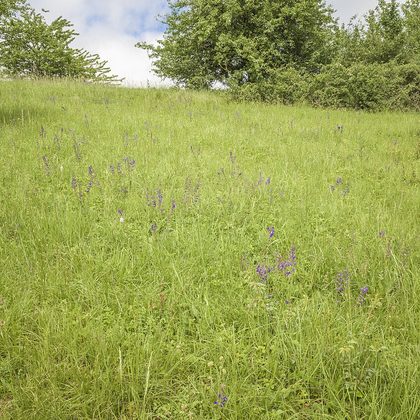
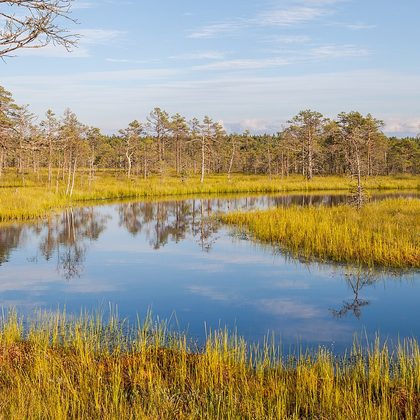
Rank, damp, unmown and ungrazed grassland: wet hay meadows, rough ditch banks and dyke feet, reed and sedge fen, purple moor-grass stands, bog, wet heath, young forestry plantations and clearfell with regrowth, railway embankments, fallow land and dune slacks. The species depends on a dense, tall herb layer and disappears where ground is closely grazed or mown; there the Common Vole replaces it. In Britain and Scandinavia the Field Vole also occurs in woodland and on heath, moorland and bog, and in the mountains above two thousand metres.
Where the animal is most at home, classified with EUNIS — the European standard for habitats.



Distribution
From Britain and the Atlantic coast into Siberia and from Lapland to the Alps and the Carpathians. In the south and south-west the species is replaced by two split-off sister species; it is therefore absent from the Iberian Peninsula, southern France and Italy. Older records of Microtus agrestis from Galicia, the Cantabrian coast, the Pyrenees and Catalonia refer to M. rozianus and M. lavernedii. In Britain the Field Vole is one of the most abundant mammals, common from Cornwall to the Scottish Highlands and present on most of the larger islands; on the mainland it is the only Microtus. In Ireland the species was naturally absent; since 2020 it has been confirmed there, first in County Monaghan, and breeding populations now occur in the northern third of the island, probably after deliberate introduction. In the Netherlands and Belgium it is common where grassland remains rank, with lower numbers in the north-west of the Netherlands and on some of the Wadden Islands, and absent from intensively mown farmland. Unlike the Common Vole the Field Vole does not cause agricultural plagues, but its numbers fluctuate with vole years; this is reflected in the breeding success of Short-eared Owl, Hen Harrier, Kestrel and Rough-legged Buzzard and in the numbers of Weasel.
- Native
- dark = core range, pale = thinly spread
Way of life
Active in short bouts of two to four hours spread over day and night, in summer mainly at dusk and at night, in winter mainly by day; in the Common Vole activity is more diurnal. Almost entirely herbivorous: leaves and stems of grasses and herbs, with a preference for clover and dandelion, and in winter grass seed, roots, fungi and bark. The Field Vole is not colonial but lives in overlapping ranges of a few hundred to well over a thousand square metres, in which breeding females defend a territory and males avoid one another; the mating system is promiscuous, and up to a third of litters have more than one father. From March to October, and in mild winters all year, litters follow after a gestation of about twenty days, with one to eight young; northern litters are larger than southern ones and summer litters larger than winter ones. Young females are fertile at about four weeks and, if born early in the year, breed before their first winter. Scarcely any Field Vole reaches twenty months, and almost none survives a second winter. There is no hibernation; under snow the species is at its most active.
Where and when to look
Look in March, when after the thaw the whole runway system is exposed: walk a rough dyke foot, a wet meadow corner or a young plantation and look for the grass balls and the channels between them. The animal itself is best seen by waiting patiently at the edge of a moor-grass tussock at first light or at dusk; it moves with its head low and disappears at the least sound. A hunting Short-eared Owl, Kestrel or Rough-legged Buzzard over rough ground gives an indication of a suitable site. The most reliable method is pellet analysis: collect pellets under a Barn Owl roost in winter and tease them apart. This gives more information on the voles in an area than field observation, and it is the only method that separates Field Vole from Common Vole with certainty.
Conservation status
Least Concern (LC, 2024). Across its range the Field Vole is one of the most abundant mammals in northern Europe; the British pre-breeding population alone is estimated at seventy-five million. At the eastern edge of the range, in eastern Siberia, the species is scarce. The species depends on rank vegetation. Where verges, dykes and ditch banks are cut short two or three times a year, where grassland reserves are grazed short and where hay meadows dry out, the Field Vole disappears and the Common Vole takes its place. For management this means phased mowing, leaving uncut strips over winter and not lowering water tables further. In northern Europe Field Voles are a main component of the diet of Short-eared Owl, Long-eared Owl, Kestrel, Weasel and Stoat, and in Britain also of the Hen Harrier.
Scientific name
Microtus agrestis | (Linnaeus, 1761)
Linnaeus described the species in 1761 as Mus agrestis; because it was later moved to another genus, the author and year stand in brackets. Microtus is Greek, from mikros, 'small', and ous, genitive ōtos, 'ear', after the small ears hidden in the fur. agrestis is Latin for 'of the fields, rural', from ager, 'field'. The specimen the first description was based on came from Sweden, Uppsala.