All species › Hedgehogs, shrews and moles › Shrews › South European White-toothed Shrew
South European White-toothed Shrew | Crocidura fimbriata
Crocidura fimbriata | Crocidura fimbriata
Crocidura fimbriata is the small white-toothed shrew of central Europe and the Balkans. In Germany, Austria, Czechia, Hungary and Greece this species was called Crocidura suaveolens for a century, and before that mimula. Since the Mammal Diversity Database split the suaveolens group, it carries the oldest available name: fimbriata, which Wagler gave in 1832 to a shrew from Bavaria. The English name 'South European White-toothed Shrew' does not fit well with this type locality. Measurements, range limits and way of life of the species are still largely unknown.
No photograph of a living wild animal of this species with a suitable Creative Commons licence exists. Do you have one that meets the rules? Send it in.
Tracks
No signs can be attributed specifically to this species; what follows applies to the genus and was recorded in central Europe under the old name. The dropping is two to four millimetres long, dark grey to black, pointed at both ends and glossy from fine insect remains; it lies at a fixed place in a run, under a stone, plank or paving slab. The runs are half a centimetre to one and a half centimetres wide and run through the litter layer, under the turf and along the foot of walls and field margins; they are narrower than vole tunnels, which are also used. A print is barely a centimetre long, with five toes on fore and hind foot, and is not recognisable on almost any substrate. Sound: high, shrill, rapidly repeated squeaks when foraging and in conflicts. Pellets of Barn, Little and Long-eared Owls are the main source for establishing presence, with the same limitation as in the field: within the suaveolens group only the genus, not the species, can be determined from the remains.
Identification
A small, finely built white-toothed shrew with the characters of the genus: pure white teeth without red-brown tips, a long, pointed, constantly moving snout, very small eyes, ears projecting above the fur and a tail with long, projecting tactile hairs among the short hair. The coat is brownish grey to grey on the back and paler grey on the belly, with a gradual transition: there is no dividing line. No field measurements have been published for this species in the strict sense. The handbooks still treat the animal under the Lesser White-toothed Shrew or under Crocidura gueldenstaedtii, and the measurement series given there belong to those species in the broad sense.
Similar species
In the field the species cannot be identified. The Bicolored Shrew (Crocidura leucodon) can be ruled out; it occurs throughout the range and has a sharp boundary between dark back and white belly; if that boundary is present it is the Bicolored Shrew, if it is absent it is not that species. The red-toothed shrews (Sorex) can also be recognised: red-brown tooth tips, three colour zones with a separate flank band and small ears lying in the fur. Savi's Pygmy Shrew (Suncus etruscus), at a few grams, is clearly smaller. Separation from its close relatives is not possible. From the Greater White-toothed Shrew (Crocidura russula), with which it co-occurs from south-western Germany to northern Italy, it differs only in average size, which is not usable for an individual animal. From the Lesser White-toothed Shrew (C. suaveolens) and from C. gueldenstaedtii at the eastern and south-eastern edge of the range it cannot be distinguished externally; there the names rest on locality and DNA. A white-toothed shrew without a flank boundary in, for example, Czechia or Croatia is therefore best recorded as 'Crocidura, small species', with a precise location. In this group the locality is the most important identification datum.
Habitat
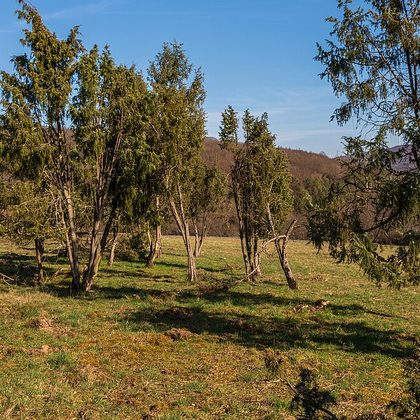
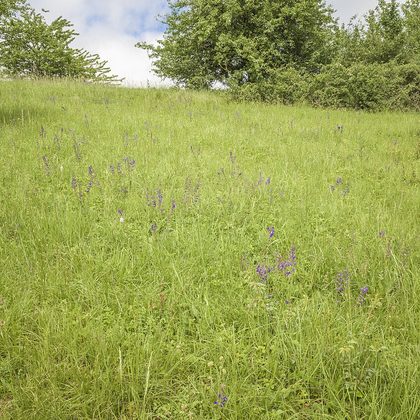
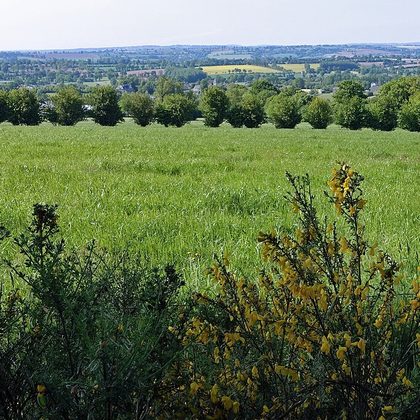
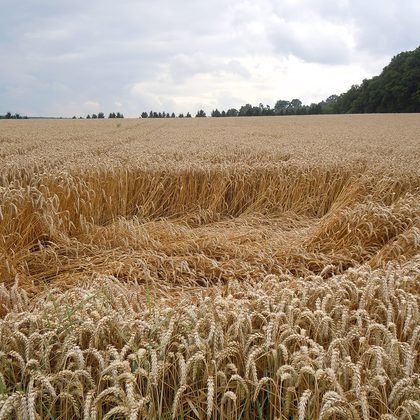
Nothing has been published separately on the habitat selection of this species in the strict sense; what follows is based on data from central Europe and the Balkans under the old name. The species can be expected in warm, dry and open areas: dry to moderately damp grassland with a permanent, herb-rich sward, sunny south slopes and stone heaps, field margins, verges, dykes and railway embankments, hedgerows and shelterbelts, vineyards, orchards, allotments and gardens. A dense herb or litter layer is essential; flailed verges and grassland mown completely every year are unsuitable. In winter part of the population moves to farmyards, sheds, hayricks and compost heaps, where the animals are then most often seen. In the mountains the species stays below the treeline.
Where the animal is most at home, classified with EUNIS — the European standard for habitats.


Distribution
Central and south-eastern Europe. The Mammal Diversity Database lists Germany, Switzerland, Liechtenstein, Austria, Czechia, Slovakia, Poland, Hungary, Moldova and Ukraine, and further Italy, Slovenia, Croatia, Bosnia and Herzegovina, Serbia, Montenegro, Kosovo, North Macedonia, Albania, Bulgaria, Romania and Greece. The handbook describes the same lineage more broadly, from north-western France and northern Italy east to western Ukraine and the Balkans. The boundary with Crocidura iculisma in the west and with C. gueldenstaedtii and C. suaveolens in the east and south-east cannot be determined precisely; the ranges rest on individual samples and not on systematic mapping. The species is absent from the Low Countries, where only the Greater White-toothed and Bicolored Shrews occur, and from the Iberian Peninsula, where the western lineage of this complex is Crocidura iculisma. The type locality is in Bavaria. In older literature the species appears under Crocidura suaveolens, C. suaveolens mimula or C. gueldenstaedtii mimula, and further under names such as moschata, minor, antipae, italica, debeauxi and balcanica.
- Native
- dark = core range, pale = thinly spread
Way of life
Nothing has been studied of the way of life of this species in the strict sense; what follows applies to the small white-toothed shrews of the group. They are active in short bouts throughout the twenty-four hours, with the emphasis on night and twilight, and cannot go long without food; a shrew uses roughly its own weight each day. The diet consists of small invertebrates: beetles and their larvae, caterpillars, spiders, woodlice, centipedes, worms and small snails. Breeding runs from early spring into late summer, with several litters of four to six young in a nest of fine grass under a stone or plank or in a tussock. There is no hibernation, because the animals are too small for it. The shrinking of skull and brain known in the red-toothed shrews (Sorex) as Dehnel's phenomenon has not been established in white-toothed shrews; in this genus energy is saved by entering short torpor on cold nights and by several animals sharing one nest. Caravanning (each young grips the fur of the one in front, the first that of the mother) is common in related species and probably also occurs in this species. A Crocidura seldom lives longer than eighteen months.
Where and when to look
In this group an observation usually yields not a species name but a locality, and that is valuable. Lay a plank or sheet of corrugated iron on a rough, sunny spot along a field margin, dyke or garden edge and lift it every few weeks. Listen on summer evenings along walls and compost heaps for the shrill squeaking. In winter sheds and hayricks are the best places. For research it is useful to dissect pellets and keep the material: because the boundaries between this species and its relatives are nowhere fixed, dated, precisely located series of skull remains from, for example, southern Germany, Croatia or Greece are needed to map those boundaries. As far as is known, no freely licensed photograph exists of an animal identified as this species; a photograph in profile, with the tail visible and a precise location, is therefore valuable.
Conservation status
Not Evaluated (NE). The IUCN follows the broad species concept in which these animals fall under Crocidura suaveolens, which is assessed as Least Concern; there is no separate assessment of Crocidura fimbriata, while the Mammal Diversity Database does recognise it as a species. This is almost certainly a widespread species in twenty-two countries, but as a result there is no official population estimate, trend or threat analysis for one of the commonest small mammals of central Europe, and all available data have been published under the name of another species. In practice the species is affected by the same factors as small-scale farmland: loss of herb-rich verges, field margins and dykes, flail mowing and complete annual mowing, clearing of stone heaps and brash piles, and the decline of insects. Specific protection is probably not needed; first basic data are needed, such as measurements, a distribution map and a delimitation from related species, as a basis for an assessment.
Scientific name
Crocidura fimbriata | (Wagler, 1832) (GBIF: Crocidura russula)
Wagler described the species in 1832 as Sorex fimbriatus; because it was later moved to another genus, the author and year stand in brackets. Crocidura is Greek, from krokys, genitive krokydos, 'flock of wool, nap', and oura, 'tail', after the long loose hairs standing out among the short ones on the tail. fimbriata is Latin for 'fringed', from fimbriae, 'fringe', after the long bristle hairs standing out from the short fur of the tail. The specimen the first description was based on came from Germany, Bavaria.