All species › Carnivores › Mustelids › Stone marten
Stone marten | Martes foina
Steenmarter | Garduña
The stone marten is a marten of open and semi-open country, rock and buildings, from western Europe to Central Asia. It often lives in buildings and is therefore the marten most often recorded near people, usually by its signs: droppings and chewed cables and insulation. In the field it can be separated from the pine marten only under good conditions.

Tracks
The forefoot print is 30 to 40 mm wide and 30 to 35 mm long, the hind print about 35 mm long and 43 mm wide. The scat is 8 to 10 cm long and 10 to 12 mm thick, and often contains stones and seeds of fruit and berries. In buildings chewed cables and torn insulation are typical. Rest sites are in rock crevices, stone heaps, hollow trees, old burrows and buildings.
Identification
A slender marten with a long body, short legs and a bushy tail about half the body length. The fur is greyish brown to dark brown; legs and tail are darker than the back. Characteristic is the white to cream throat patch (bib), which is often split into two parts that extend onto the forelegs. The underfur is pale and shows through the guard hairs, making the animal look greyer than a pine marten. Males are larger than females: males measured in the Netherlands are 40 to 52 cm long and weigh 1400 to 2100 g, females 37 to 48 cm and 900 to 1700 g.
Similar species
The pine marten is the only species with which confusion is likely. The best field character is the underfur: pale in the stone marten, dark in the pine marten. The stone marten's bib is white and often forked down onto the forelegs. In the skull the third upper premolar differs: its outer edge is slightly convex in the stone marten and concave in the pine marten. On a camera-trap image at night, or with an animal seen briefly in headlights, the species often cannot be identified with certainty. The polecat is darker, has a white facial mask, no bib and a shorter tail.
Habitat
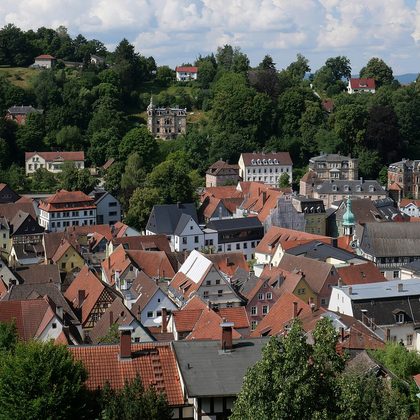
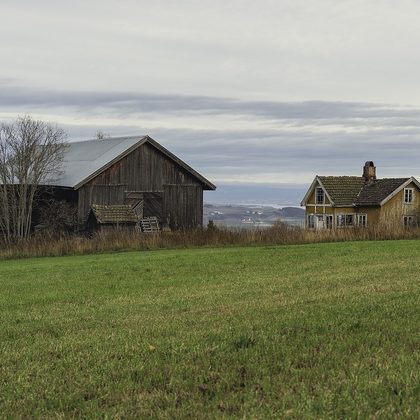
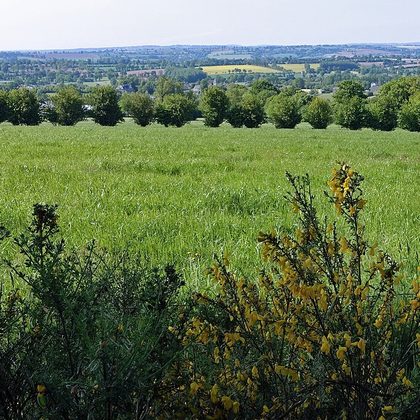
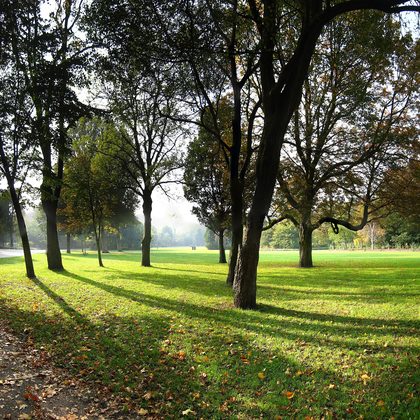
Woodland and open and rocky ground up to 4000 m, but also fragmented woodland, hedgerows, farmland, villages and towns. The species lives in more open terrain than the other martens. In a study in fragmented agricultural landscape it preferred areas with copses and scrub and watercourses with continuous bank vegetation, and avoided arable land. It also lives close to people and uses buildings as rest sites.
Where the animal is most at home, classified with EUNIS — the European standard for habitats.



Distribution
Mainland central and southern Europe, the Caucasus, Turkey, the Levant and further the Middle East and Central Asia to Mongolia, central and south-west China and northern Myanmar. It is absent from Britain and Ireland; in Scandinavia it occurs in Denmark and southern Sweden. It was introduced to Ibiza and has since disappeared there; it has been introduced to the United States (Wisconsin).
- Native
- dark = core range, pale = thinly spread
Way of life
Nocturnal and crepuscular; an animal can travel 10 to 15 km in a night. Stone martens are solitary. They climb well but rarely go high into trees. Home ranges measure 12 to 211 ha in different studies and 80 to 700 ha in the Netherlands; they are larger in summer than in winter and larger in males than in females. Food consists of rodents, birds, eggs, reptiles, amphibians, insects and fruit and berries, with strong seasonal and regional variation: in France voles made up 30 to 55% of the diet, in central Italy fruit was the main food and the winter diet was 84% fruit by volume, mainly juniper and sloe. Mating takes place from June to August. Because of delayed implantation of the fertilised egg, young are born only in March or April; total gestation is 230 to 275 days, actual development about 30 days. There are usually 3 to 4 young.
Where and when to look
Look for signs in and around buildings: droppings containing fruit stones and seeds, and chewed cables and insulation. A camera trap at a latrine gives the best images; check the underfur and the shape of the bib to separate it from a pine marten.
Conservation status
Least Concern (LC, 2024). The species is common in most of Europe and Asia. It is hunted for its fur, which is worth less than that of the pine marten. In the Netherlands it is increasing, except in the west of the country; traffic and illegal control are the main causes of death there, despite legal protection.
Scientific name
Martes foina | (von Schreber, 1776)
Von Schreber described the species in 1776 as Mustela Foina; because it was later moved to another genus, the author and year stand in brackets. Martes is the Late Latin word for 'marten', taken over from a Germanic language (compare German Marder); its further origin is unknown. foina goes back to Late Latin fagina, 'of the beech', from fagus, 'beech'; French fouine comes from the same word, and English once had beech marten. The specimen the first description was based on came from Germany.