All species › Carnivores › Mustelids › Wolverine
Wolverine | Gulo gulo
Veelvraat | Glotón
The wolverine is the largest terrestrial member of the weasel family. Within the guide area it occurs only in northern Fennoscandia and adjacent Russia, in fell, taiga and tundra. The animal itself is seldom seen; most field work on the species relies on tracks in snow, on DNA from scats and hair, and on counting natal dens in snowdrifts.
Tracks
The print is large: the forefoot measures 9 to 18 cm long and 7 to 14 cm wide, the hind foot 8 to 12 cm long and 6 to 14 cm wide. Normally five toes with claw marks show; on hard ground often only the four front toes register. The wolverine is partly plantigrade, so in soft snow part of the sole registers too. The usual gait is a lope that leaves the prints in groups of three (Norwegian: trespor); the trail runs purposefully through the terrain. The print differs from a lynx print in the claw marks and the fifth toe, and from a wolf or dog print in the number of toes and the broader, rounder front; compared with a bear the trail straddles far less. At a kill, usually a reindeer or sheep, powerful bites high on the neck and across the back with a canine spacing of 2.4 to 3.5 cm and crushed neck vertebrae point to a wolverine. Prey and parts of prey are cached in springs, bogs, streams, screes and snowdrifts, or wedged in a tree fork, and covered with snow or earth. At natal dens large amounts of scat accumulate at fixed latrines.
Identification
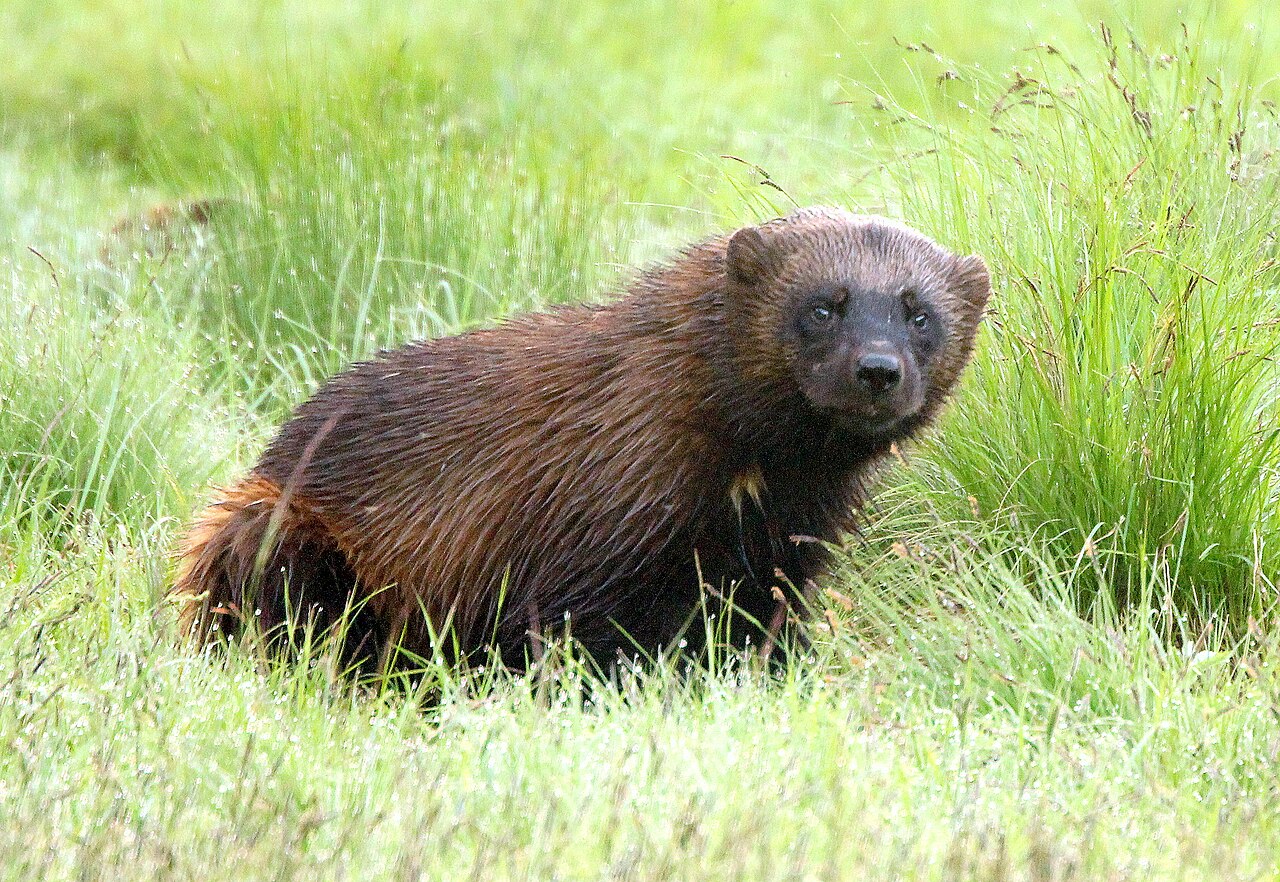
A heavily built, stocky animal with short legs, large feet with strong claws and a broad head with small, rounded ears. The fur is long and ranges from almost blond to dark brown. Characteristic are two pale, yellowish bands running from the neck along the flanks to the rump; white patches on throat, chest or legs are common. The tail is short and bushy. Males weigh up to 18 kg, females up to about 12 kg.
Similar species
A young brown bear has a similar silhouette and also walks on the whole sole, but lacks the pale flank bands and the bushy tail; The badger is grey and has a black-and-white striped head. The pine marten has the same build in miniature but weighs two kilos at most, is slimmer and has a yellow or orange throat patch. On a night-time camera-trap image a dog or fox can resemble a wolverine until the short legs and the pale band come into view. In snow the confusion lies mainly with the print, which is about as large as that of a lynx or a wolf.
Habitat
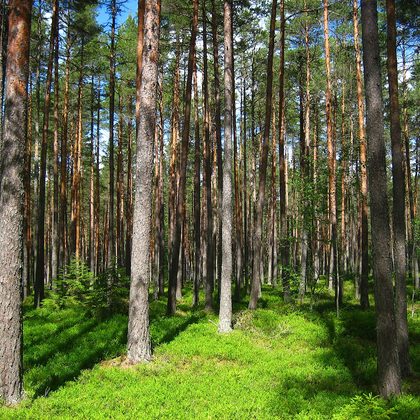
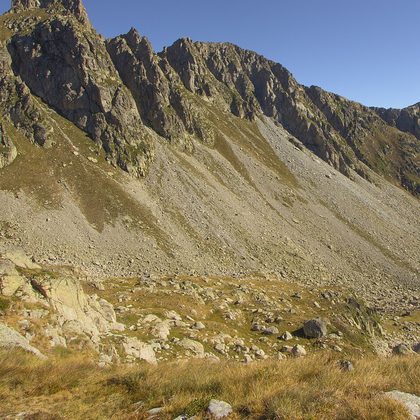
Mature coniferous forest in the taiga and the treeless tundra; in Norway mainly the mountains. The species uses forest more in winter and open tundra more in summer, and moves seasonally in altitude, higher in summer and lower in winter, probably in response to snow and prey. Natal dens are in alpine, subalpine or tundra terrain under at least a metre of snow; in Norway usually in a snowdrift against a low rock face. Studies in North America show that the species avoids roads, clearcuts and areas with heavy winter recreation.
Where the animal is most at home, classified with EUNIS — the European standard for habitats.


Distribution
Circumpolar: Fennoscandia, Russia, Mongolia, northern China, Canada and the western United States. Within the guide area the species is restricted to Norway, Sweden, Finland and north-western Russia; the Mammal Diversity Database also lists Estonia. In Norway it lives mainly in the mountains along the borders with Sweden and Finland, from Innlandet northwards. A spatial capture-recapture analysis by the Norwegian University of Life Sciences (NMBU), based on a series of nine winters (2014–2022), estimated the Scandinavian population at 980 to 1088 animals, with slight growth that took place mainly in Sweden; the Norwegian population stayed level over that period. Density in Scandinavia is around one animal per 500 km².
- Native
- dark = core range, pale = thinly spread
Way of life
Mainly nocturnal but also active by day, and active all year: deep snow does not hinder the species. The wolverine is solitary, swims well and climbs trees. It covers large distances; daily movements of more than 30 km are common. A large part of the food is carrion of large ungulates such as moose and reindeer, in many areas from animals killed by wolves or other large predators. It also hunts reindeer itself (especially in deep snow), sheep, rodents, hares, birds and eggs, and occasionally eats berries. Large prey is killed with a bite to the neck or throat. Mating takes place from May to August; the fertilised egg implants only between November and March, so the young are born from January to April after a total gestation of 215 to 270 days. A litter has one to five, usually two to four young of about 84 g, furred but with closed eyes. They are weaned at seven to eight weeks and reach adult size by November, when they leave the mother. Females give birth about every second year and reach sexual maturity only after two to three years.
Where and when to look
The chance of seeing a wolverine is small; snow provides most records. From February to April, when the snow carries, a trail in the fells can be followed for kilometres. Look for the lope with three prints per group and count the toes: five points to wolverine, four with a round front to a canid or lynx. Because the species caches food and returns to carrion, a camera trap at a reindeer or moose carcass is a common method. Natal dens in snowdrifts must not be disturbed; keep your distance and report the location to the national large-carnivore monitoring.
Conservation status
Least Concern (LC, 2025) globally. In the past, fur trapping contributed to a decline in numbers and distribution, and the species was long persecuted for predation on reindeer and sheep. In Norway the wolverine is listed as Endangered (EN) on the national Red List. Management there works with a national target of 39 litters a year; in 2025 Rovdata recorded 51 litters and the population was estimated at 370 adults. Scandinavian monitoring relies on DNA from scats and hair and on the registration of natal dens.
Scientific name
Gulo gulo | (Linnaeus, 1758)
Linnaeus described the species in 1758 as Mustela Gulo; because it was later moved to another genus, the author and year stand in brackets. Gulo is the Latin word for 'glutton', from gula, 'throat'. The specific name repeats the genus name. The specimen the first description was based on came from Lapland.