All species › Passerines › Tits › African blue tit
African blue tit | Cyanistes teneriffae
Afrikaanse pimpelmees | Herrerillo africano
In the pine woods of Tenerife you hear a blue tit, look up, and something is wrong: the cap is not pale blue but almost black, and a stripe as broad as a great tit's runs down the yellow belly. The African blue tit is the tit of the Canary Islands and the Maghreb, darker and more sharply marked than the familiar bird, and it has been treated as a separate species for some years now. On most of the islands it is the only tit there is.

Voice
Recognisably blue tit, but harder and faster. The song is a short, accelerating tsee-tsee-tseerrrr, the closing trill drier and more rattling than in the northern bird. Calls are nasal and sharp: an angry cher-r-r-r at the nest and a thin tsi-tsi-tsi in contact. In Canarian pine forest the sound carries a long way between the trunks, and it is almost always the voice that gives the bird away before you catch the movement high in the crown.
No freely licensed recording is available for this species yet.
Identification
As small as blue tit, 11 to 12 cm, but with far more contrast. The crown is dark: deep blue-black to black, not the pale cobalt of the northern bird. A broad black eyestripe crosses the white face, runs behind the cheek and joins a black nape, so the white cheek is sharply framed. From the chin a broad black bib runs down as a clear wide stripe over the deep yellow underparts. The mantle is blue-grey to slate, without blue tit's green; wings and tail are cobalt. The islands differ among themselves: on Tenerife, La Gomera, La Palma and El Hierro the wing is plain, while birds of Fuerteventura and Lanzarote and those of the Maghreb show a white wing bar and a paler, greyer back. Seven subspecies in all, most islands with their own. Sexes alike; juveniles have yellow cheeks and a dull crown.
Confusion species
Blue tit is the only species in question, and yet you will never see the two together: blue tit is absent from both the Canaries and north-west Africa, and the two ranges nowhere meet. Two things carry the difference. The crown: dark blue-black to black on African blue tit, so the head looks dark and severe from above, against blue tit's cheerful pale blue. And the throat stripe: broad, black and sharply edged, from the chin well down the breast, where blue tit has only a thin, ill-defined dark line. Add a blue-grey rather than greenish mantle. In Morocco and Algeria great tit is present too, but it is much bulkier, with a black head and a white cheek and no blue anywhere.
Habitat
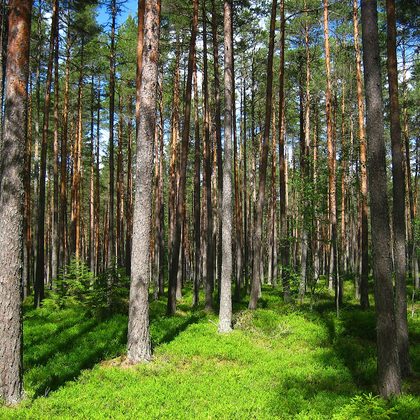
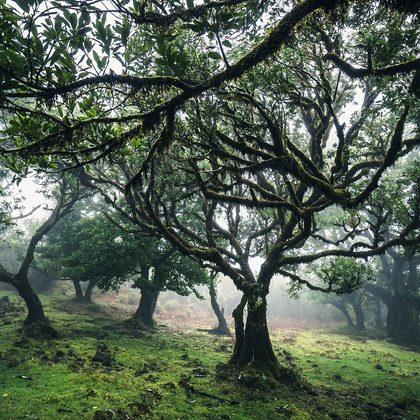
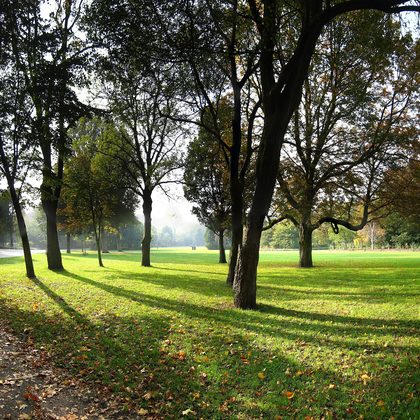
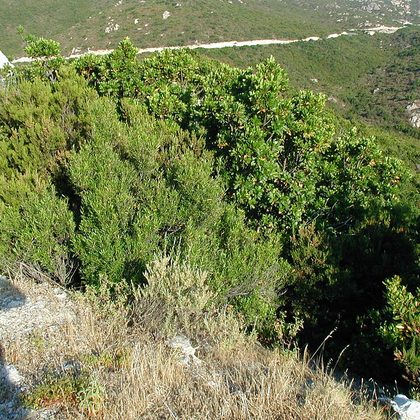
On the Canaries, anywhere with trees or tall shrubs: the Canary pine forest of the higher slopes, the laurel forest of the humid northern flanks, tree heath, and beyond that gardens and parks, banana and orange plantations, palm gardens and the thermophilous euphorbia scrub lower down. On the drier eastern islands it depends on the few palm groups and gardens there are. In the Maghreb it lives in mountain forest: cedar, cork oak, holm oak and mixed conifers in the Rif, the Middle Atlas and the Kabylie ranges, plus gardens and orchards. It nests in tree holes, wall crevices and nest boxes.
Where the bird is most at home, classified with EUNIS — the European standard for habitats.
Range and movements
Two blocks, both inside this guide. First all seven main Canary Islands, from La Palma and El Hierro in the west to Lanzarote in the east, with a distinct subspecies on almost every island — one of the clearest cases of island differentiation anywhere in the western Palearctic. Second north-west Africa: Morocco, northern Algeria, Tunisia and a small area of north-east Libya. It is absent from Madeira, the Azores and the Selvagens. Resident; it does not leave its island and moves little even within one, at most from the high pines down to lower gardens in winter.
- Resident
- Winter
- Passage
- dark = core range, pale = thinly spread
Where and when to look
Tenerife is the easiest: the pine woods above La Esperanza or along the road to the Teide, in the first hour after sunrise. In gardens and at picnic sites it comes within a few metres and photographs well. Anyone visiting several islands should look hard at the wing: the white wing bar of the Fuerteventura and Lanzarote birds is the most striking difference between the island forms, and one trip can give you two very different-looking birds. In Morocco, try the cedar forest at Azrou.
Conservation status
Not globally threatened (IUCN: Least Concern) and common on most islands. The concerns are local and are about habitat: the large fires that now hit Canary pine forest more often, the remnants of laurel forest that are small on several islands, and on Fuerteventura and Lanzarote the tiny, fragile populations tied to a handful of palm groups and gardens. In the Maghreb old cavity-rich forest is thinning under felling and grazing. Because nearly every island has its own form, a local blow weighs more heavily here than the overall total suggests.