All species › Passerines › Finches › African chaffinch
African chaffinch | Fringilla spodiogenys
Afrikaanse vink | Pinzón africano
The chaffinch of the Maghreb is the most distinctive of the four, and the only one that does not live on an island. It has been treated as a separate species since 2021, on the strength of genetic work, measurements and song. First seen in the cork oak woods of Tunisia or the cedar forest of the Middle Atlas it gives you a jolt: a chaffinch with a moss-green back, a white eye-ring and near-white underparts.

Voice
The song is a short, dry, rattling phrase that accelerates and stops without a flourish — noticeably shorter and softer than a full chaffinch phrase, and with fewer notes. It runs from February into June, from a branch at the woodland edge or from an olive tree. The call is a short hard chip or pink, along with a soft rising hweet.
No freely licensed recording is available for this species yet.
Identification
The male has an ash-grey head with a black band across the forehead above the bill, black lores and a narrow but clear white eye-ring — the scientific name spodiogenys refers to those ash-grey cheeks. The mantle is a bright moss-green to yellow-green, sharply set off against the grey nape. The underparts are pale: from off-white to a light greyish pink, with a pink wash across the breast in western birds and almost no colour in eastern ones, and always a white belly. The wing is black with a very broad white shoulder patch, a second white bar and yellow fringes; outer tail feathers white. The female is grey-brown and much paler than a female common chaffinch, with the same broad white wing markings.
Confusion species
Against common chaffinch this is no puzzle: the back is moss-green instead of rust-brown, the underparts pale instead of brick-pink, the white wing panel broader, and the white eye-ring with black lores gives the head an expression of its own. Large numbers of European common chaffinches do winter in North Africa, so the two stand side by side there; look at the back first and the underparts second. Against the island chaffinches: Azores and Madeira chaffinches have a blue-grey rather than ash-grey head and far more colour on the breast, and neither has that sharply drawn white eye-ring. Birds become paler towards the south and east; those of eastern Tunisia are the whitest of all.
Habitat
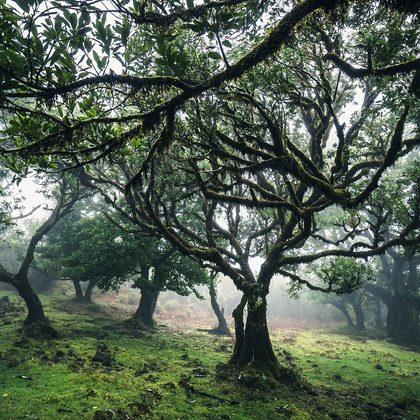
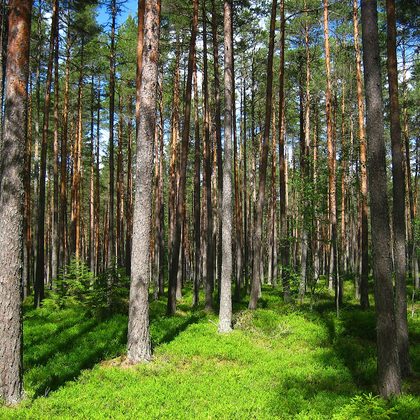
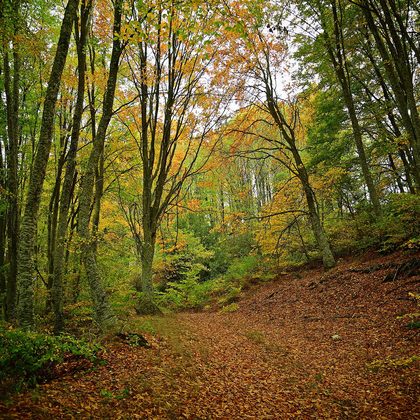
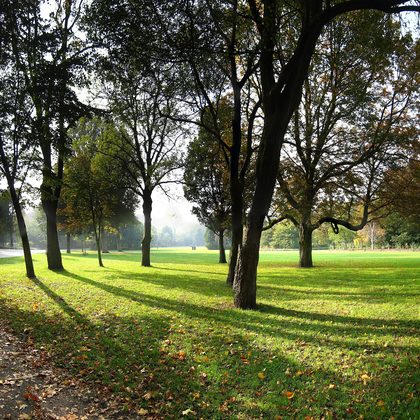
Maghreb woodland in all its forms: cork oak and holm oak in the Rif and the Tell, deciduous oak in the damper valleys, cedar forest in the Middle Atlas, Aleppo pine and juniper on the drier slopes, and beyond that olive groves, orchards, parks, gardens and the vegetated edges of villages and oases. It ranges from sea level to well over two thousand metres. It feeds on the ground under the trees, on tracks and along verges.
Where the bird is most at home, classified with EUNIS — the European standard for habitats.
Range and movements
North-west Africa: Morocco, northern Algeria, Tunisia and north-west Libya, with a separate isolated population in north-east Libya. It is resident and does not move away. On the Italian islands of Pantelleria and Lampedusa, which fall just inside this guide's map area, it has been recorded a handful of times; on the European mainland it has not.
- Resident
- Breeding (summer)
- Winter
- Passage
- dark = core range, pale = thinly spread
Where and when to look
The cedar woods above Azrou in the Middle Atlas, or the cork oak forest around Aïn Draham in north-west Tunisia, in March or April. Look for it on the ground along the forest road, because that is where it feeds, and check the back of every chaffinch first: moss-green is this species, rust-brown is a winter visitor from Europe. In winter they often mix in the same flocks, and then you have the comparison right in front of you.
Conservation status
The category above is that of the common chaffinch. BirdLife, which assesses birds for the Red List, still keeps this finch within that species and so does not assess it separately; the guide therefore shows the category of the wider species rather than “not evaluated”, because assessed it has been — only under a broader species concept. It is locally numerous in the wooded parts of the Maghreb, though scarce outside them. The steady loss of North African woodland is the main pressure: felling, heavy grazing of the understorey by goats and sheep, and repeated fires. The cedar forest of the Middle Atlas is going back fastest of all.
Scientific name
Fringilla spodiogenys Bonaparte, 1841
Bonaparte described the species in 1841 and placed it straight away in the genus where it still stands. The genus Fringilla was introduced in 1758 by Linnaeus. Fringilla is the Latin word for 'finch'. spodiogenys is Greek for 'ash-cheeked', from spodios 'ashy grey' and genys 'cheek'. The specimen the first description was based on came from Sfax, Tunisia.