All species › Passerines › Finches › Gran Canaria blue chaffinch
Gran Canaria blue chaffinch | Fringilla polatzeki
Gran-Canarische blauwe vink | Pinzón azul de Gran Canaria
A few hundred of these birds exist, and all of them live in a handful of pine forests in the west of Gran Canaria. That makes it the scarcest songbird in this guide's map area. Until 2016 it was counted with the blue chaffinch of Tenerife; since then it has been treated as a separate species, on the strength of genetic work, measurements and song. In the field nearly every bird carries colour rings, because the whole population is followed.

Voice
The song is a short, high, thin series of identical notes, delivered slowly and without acceleration or flourish, and it sounds a little shorter and higher than the blue chaffinch's; song is one of the characters on which the two species were separated. The call is a soft sharp tsee that carries a long way through the quiet pine forest. It sings mainly from February to June, from a pine branch halfway up the canopy.
No freely licensed recording is available for this species yet.
Identification
A blue chaffinch, but everything a shade lighter. The male is pale blue-grey on head, mantle and breast, with a black band across the forehead and a broken white eye-ring; belly, flanks and undertail are white to light grey, so the bird looks clearly paler below than above. Two clean white bars cross the wing and show up well. The bill is grey and noticeably finer and more pointed than a blue chaffinch's, and the wing is shorter. The female is dull grey-brown with off-white underparts and the same white wingbars.
Confusion species
Blue chaffinch of Tenerife is the only species it can be confused with, and in practice the island is the answer: that bird lives on Tenerife, this one on Gran Canaria, and there is nowhere the two occur together. If you want to do it on plumage, this is the paler of the two: lighter, greyer blue, with a white rather than blue-grey belly, with clean white wingbars where the Tenerife bird has only faint greyish streaks, and with a slimmer bill. It is also slightly smaller and shorter-winged. Canary Islands chaffinch, which shares the island and the same pine forest, is smaller and slimmer, has an orange-pink breast and a thin pointed bill — do not mix the two up, because a record of this species counts for something.
Habitat
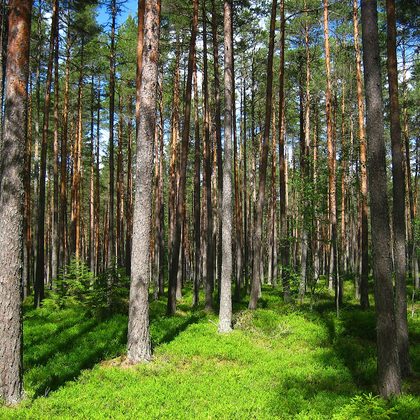
Old Canary pine forest with an understorey of cistus and other shrubs, at around a thousand to fifteen hundred metres. Unlike the Tenerife bird it needs that shrub layer: it nests there and takes part of its food there, alongside the pine seeds it picks up off the ground. Young planted pine woods on the summit ridge turn out to serve as long as they are managed.
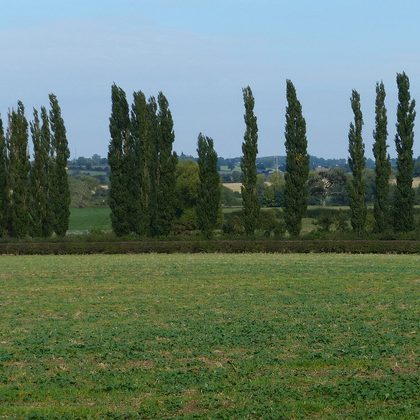
Where the bird is most at home, classified with EUNIS — the European standard for habitats.
Range and movements
Gran Canaria alone, and there only in the western mountains: the strict nature reserve of Inagua with the adjoining forests of Ojeda and Pajonales, and since 2010 a second group on the highest ridge, La Cumbre. It is known from Tamadaba as an occasional visitor. It occurs nowhere else in the world and does not leave the island.
- Resident
Where and when to look
This is not a bird you pick up in passing. The best chance is an early morning in March or April along the forest road through Inagua or Ojeda: park, stand still and listen for the sharp tsee among the pines. Check the size and the bill of every chaffinch you see, because Canary Islands chaffinch is far commoner there. Follow the local rules for the reserve and keep to the roads; the area is warden-patrolled and it is the last place this bird has.
Conservation status
Endangered on the IUCN Red List, and so one of the rarest birds of this guide's map area. Centuries of logging left it in three pine forests; the 2021 European Red List arrived at around 430 birds, of which 362 were counted in Inagua, Ojeda and Pajonales in 2019 and 68 at La Cumbre. Fire is the great danger: Inagua burned badly in July 2007, and one bad summer can reach a large share of the species. Since 2010, therefore, a programme has used captive-bred birds and birds moved from Inagua to build a second population at La Cumbre, precisely so that not every egg sits in one forest; that group is now breeding and growing.
Scientific name
Fringilla polatzeki Hartert, 1905
Hartert described the species in 1905 and placed it straight away in the genus where it still stands. The genus Fringilla was introduced in 1758 by Linnaeus. Fringilla is the Latin word for 'finch'. polatzeki honours the collector Johann Polatzek (1838–1927), who gathered birds in the Canary Islands. The specimen the first description was based on came from Gran Canaria.