All species › Passerines › Finches › Tenerife blue chaffinch
Tenerife blue chaffinch | Fringilla teydea
Blauwe vink | Pinzón azul
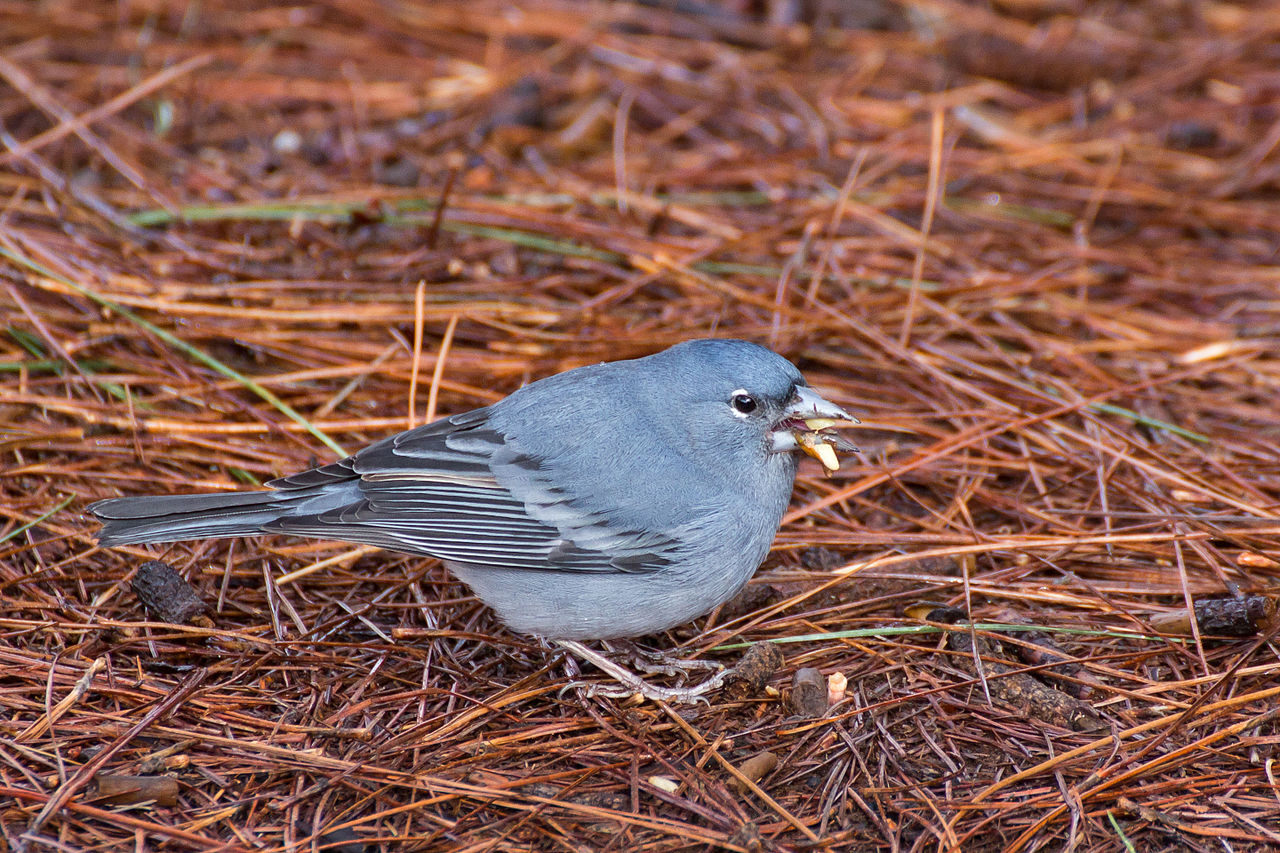
The blue chaffinch belongs to one forest on one island: the Canary pine of the Corona Forestal, the broad belt that rings Teide. It is the largest finch of this guide's map area and the only one that is a single colour from head to tail — a dull, smoky slate blue, as though the bird had been washed out in the light of the pine wood. To find it you go up, to the picnic sites above a thousand metres.
Voice
The song is disappointingly plain for so striking a bird: a short, high, thin run of four to seven identical slightly wheezy notes, delivered slowly and without the acceleration and flourish of a chaffinch phrase, repeated endlessly from a pine branch. It runs from February into June. The call is a soft sharp tsee or tseep that carries surprisingly far through the silence of the pine forest — usually you hear it well before you see the bird.
No freely licensed recording is available for this species yet.
Identification
Big and long-bodied, noticeably larger than a common chaffinch, with a heavy, blunt, blue-grey bill and a long tail. The male is slate blue all over: head, back, breast and flanks, a shade darker on the forehead and paler, almost white, on belly and undertail. A broken white ring surrounds the eye, the one bright mark on the bird. The wing is dark with two faint, narrow greyish-white bars that hardly show at any distance; the tail is dark without white. The female is olive-brown to grey-brown, paler below, with the same heavy bill and even weaker wingbars. Juveniles resemble the female.
Confusion species
Beside Canary Islands chaffinch, which lives in the same forest, size strikes you first: blue chaffinch is a class bigger, with a far thicker bill and a longer tail. The underparts settle it: orange-pink breast and white belly on Canary Islands chaffinch, the same blue-grey from top to bottom here, without a trace of pink. Canary Islands chaffinch also shows clean, well-marked white wingbars; those of blue chaffinch are narrow and faint and disappear at any distance. Gran Canaria blue chaffinch looks much like this species — paler and greyer, with a slimmer bill and, in fact, clearer white wingbars — but that is a distinction you never have to make in the field: that bird lives on Gran Canaria and this one on Tenerife, and there is no island where they meet. Females are the harder problem; go by bill and size.
Habitat
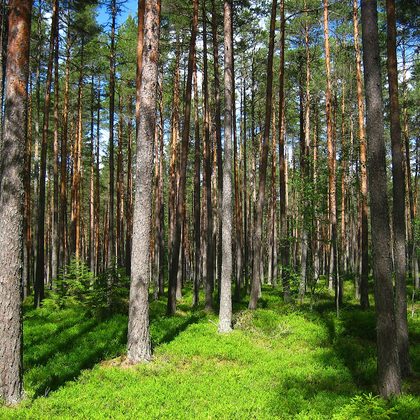
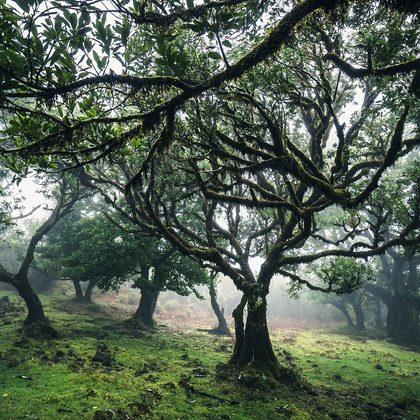
Mature Canary pine forest with an open understorey, from about a thousand to two thousand metres, at its densest where the ground lies thick with pine needles. Also in mixed woodland where pine, tree heath and laurel forest run together, and locally lower down on the damp northern slope. It lives on the seeds of the Canary pine, which it picks up off the ground, and in summer on insects for the young.
Where the bird is most at home, classified with EUNIS — the European standard for habitats.
Range and movements
Tenerife alone. It occupies nearly the whole of the Corona Forestal, the pine belt that rings the Teide massif, with the best-known sites on the southern slope at Las Lajas and the Pinar de Chío and in the north around La Caldera. It does not migrate and barely leaves the forest; it occurs on no other Canary island.
- Resident
Where and when to look
The Las Lajas picnic site, on the road from Vilaflor up to Teide, is the classic place: arrive early, sit down by the drinking trough and wait. The birds come to the ground there to drink and feed, and allow an approach to a few metres. If that fails, drive the forest road to the Pinar de Chío and listen for that sharp tsee along the way; the wood is quiet enough that a single call tells you where to look.
Conservation status
Near Threatened on the IUCN Red List: not in immediate danger, but with a range small enough for one bad year to reach all of it. The population is put at around a thousand pairs or more and is stable to slightly increasing; the Spanish national assessment lists it as vulnerable. The whole species hangs on one forest on one island, which makes fire the greatest danger: Canary pine sprouts again after a burn, but the seed crop is lost for years. Feral cats and rats play a part too, as does the loss of old trees with cavities.
Scientific name
Fringilla teydea Barker-Webb et al., 1836
Barker-Webb et al. described the species in 1836 and placed it straight away in the genus where it still stands. The genus Fringilla was introduced in 1758 by Linnaeus. Fringilla is the Latin word for 'finch'. teydea refers to Mount Teide, the volcano on Tenerife in whose pine forests the bird lives. The specimen the first description was based on came from Tenerife.