All species › Bustards › Bustards › African houbara
African houbara | Chlamydotis undulata
Westelijke kraagtrap | Avutarda hubara africana
The only bustard of the Canary Islands, and the only desert bustard you can see in Europe without a stroke of luck. You are out early on a flat stony plain on Lanzarote or Fuerteventura, the wind scours across the gravel, and you are looking for a bird the size of a small goose that is exactly the colour of the plain. Only when it stretches its neck does a black line appear where a moment ago there was nothing.

Voice
Effectively silent. A displaying male gives at most a low, dull booming that the wind swallows at thirty metres, and beyond that you hear nothing at all. Do not count on sound with this species: it is a bird you find with binoculars or not at all.
No freely licensed recording is available for this species yet.
Identification
A long-legged bustard with a long grey neck and a short, broad body. Upperparts sandy with dense dark vermiculations and arrowheads, underparts white. Down the side of the neck hangs a band of loose, elongated black feathers with white at the base, and the crown carries a short black-and-white crest. Legs long and grey-green. In flight, a large white panel at the base of the primaries with a black tip, the neck held straight out, the beats slow and deep. In display the male throws those neck and crown feathers up over his head so that the head disappears and a white ball trots across the plain, running a fixed circuit for minutes on end, from December to March.
Confusion species
On the Canaries it stands alone; what gets taken for a bustard at range there is usually a stone-curlew or a cream-coloured courser, both far smaller and quite differently headed. In heat shimmer on a flat plain that is harder than it sounds, so work on height above the ground and on the black neck line. Macqueen's bustard, Chlamydotis macqueenii, has been treated as a separate species since 2003 and turns up in the region only as a major rarity; that bird is larger and paler, with a longer crest and more white in the wing, while this one is darker and more densely marked above. On the Canaries the question never arises — every houbara there is this species. On the Moroccan mainland it does, and then the rule is that the finer and darker the upperpart markings, the more likely the African bird.
Habitat
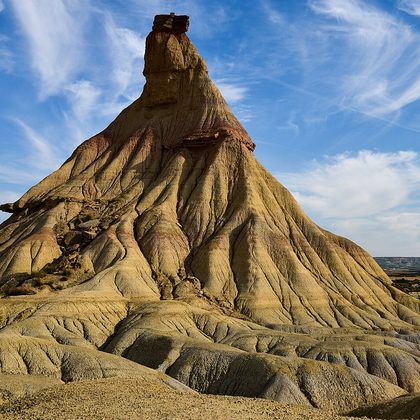
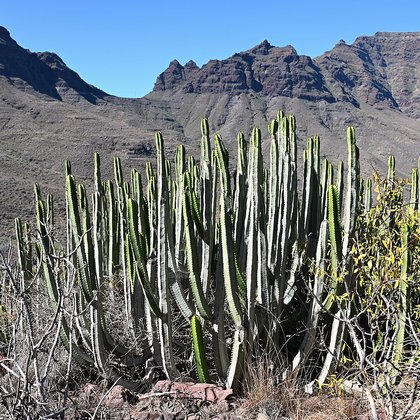
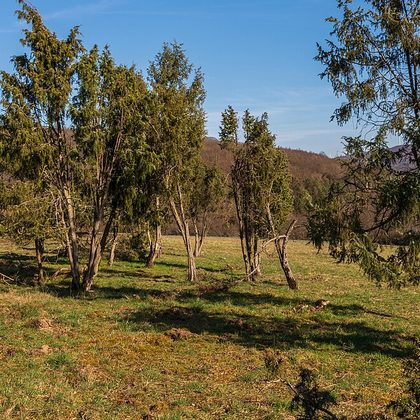
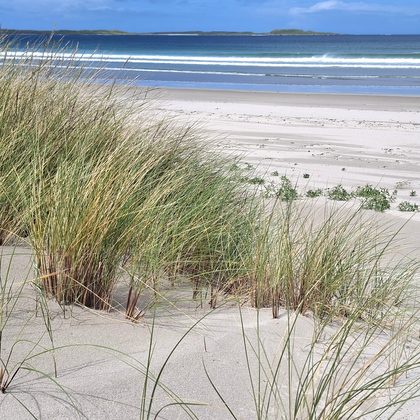
Flat open semi-desert: gravel plains with scattered boulders, the sand sheets of the jable, stabilised dunes, and the lowest, driest shrub steppe with widely spaced low bushes. Also small patches of grassland and the edges of small unirrigated plots, where the birds feed morning and evening. Lava fields, tall crops and built-up ground are avoided.
Where the bird is most at home, classified with EUNIS — the European standard for habitats.
Range and movements
Two separate parts within the guide's window. First the eastern Canaries: Fuerteventura, Lanzarote and La Graciosa, formerly Lobos as well; it has gone from Tenerife and Gran Canaria. Those birds are the race C. u. fuertaventurae, smaller, darker and more heavily marked than mainland stock. Second, North Africa: the Atlantic plains and the pre-Sahara of Morocco and Western Sahara, running east through Algeria, Tunisia and Libya to the Nile. It does not occur on the Iberian mainland.
- Resident
- Winter
- Passage
- dark = core range, pale = thinly spread
Where and when to look
January or February, the first hour after sunrise, and stay with the car. On Lanzarote the jable between Teguise, Soo and Muñique is the classic ground; on Fuerteventura the plains around Tindaya and the Istmo de la Pared. Drive the tracks at walking pace and scan from the window: a walking bird shows against the skyline, a standing one does not. Do not walk out onto the plain — the birds crouch and then leave, and disturbance is a genuine problem here. A displaying male at three hundred metres is a white speck that keeps reappearing in the same spot.
Conservation status
Vulnerable on the world list and listed as endangered in Spain. The Canary population is put at roughly seven hundred birds across Fuerteventura, Lanzarote and La Graciosa, which is a recovery on the position in the 1970s and 1980s. What still costs them: collisions with power and telephone lines — a LIFE project marked or buried a series of lines between 2003 and 2007 — together with off-road driving, tourist development, feral cats and dogs, and illegal shooting. In North Africa falconry hunting sits on top of all that, and captive-bred birds are released there on a large scale to keep the hunt supplied.