All species › Passerines › Laughingthrushes › Arabian babbler
Arabian babbler | Argya squamiceps
Arabische babbelaar | Turdoide árabe
There is no such thing as one Arabian babbler. They arrive six or twelve at a time, in a long line from bush to bush, whistling and squabbling, tails trailing through the sand behind them. Such a group is a household: one pair breeds and every other member helps to build, feed and stand guard, last year's young included. In the wadis of the Arava they were watched so closely and for so long from the 1970s onwards that they are among the best-studied wild birds anywhere.

Voice
The name is earned. The group keeps up an all-day conversation of clear whistles, squeaks, chattering phrases and low grumbling, with no beginning or end to it, and you hear it long before you see a bird. The contact call is a clear, rising peeoo by which they keep track of one another in the scrub. At danger the sentinel gives a sharp rattling alarm and the whole group dives into cover, from where it goes on scolding. When two groups meet at a territory boundary the result is a loud, sustained chorus, the birds pressed together shoulder to shoulder and calling at the neighbours as one — the noisiest sound in the wadi.
No freely licensed recording is available for this species yet.
Identification
Big and long-bodied, with a tail that makes up almost half the bird and is graduated, so that it opens like a fan on landing. The colour is sandy grey-brown, paler below, with a dirty white throat. The crown and cheeks carry fine dark shaft-streaks that at close range read as scaling — hence the scientific name squamiceps. The bill is long, black and slightly decurved, and the eye is pale: a creamy yellow to light grey iris that gives the bird a staring expression. The legs are strong and flesh-coloured. The sexes are alike. Young birds still have a dark eye and an unstreaked crown, which picks them out at once within a group. The flight is weak and fluttering, on short round wings with that long tail trailing; it rarely flies far, and usually just above the ground.
Confusion species
Nothing inside the map area resembles it: in the Levant and Sinai it is the only babbler. The comparison that matters is with the fulvous babbler, its opposite number at the other end of the continent, and the two are almost as easily told by country as by plumage. Arabian babbler is the larger, colder and greyer of the two, with fine dark streaking on crown and cheek, a pale yellowish iris and a longer tail; fulvous is warmer and more rufous-sandy, plain-headed without streaking, with a dark brown eye. Their ranges do not touch: the Nile and the Egyptian deserts lie between, with Arabian babbler on the eastern side — Sinai, the Arava, Arabia — and fulvous from Libya westwards through the Maghreb to the Atlantic. If you are ever in doubt in the field, look at the eye: pale is Arabian, dark is fulvous.
Habitat
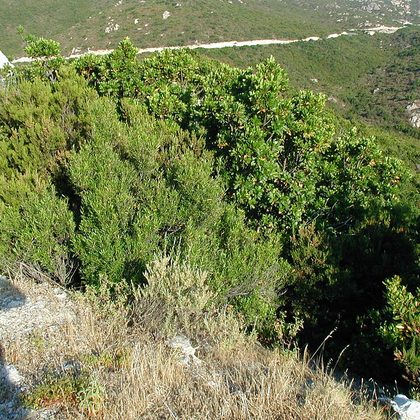
Desert and semi-desert with bushes and trees, never the bare plain: acacia wadis, dry watercourses with jujube and tamarisk, rocky side gullies with scrub, and the man-made versions of all that — date plantations, kibbutz gardens, field edges and the plantings around desert settlements, where it settles in without difficulty. It feeds mainly on the ground, turning leaves and pebbles with its bill for insects, and also climbs about in acacia crowns. At night the group roosts pressed tightly together along a branch.
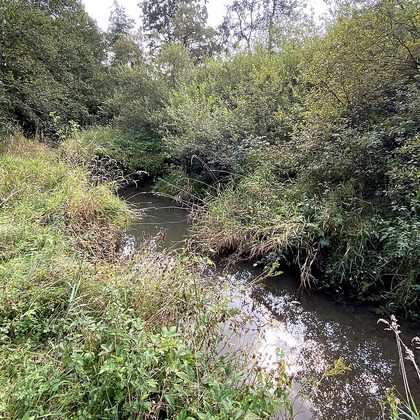
Where the bird is most at home, classified with EUNIS — the European standard for habitats.


Range and movements
From the southern end of the Dead Sea and the Judean desert south through the Negev and the Arava, on both sides of the Israeli-Jordanian border, on across Sinai and the whole Arabian peninsula to Oman and Yemen, plus a strip along the Egyptian Red Sea coast. Inside the map area that means Israel, Jordan and Sinai; it goes no further north and has never crossed the Mediterranean. The birds are sedentary in the extreme: a group holds the same stretch of wadi for years, and the young often stay on in the territory where they hatched.
- Resident
- Winter
- Passage
- dark = core range, pale = thinly spread
Where and when to look
Any acacia wadi in the Arava or the Negev will do, and all it takes is to stand still and listen — Hatzeva, the Shezaf reserve, Ein Gedi, Yotvata, the gardens of a kibbutz. The group will often come to you, since they are remarkably unafraid. Then watch three things. First the sentinel: one bird always sits high and silent while the rest work the ground. Second the feeding: adults pass food to one another and to the young even when nobody is hungry. Third the preening: two birds side by side on a branch, one combing through the other's nape feathers. Half an hour with a single group tells you more than a whole morning of searching.
Conservation status
Not threatened. The range is large, numbers are stable, and the species does well locally around human settlement, where gardens, irrigation and waste provide food all year. Where it does go wrong is in the wadis themselves: the death of old acacias behind dams and under groundwater abstraction takes the structure away from the groups, and a wadi without acacias stays empty. Beyond that the birds are sensitive to disturbance at roost trees and to cats and rats around settlements. Otherwise this is one of the very few desert birds whose trend we genuinely know, simply because it has been watched for so long.