All species › Passerines › Laughingthrushes › Fulvous babbler
Fulvous babbler | Argya fulva
Bruingele babbelaar | Turdoide rojizo
The fulvous babbler is the Maghreb version of the same idea: a long-tailed, sand-coloured bird that exists only in parties, and that you see crossing an oued in a line from tamarisk to tamarisk, low and fluttering, one after another. Anyone who has watched Arabian babbler in Israel recognises the build, the manner and the voices at once — but the two sit on opposite sides of a desert that neither of them crosses.

Voice
A party keeps up a continuous conversation of clear, faintly mournful whistles, short chattering phrases and soft grumbling. The contact call is a full, rising whistle that the members give in turn for as long as they are on the move, and which carries hundreds of metres along a silent oued. At any disturbance comes a hoarse rattling alarm, after which the whole group vanishes into the thickest scrub and goes on calling from inside it. The sound is less varied and less squeaky than an Arabian babbler's, with more weight on round whistled notes. There is no true song to separate from the rest: the calling runs all year and is loudest early in the morning.
No freely licensed recording is available for this species yet.
Identification
Large and slim, with short round wings and a long graduated tail that opens briefly on landing. The whole bird is warm sandy brown, deepest above and running to buff-yellow on the belly; the throat is paler and stands out slightly against the warmer breast. The head is plain: no streaking, no mask, no obvious eye-ring. The eye is dark brown and so all but vanishes into the face. The bill is stout, blackish and slightly decurved, the legs strong and pale horn. Sexes are alike, and young birds are barely separable from their parents. The silhouette is the most useful thing: a thrush-sized bird with a tail that looks too long for it, carried half-raised while it runs between the bushes.
Confusion species
There is no other babbler across its whole Maghreb range, and nothing else of that size that looks remotely like it. The comparison that matters is with Arabian babbler on the far side of the desert: the same build, the same long tail, the same parties, the same way of working the ground. There are differences. Fulvous babbler is warmer and more rufous-sandy, plain-headed with no streaking on crown or cheek, dark brown-eyed and slightly shorter-tailed; Arabian is greyer and colder, streaked on the crown, and has a pale yellow eye that gives it a staring look. In the field you never have to make that comparison, because the ranges exclude each other: fulvous runs from Morocco and Mauritania east to Libya and western Egypt, Arabian lies east of the Nile. What does cause trouble is a party at range: a line of brown birds skimming across an oued suggests starlings, or young Maghreb magpies, until you see the long graduated tail and the fluttering flight.
Habitat
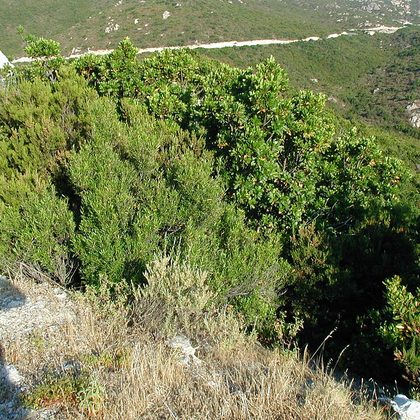
Desert and semi-desert with scrub: tamarisk and jujube in the beds of oueds, acacias in the southern wadis, thorn scrub on sand flats and at the foot of dunes, esparto and wormwood steppe with scattered thickets. It also likes the edges of human land use — palmeries and date gardens, thorn-branch fences around small fields, olive and argan margins by villages — as long as there is dense low cover to disappear into. It feeds walking and hopping on the ground, turning leaves and dry dung, and then climbs back into a tamarisk to rest.
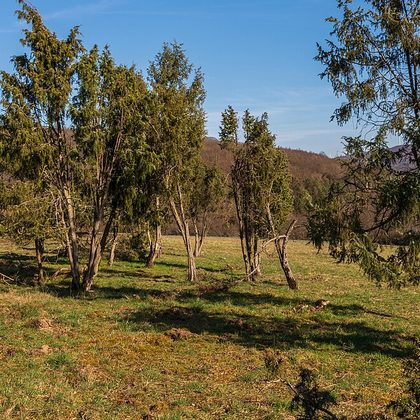
Where the bird is most at home, classified with EUNIS — the European standard for habitats.

Range and movements
North Africa from the Atlantic coast to Egypt: Morocco and the Western Sahara, Mauritania, Algeria, Tunisia, Libya and the desert west of the Nile, with an extension south into Mali, Niger and northern Sudan. Inside this guide's map that means the Maghreb: the southern flank of the High Atlas and the Anti-Atlas, the oueds of the Draa and the Ziz, the Algerian Saharan fringe and the southern half of Tunisia. It has never been recorded in Europe, and given how sedentary it is and how poorly it flies, that is not to be expected.
- Resident
- Breeding (summer)
- Winter
- Passage
- Migration direction
- dark = core range, pale = thinly spread
Where and when to look
The oueds south of the Atlas are the place: the tamarisks along the Draa, the country around Merzouga and Rissani, the Tagdilt track near Boumalne, and in Tunisia the national parks of Jebil and Bou Hedma. Go early, because by ten o'clock they are deep in the thickest scrub and silent. Do not look for one bird but for movement in a line: one crosses first, then the rest, a few seconds apart. And let your ears do the work — the rising whistle reaches you before you reach the oued, and after that it is a matter of walking quietly along the edge until the party shows itself.
Conservation status
Not threatened. The range covers almost the whole North African desert belt and the species is widespread across it, though nowhere numerous and hardly counted anywhere. The pressure comes from the loss of scrub in the oueds: cutting for firewood and fencing, heavy grazing by goats and camels, and the conversion of tamarisk-lined banks into irrigated fields and melon plots. Against that, it is quite at home in the thorn hedges and garden edges of villages, so in inhabited country it often hangs on where the wild scrub has already gone.