All species › Passerines › Thrushes › Black-throated thrush
Black-throated thrush | Turdus atrogularis
Zwartkeellijster | Zorzal papinegro
Black-throated thrush is the westernmost of the Siberian thrushes and the only one of the three with a genuine wintering ground inside the area of this guide: it breeds in the Urals and western Siberia and moves to Iraq, Iran and on east into the Himalaya. In north-west Europe it is a much-wanted vagrant, and unlike most Siberian strays it does not melt away after two days — a bird that has found a good berry bush or a lawn full of worms will sometimes hold the same hundred square metres for two months. The Netherlands has thirteen accepted records, nine of them since 2000.

Voice
On migration and in winter there are two sounds to know. The first is a thin, drawn-out, slightly falling seeh, recalling a Redwing but softer and fuller; the second a hard chattering chack-chack-chack, like a Fieldfare with the volume turned down, which breaks out the moment a flock lifts. A disturbed bird gives a short dry tuk. The song, essentially never heard in this region, is a plain series of short, faintly wistful fluted motifs of two or three notes, each followed by a pause and rounded off with a dry chatter; in the Urals it runs from May into July, usually from the top of a spruce.
No freely licensed recording is available for this species yet.
Identification
A large thrush, a shade smaller than a Fieldfare but slimmer and longer-tailed. Everything above is one single colour: crown, mantle, wings, rump and tail are plain cold grey-brown, with no chestnut mantle, no rufous wing panel and no colour break at all between back and tail. The male carries jet-black lores, throat and upper breast as a sharply cut bib against a clean white belly; in fresh winter feathering those black feathers are pale-fringed, so the bib looks scaled and only becomes solid towards spring. Females and first-winter birds replace the bib with a white throat, a dark malar stripe and rows of black spots that run together into a necklace on the upper breast, with a weak pale supercilium above. Flanks grey and almost unmarked, belly and undertail coverts white, bill yellow with a dark tip, legs dark. There is one warm colour on the bird: the underwing coverts are orange-rufous, and they flare on take-off against an otherwise drab thrush.
Confusion species
Dusky thrush is what it all turns on — see its own page, where the same difference is set out from the other side. The wing decides it: Dusky has a broad rufous panel across the coverts and secondaries, rufous on the rump and rufous fringes in the tail, while on Black-throated not a single feather of the upperparts is warm-toned. Dusky also has a boldly marked head, with a broad white supercilium, a white submoustachial and a dark ear-covert patch, and black crescents scattered over breast and flanks rather than a closed bib or a plain necklace. What does not help here is the underwing: both species show rufous underwing coverts. On females and first-winter birds the trap is wide open, and then the wing remains the deciding character. Red-throated Thrush Turdus ruficollis, formerly counted as one species with this bird and treated separately in the world lists since about 2010, has the same grey upperparts but a rufous throat and breast and rufous outer tail feathers; where the two meet, intermediates occur that can hardly be named in the field. Fieldfare is bulkier, with a grey head and rump against a chestnut mantle and a brilliant white underwing; Blackbird has no pattern at all. The large spotted Asian thrushes that can appear in the same weeks always give themselves away by the broad black-and-white band across the underwing — something no Turdus thrush has.
Habitat
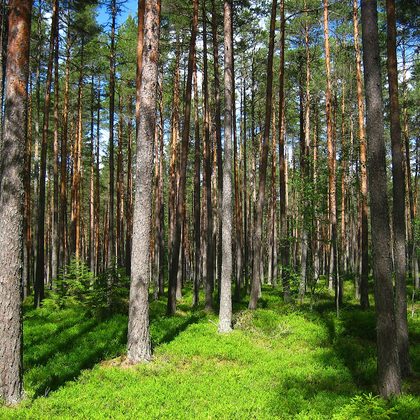
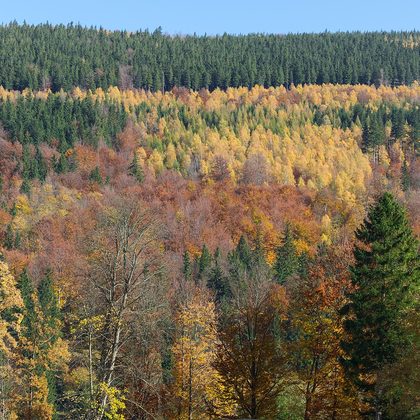
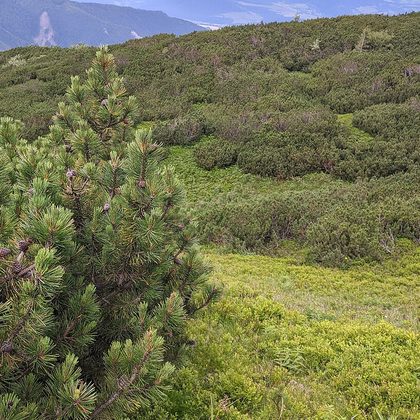
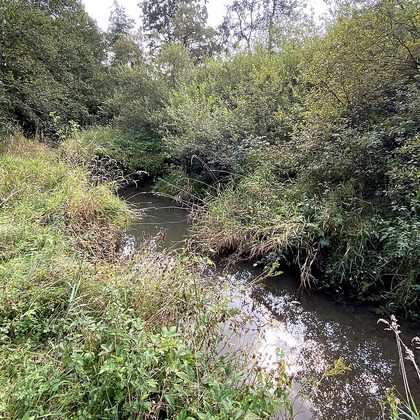
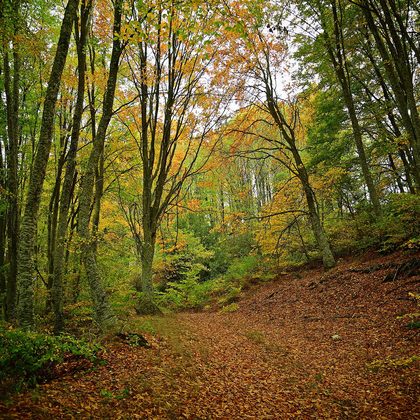
Breeds in the taiga of the Urals and western Siberia: spruce, pine and larch forest with a dense understorey, birch woodland and mixed forest, and in the mountains up into the stunted subalpine birch and willow scrub above the treeline. Along the rivers it takes to willow and alder thickets. It feeds walking on the forest floor among moss and litter. The winter quarters are far more open: open woodland and tree groups on hillsides, orchards, terraced fields and scrub with sea buckthorn, juniper and rowan. Vagrants in Europe nearly always end up in berry-bearing hedges, orchards and village gardens.
Where the bird is most at home, classified with EUNIS — the European standard for habitats.
Range and movements
Breeds from the Urals east to the Yenisei and south into the Altai and the mountains of Central Asia. The western limit of the breeding range lies on the western slope of the Northern and Polar Urals, just beyond the eastern edge of this guide's map. It winters in the south-eastern corner of the region — Iran and Iraq, with smaller numbers in eastern Turkey, Israel, Kuwait and along the Gulf — and further east in Afghanistan, Pakistan, northern India and Nepal. Westwards it is a vagrant, with birds almost every year in Finland, Sweden and Britain. The thirteen Dutch records run from March 1981 at Groningen to a bird in the city of Utrecht from 31 March to 3 April 2020. What stands out is how long they stay: Den Helder from 4 January to 20 March 1996, Oldambt from 21 January to 3 April 2018, Coevorden from 27 January to 18 March 2019.
- Winter
- Passage
- dark = core range, pale = thinly spread
Where and when to look
You seldom find this one yourself; you travel to it. The Dutch records fall strikingly often in January and February and strikingly often in built-up ground: a patch of municipal shrubbery, a school yard, a line of rowans along a cycle path. Expect the bird to stay for weeks, go at first light, stay on the pavement and leave the residents in peace. On site, look at the wing before you look at the throat — the plain grey-brown wing without a trace of rufous is the character that still holds on a female. To find your own, work large flocks of Fieldfares and Redwings in late autumn for one bird that looks drabber than the rest and shows a rufous underwing as it flies up.
Conservation status
Not globally threatened. The breeding range is vast and numbers are large; trends in the Siberian taiga are poorly known, simply because almost nobody counts there. What matters for the category is that the Red List now assesses black-throated thrush in its own right rather than under the broad Turdus ruficollis: it has its own assessment, and that assessment is Least Concern. For the area of this guide it is more than a vagrant — it winters regularly in Iran and Iraq, and for that reason it stands here as a winter visitor. In north-west Europe, by contrast, it is a matter of single birds only. Records there are increasing, but that probably says more about the number of observers and about the species being counted separately since around 2010 than about the bird.