All species › Passerines › Tits › Coal tit
Coal tit
Periparus ater | Zwarte mees | Carbonero garrapinos
The Coal Tit is the smallest tit in Europe and the quickest of the family: it arrives, takes a seed and is gone again before you have raised your binoculars. Its white nape patch is the one thing you need to remember.

Voice
The song is a fast, high, clear wee-choo wee-choo wee-choo, strongly recalling Great Tit but much quicker, thinner and higher — as though the Great Tit were played at double speed. There is also a thin, rising tsuu-ee and fine tsee-tsee contact notes within the flock. Song runs from January into June, peaking in March and April; in conifer woods it often starts before first light.
Recording: Sander Pieterse — CC BY-SA 4.0 · Wikimedia Commons
Identification
Tiny and short-tailed, with a proportionally large head. The head is glossy black with big white cheeks, and on the nape sits an elongated white patch, visible from the side and from behind — that is the decisive mark. The black bib runs down onto the upper breast. The mantle is blue-grey without green, the wing carries two narrow white bars formed by the pale tips of the coverts, and the underparts are off-white with a buff wash on the flanks. Juveniles show yellowish cheeks and a yellowish nape patch. Spanish and Portuguese birds are slightly browner above.
Confusion species
Great Tit is much larger, with an olive-green mantle, a yellow belly with a black stripe and no white nape patch. Crested Tit shares the same conifer wood but has a crest and a sickle-shaped head pattern. Marsh and Willow Tit lack both the white nape and the wing bars, have brown upperparts and a far smaller bib. Blue Tit has a blue cap and yellow underparts. In short: only Coal Tit combines a black head with white cheeks and a white nape patch.
Habitat
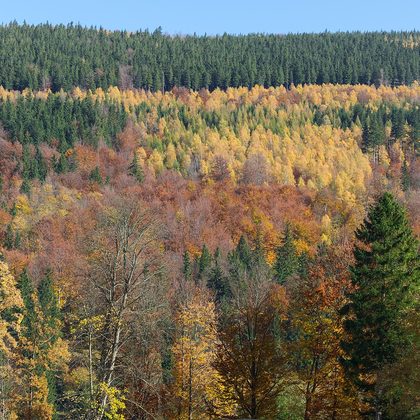
Conifer woodland of every kind, favouring spruce and Douglas fir, plus mixed forest, larch, old gardens with conifers, parks and cemeteries. Nests in holes low to the ground: mouse burrows, hollow stumps, crevices under roots and nest boxes. In winter a regular at feeders, where it carries sunflower seeds off and caches them rather than eating them on the spot.
Where the bird is most at home, classified with EUNIS — the European standard for habitats.


Range and movements
Almost all of Europe, from Lapland to Andalusia, everywhere tied to conifers. In the Netherlands a common resident of the sandy soils and the dunes, with genuine irruptions of north-eastern birds in some autumns, when it turns up even in city gardens. In Spain common in the pine and fir forests of the Pyrenees, the Cantabrian mountains, the Iberian System and the southern sierras, with its own browner race on the peninsula.
- Resident
- Breeding (summer)
- Winter
- Passage
- Migration direction
- dark = core range, pale = thinly spread
Where and when to look
Hang a sunflower-seed feeder at the edge of a spruce wood in November or December and count the birds that carry something away: nine in ten will be Coal Tits. In the wood itself it pays to stand and listen before sunrise in March; once the fast, high version of the Great Tit song is in your ear, you hear the species everywhere.
Conservation status
Not threatened, and stable to increasing in Europe, helped by the large-scale conifer planting of the twentieth century. Dutch numbers swing sharply from year to year with the spruce seed crop and the irruptions from the north-east. Conversion of conifer plantation to broadleaved woodland costs breeding pairs locally.