All species › Passerines › Buntings › Corn bunting
Corn bunting | Emberiza calandra
Grauwe gors | Triguero
Europe's largest and dullest bunting: a coarse, streaky brown bird without a single patch of colour, jangling out its song from a wire or a fence post like someone shaking a bunch of keys. Once you know it, you hear it right across the corn.

Voice
The song opens with a few hesitant ticks that accelerate into a dry jangle, classically likened to a bunch of keys being shaken: tik… tik-tik-tsississississ. It sings from March into August, including through the middle of a hot day, always from a wire, post, thistle or stone. The call is a short hard tsip, often repeated in a short series in flight.
No freely licensed recording is available for this species yet.
Identification
Bulky, short-tailed and heavy on the perch, with a thick pale conical bill and a big, plain head. Uniformly greyish brown with dark streaks on mantle, breast and flanks, running together into a vague central breast blotch. The sexes look alike; the male is simply bigger. In flight it lacks what nearly every other bunting shows: white in the tail. The flight is heavy and low, often with the legs left dangling.
Confusion species
The absence of white in the outer tail feathers separates it from every bunting in this guide but one. That one is black-headed bunting, which can sit alongside it in south-eastern Europe: slimmer, warmer-toned and with yellow on the belly and undertail. Female and immature buntings of other species are smaller, finer-billed and do show white in the tail. Skylark has a crest, a thin bill and a white trailing edge to the wing; a female house sparrow is smaller, shorter-tailed and does not sit on a wire to sing.
Habitat
Large-scale treeless arable: cereal fields, fallow, lucerne and dry weedy rough ground, with stubbles and seed-rich margins in winter. It needs conspicuous song posts — wires, fence posts, the odd bush — and a crop harvested late enough for a nest on the ground. In Iberia and the Maghreb it also holds the cereal steppes and the open oak dehesas.
Where the bird is most at home, classified with EUNIS — the European standard for habitats.
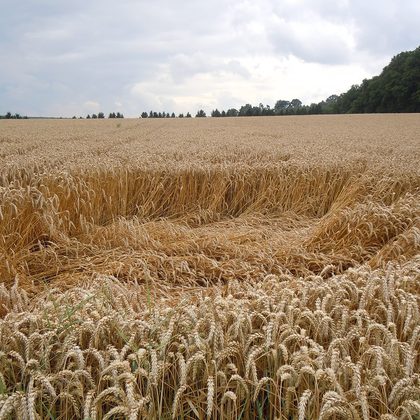
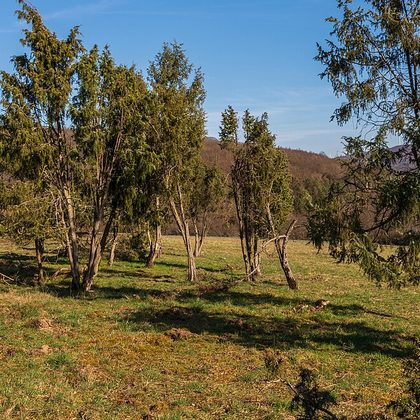
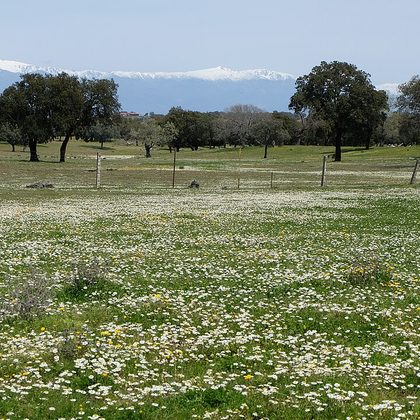
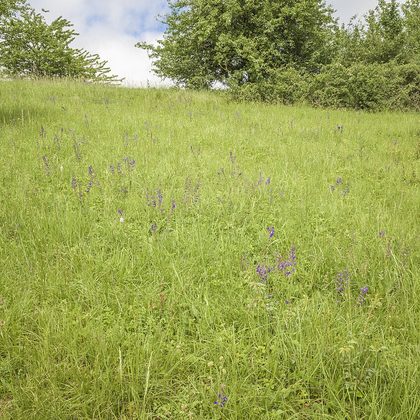
Range and movements
From Ireland and southern England to Turkey and the Levant, by far most numerous in Spain, Portugal and north-west Africa, where it is one of the commonest birds of open country. Largely resident, with only the north-eastern populations moving south. In Britain it has retreated to eastern England, the Scottish east coast and a few island strongholds, and it is all but gone from the Netherlands and Denmark.
- Resident
- Breeding (summer)
- Winter
- Passage
- dark = core range, pale = thinly spread
Where and when to look
Drive or cycle slowly along a corn road in May and June and watch the wires: a corn bunting sits there like a fat brown knot, head up and bill wide open. Wind the window down, because you hear it before you see it. In winter search stubbles, grain stores and stock-feeding places, where dozens can gather.
Conservation status
Not globally threatened (IUCN: Least Concern), but one of the worst-hit farmland birds of north-west Europe, gone from the Netherlands and Denmark and much reduced in Britain, Germany and France. The causes are the switch to autumn-sown cereals, harvesting and cutting before the young fledge, herbicide use and the loss of winter stubble. In Iberia and the Maghreb it remains almost everywhere.
Scientific name
Emberiza calandra Linnaeus, 1758
Linnaeus described the species in 1758 and placed it straight away in the genus where it still stands. He introduced the genus Emberiza in that same work. Emberiza comes from Old German Embritz, a name for a bunting. calandra is from Ancient Greek kalandros, the calandra lark.