All species › Passerines › Buntings › Rock bunting
Rock bunting | Emberiza cia
Grijze gors | Escribano montesino
The bunting of sunny, stony mountain slopes: an ash-grey head full of black stripes above an unstreaked orange-brown belly. It hops from boulder to terrace wall and only really shows itself at close range.

Voice
The song is a high, thin, hurried series of sibilant notes and ticks, faster and less regular than a yellowhammer's and close in tone to a dunnock: tsi-tsi-tsirri-tsi-tsu. He sings from March into July from a rock point, a wall or the top of a low bush. Calls: a thin sharp tseee and a short tsip.
No freely licensed recording is available for this species yet.
Identification
A slim, long-tailed bunting. The male's head is pale blue-grey with three crisp black stripes: along the side of the crown, through the eye and below the cheek. Throat and breast are grey, the rest of the underparts unstreaked orange-brown. The mantle is rufous with black streaks, the rump warm cinnamon, and the outer tail feathers are white. The female is a duller version with the same head stripes; juveniles are finely streaked on the breast but already show the cinnamon rump.
Confusion species
No other bunting in the region has a grey head with three black stripes above an unstreaked orange-brown belly. Yellowhammer has yellow in the face and a chestnut rump; cirl bunting has an olive-grey rump and streaked flanks; house bunting, which shares its range only in the Maghreb, is smaller and shorter-tailed with a finely white-streaked head and none of the heavy black banding. In flight it reads as a long, narrow bunting with strikingly white tail sides.
Habitat
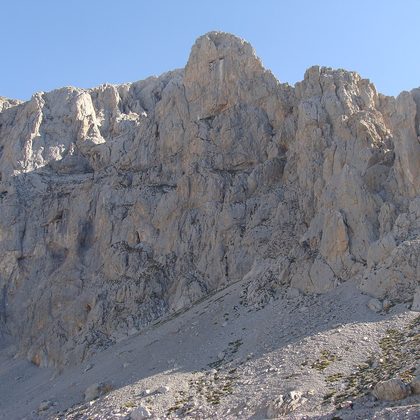
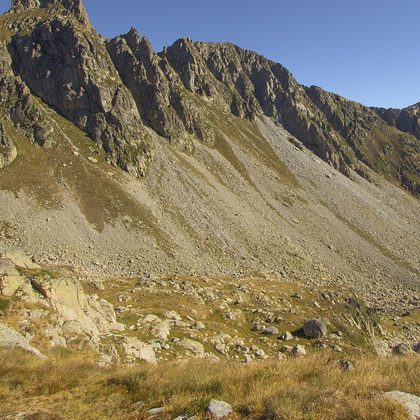
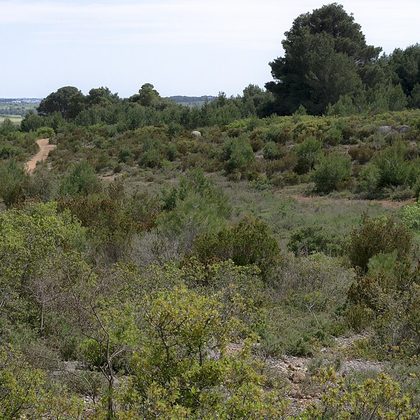
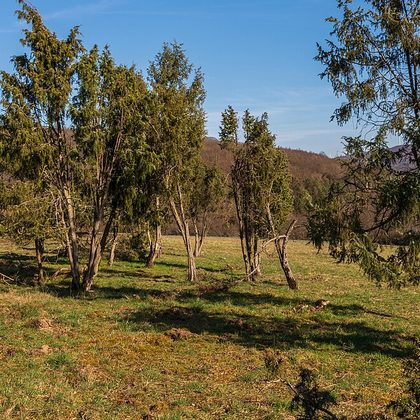
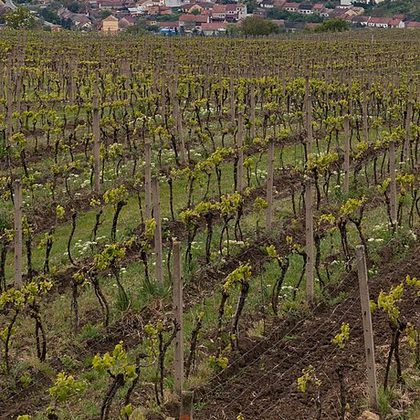
Sunny rocky slopes with scree, abandoned terrace walls and scattered bushes, gorge sides, old vineyards on steep ground, and open montane pine and oak woodland with plenty of exposed rock. From sea level to above two thousand metres; in winter it drops to lower valleys, vineyards and the edges of villages.
Where the bird is most at home, classified with EUNIS — the European standard for habitats.
Range and movements
The mountains of southern Europe and north-west Africa: Iberia, the Pyrenees, the Alps, the Apennines, the Balkans and Greece, and on through Turkey, the mountains of the Levant and the Atlas ranges of Morocco, Algeria and Tunisia. Chiefly resident, with an altitudinal movement that empties the highest slopes in winter. North of the Alps it is a rare visitor.
- Resident
- Breeding (summer)
- Winter
- Passage
- dark = core range, pale = thinly spread
Where and when to look
Walk a south-facing slope of terraces and boulders early in the day in April and watch for a bird hopping from stone to stone; the thin song usually comes from a projecting point. Stand still and wait — it is not shy, but it is easy to overlook while it feeds on the ground. In winter an old vineyard below the mountain front is the best bet.
Conservation status
Not globally threatened (IUCN: Least Concern) and common through most of its range. At the northern edge — Switzerland, Austria, southern Germany — it has declined as terraces and steep vineyards were abandoned and grew over. Where grazing, stone piles and open rocky ground survive, it holds up well.
Scientific name
Emberiza cia Linnaeus, 1766
Linnaeus described the species in 1766 and placed it straight away in the genus where it still stands. The genus Emberiza was introduced in 1758 by Linnaeus. Emberiza comes from Old German Embritz, a name for a bunting. cia comes from a local Italian name for the bird, related to zirlare, 'to chirp'. The specimen the first description was based on came from Lower Austria.