All species › Passerines › Buntings › Cinereous bunting
Cinereous bunting | Emberiza cineracea
Smyrnagors | Escribano cinéreo
A large, pale bunting of bare stony slopes, with a greenish-yellow head on a grey body. Within the area of this guide it breeds only on a handful of Aegean islands and in western Turkey, in numbers running to a few hundred, which makes it one of Europe's most narrowly distributed breeding birds.

Voice
The song is short, hard and faintly mournful: three or four identical plaintive notes followed by a lower one, in tone between an ortolan and a corn bunting and with a metallic edge. It carries well over bare slopes and is delivered from a rock point or a low bush, mainly early in the morning from April into early June. The call is a short hard tsip.
No freely licensed recording is available for this species yet.
Identification
Bulky and long-tailed, with a heavy grey bill and white sides to the tail. The male is strikingly two-toned: head, throat and upper breast greenish-yellow, the rest of the bird grey with a lightly marked mantle and a white belly, plus a narrow pale eyering. The female is duller, with a greyer head on which the yellow shows only on the throat and around the eye, and fine streaking on the breast. Juveniles are sandy grey and weakly streaked but keep the pale, cool ground colour of the species.
Confusion species
On the islands there is little to go wrong with, but a dull female is another matter. Ortolan is smaller and slimmer, with a clear yellow eyering and warm orange-buff underparts, where cinereous bunting is grey and white below. Cretzschmar's is smaller, blue-grey on the head and orange-brown on the throat. Rock bunting has heavy black head stripes and an unstreaked orange-brown belly. A female black-headed bunting is warmer sandy-brown and lacks the greenish-yellow cast to the head. Size, the heavy grey bill and that cool grey belly usually settle it.
Habitat
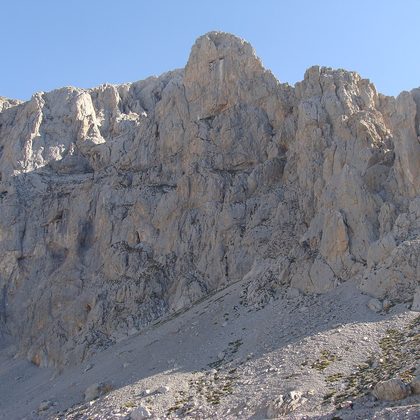
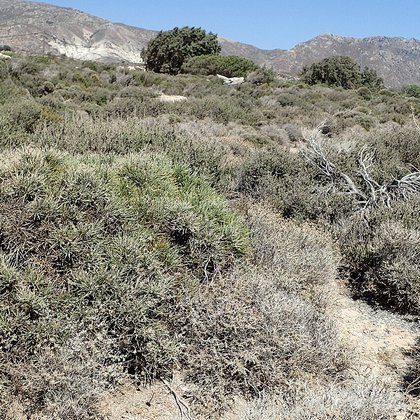
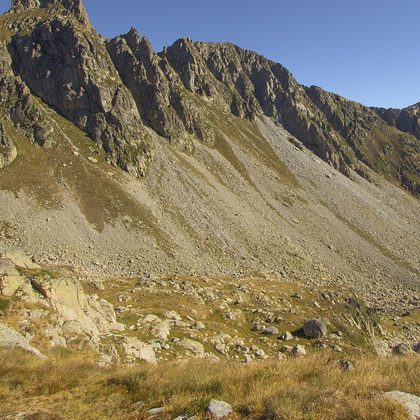
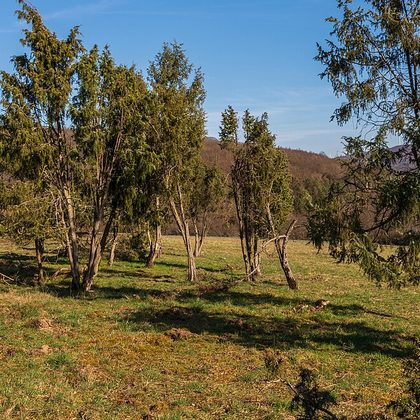
Dry, steep and almost bare hillsides: rock faces and rock plateaus with scattered low bushes, scree and boulder fields, weathered phrygana with thorny cushions and dry grassy patches between. It feeds walking over open ground among the stones and uses the boulders as song posts; dense maquis it avoids.
Where the bird is most at home, classified with EUNIS — the European standard for habitats.
Range and movements
Within the area of this guide the cinereous bunting breeds only in western Turkey and on a few east Aegean islands — Lesvos, Chios, Samos, Ikaria and Skyros — where the Greek population is put at a few dozen to roughly a hundred pairs. Further east, in south-east Turkey and Iran, lives a second form with a wholly yellow head. The whole population winters outside the map, along the Red Sea and in north-east Africa; the breeding grounds are occupied in April and left again in August.
- Breeding (summer)
- Passage
- dark = core range, pale = thinly spread
Where and when to look
Lesvos in the second half of April is the address. Drive out to the bare, stony slopes above Sigri and the petrified forest in the west of the island, stop at sunrise and listen for three or four plaintive notes with a lower ending; the bird sings from a projecting rock and is easy to find in a telescope. Look for the division between the greenish-yellow head and the grey body — at range that is all you need.
Conservation status
Near Threatened (IUCN). The species is not numerous and has a small, fragmented breeding range, and that makes it vulnerable: grazing pressure, the conversion of bare slopes to olive groves and plantations, fire, and the building of wind farms and access tracks on exactly those open hillsides all play a part. The Greek population is small enough to be counted island by island. Within the area of this guide this is a bird whose future rests on a few Aegean slopes.
Scientific name
Emberiza cineracea Brehm, 1855
Brehm described the species in 1855 and placed it straight away in the genus where it still stands. The genus Emberiza was introduced in 1758 by Linnaeus. Emberiza comes from Old German Embritz, a name for a bunting. cineracea is Latin for 'ashy', from cinis, 'ashes', after the grey plumage. The specimen the first description was based on came from Izmir, Turkey.