All species › Passerines › Buntings › Ortolan bunting
Ortolan bunting | Emberiza hortulana
Ortolaan | Escribano hortelano
A softly coloured bunting with a yellow eyering and a yellow throat, dropping its wistful, minor-key phrase across warm arable slopes. It has gone as a breeding bird from the Low Countries and Britain, but from Spain to Finland it is still part of the furniture.

Voice
The song runs to four to six identical plaintive notes followed by two or three lower ones: sri sri sri sri – sroo sroo. It sounds mournful and hesitant, as if the bird changed key halfway through, and carries a long way over open ground. He sings from May into July from a treetop, a wire or a large stone. Calls: a short clicking plet and a thin tsyew.
No freely licensed recording is available for this species yet.
Identification
A slim, long-tailed bunting with white sides to the tail and a fairly pointed pink bill. The male has a grey-green head and breast band, a pale yellow throat and submoustachial stripe and a clear yellow eyering, with warm orange-buff underparts. The female is duller, finely streaked on crown and breast band, but keeps the same yellow eyering and throat. Juveniles are brown and streaked and give themselves away chiefly by the eyering and the pale pink bill.
Confusion species
Cretzschmar's bunting is the one that catches people out: the same shape, the same eyering, the same pink bill. On ortolan the head and breast band are grey-green and the throat and submoustachial are pale yellow; on Cretzschmar's the head is a clean blue-grey with no green cast, the throat is warm orange-brown and the eyering is whitish. On females and juveniles the difference is weaker but identical in kind — yellowish against orange-brown on throat and submoustachial, and deeper rust underparts on Cretzschmar's. Yellowhammer has a chestnut rump and no eyering; rock bunting has a grey head with heavy black stripes and unstreaked orange-brown underparts.
Habitat
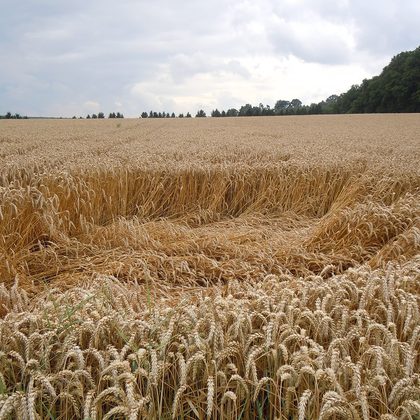
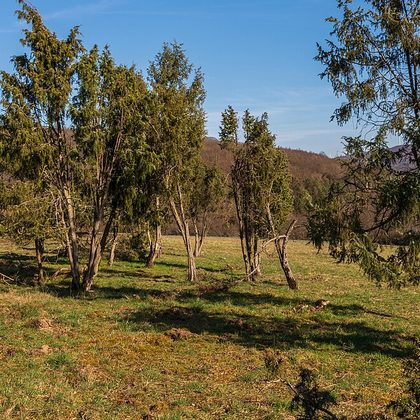
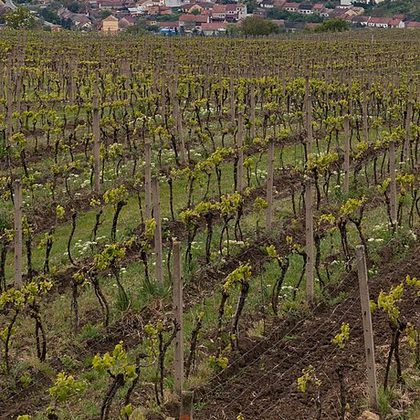
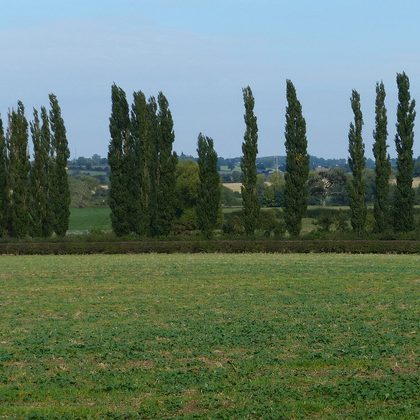
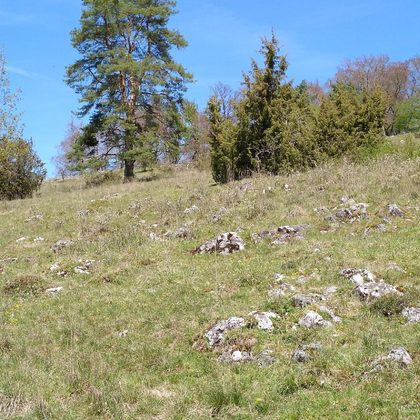
Warm, open arable with bushes and scattered trees: cereal on south-facing slopes, vineyards, almond and olive groves, terraces and stone piles. In Fennoscandia it takes an entirely different setting — clear-fells, bog margins and young plantations. Everywhere it needs bare or thinly vegetated ground to feed on, with bushes, wires or treetops to sing from.
Where the bird is most at home, classified with EUNIS — the European standard for habitats.
Range and movements
Breeds from Spain, southern France and Italy through the Balkans to Turkey and the Caucasus, with a separate northern belt in Sweden, Finland, Poland and the Baltic states, and again in the mountains of Morocco and Algeria. The whole population winters south of the Sahara, in the Sahel and Ethiopia. In Britain it is a scarce migrant, most often on the Northern Isles and along the east and south coasts in late spring and, more often, in autumn.
- Breeding (summer)
- Passage
- Migration direction
- dark = core range, pale = thinly spread
Where and when to look
In May find a sunny arable slope with scattered scrub and listen for four identical wistful notes with a lower ending; the sound travels but is repeated only at long intervals, so stand still. Then look deliberately at the top of an isolated tree or a wire. On migration in north-west Europe the call is usually the first clue, in the early morning over a coastal watchpoint.
Conservation status
Not globally threatened (IUCN: Least Concern), but the ortolan has declined across most of Europe through field enlargement, herbicide use and the loss of small-scale farming on warm slopes, disappearing from whole countries in the north-west. Trapping for the French table added to that: birds on passage in south-western France were caught in small cages, fattened and eaten as a delicacy. France banned the practice in 1999, and capture, possession and sale are prohibited throughout the European Union; enforcement was weak for years, was tightened from 2017 and the numbers taken have fallen sharply. The larger gains now lie in the farmland itself.
Scientific name
Emberiza hortulana Linnaeus, 1758
Linnaeus described the species in 1758 and placed it straight away in the genus where it still stands. He introduced the genus Emberiza in that same work. Emberiza comes from Old German Embritz, a name for a bunting. hortulana comes from the Italian name for the bird, ortolana.