All species › Passerines › Buntings › Cretzschmar's bunting
Cretzschmar's bunting | Emberiza caesia
Bruinkeelortolaan | Escribano ceniciento
The Aegean counterpart of the ortolan: the same build and the same eyering, but with a blue-grey head and a warm orange-brown throat. It breeds on bare, stony hillsides from Greece to the Levant and is one of the first songbirds back there in March.

Voice
The song is short and businesslike: three or four identical, slightly scraping notes followed by one lower, drawn-out note — tsyu tsyu tsyu tsyrrooo — over in a couple of seconds and repeated at short intervals. He sings from late March to June from a boulder, a low bush or a wall. Call: a hard, short tsep.
No freely licensed recording is available for this species yet.
Identification
A small, slim bunting with a long white-sided tail and a pink bill. The male has an unmarked blue-grey head and breast band, a warm orange-brown throat and submoustachial stripe, a narrow whitish eyering and rusty-orange underparts. The female is duller and finely streaked on crown and breast, but keeps the greyish head and the orange-brown throat. Juveniles are brown and streaked, with a rusty wash on rump and undertail.
Confusion species
Ortolan is the only real confusion species, and the two often stand on the same hillside. Look at the throat and the head. On ortolan the throat and submoustachial are pale yellow, the head and breast band grey-green and the eyering yellow; on Cretzschmar's the throat and submoustachial are warm orange-brown, the head a clean blue-grey with no green cast and the eyering whitish. Cretzschmar's underparts are a deeper rust, and the bird looks slightly smaller and shorter-winged. Voice separates them too: the Cretzschmar's phrase is shorter and drier and lacks the ortolan's lower closing notes.
Habitat
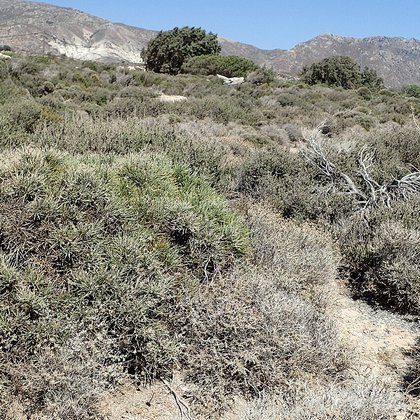
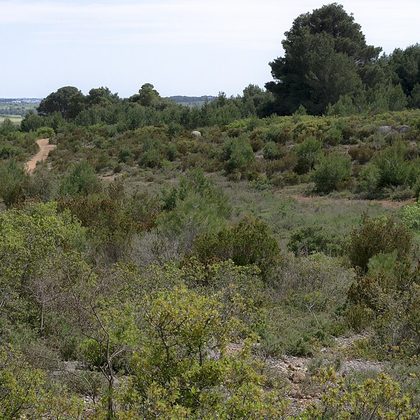
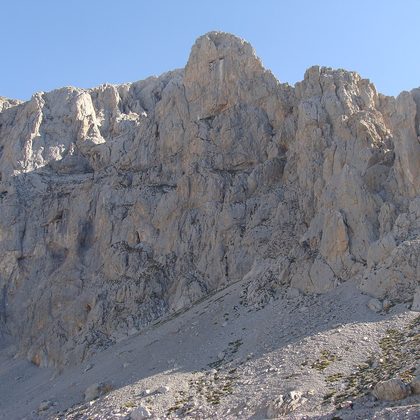
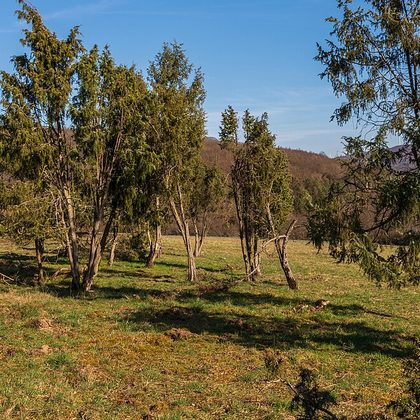
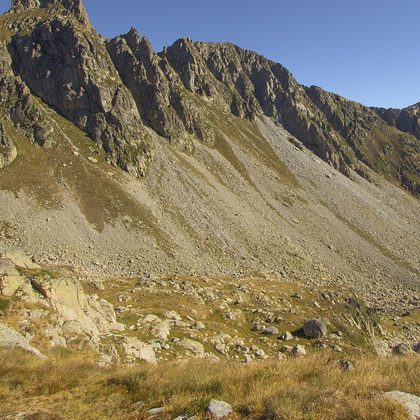
Dry stony slopes with low thorny scrub — phrygana and garrigue — and bare ground between the bushes, plus abandoned terraces, goat-grazed hillsides and rocky coastal slopes. It feeds on the open ground between the cushions of scrub and so needs terrain that has not closed over; a single rock or bush serves as a song post.
Where the bird is most at home, classified with EUNIS — the European standard for habitats.
Range and movements
A breeding bird of the Aegean world: mainland Greece, the islands, Crete, Cyprus, western and southern Turkey and the Levant into Israel and Jordan. A summer visitor, wintering in north-east Africa from Sudan to Eritrea. Beyond that it is a rare vagrant; British and other north-west European records fall mostly in late spring, several of them on the Northern Isles.
- Breeding (summer)
- Winter
- Passage
- Migration direction
- dark = core range, pale = thinly spread
Where and when to look
Go early: on the Greek islands it is at its most visible in the second half of March and in April, when males sing from low bushes and the slopes are still bare. Work south-facing ground with scattered thorn cushions and watch for the warm throat colour as the bird turns; against the light that throat looks dark, and then the blue-grey head is the better character.
Conservation status
Not globally threatened (IUCN: Least Concern), and still numerous on the Greek islands and in western Turkey. Threats are local: hillsides growing over once grazing stops, and coastal building. As a migrant to north-east Africa it also depends on conditions in the wintering area.
Scientific name
Emberiza caesia Cretzschmar, 1827
Cretzschmar described the species in 1827 and placed it straight away in the genus where it still stands. The genus Emberiza was introduced in 1758 by Linnaeus. Emberiza comes from Old German Embritz, a name for a bunting. caesia comes from Latin caesius 'bluish-grey', for the grey head of the male. The specimen the first description was based on came from Kurgos Island, Sudan.